Lou Taiwei, Zhao Zhiru, Du Hongjin, Zhang Jiwei, Ni Tian, Wang Miaoran, Li Qiuyan
Xiyuan Hospital, China Academy of Chinese Medical Sciences, Beijing, China.
PLoS One. 2024 Dec 27;19(12):e0313784. doi: 10.1371/journal.pone.0313784. eCollection 2024.
Unhealthy sleep and exposures to oxidative factors are both associated with poor cognitive performance (PCP), but limited evidence has been found regarding the relationship between sleep patterns and oxidative factor exposures independently or jointly with the risk of PCP.
We analyzed data from 2249 adults aged ≥60 years in the National Health and Nutrition Examination Survey (NHANES) database (2011-2014). Self-reported questionnaires were used to collect data on sleep duration and sleep disorder, categorizing sleep duration into three groups based on responses: short (6 hours or less per night), normal (7-8 hours per night), or long (9 hours or more per night). Sleep disorder were categorized into two groups: sleep disorder, non-sleep disorder. Oxidative balance score (OBS) was calculated based on 20 oxidative stress exposures related to diet and lifestyle factors, with higher scores indicating greater antioxidant exposures. Survey-based multivariable adjusted regression analyses were conducted to examine the associations between sleep patterns or OBS alone and in combination with overall and PCP risks.
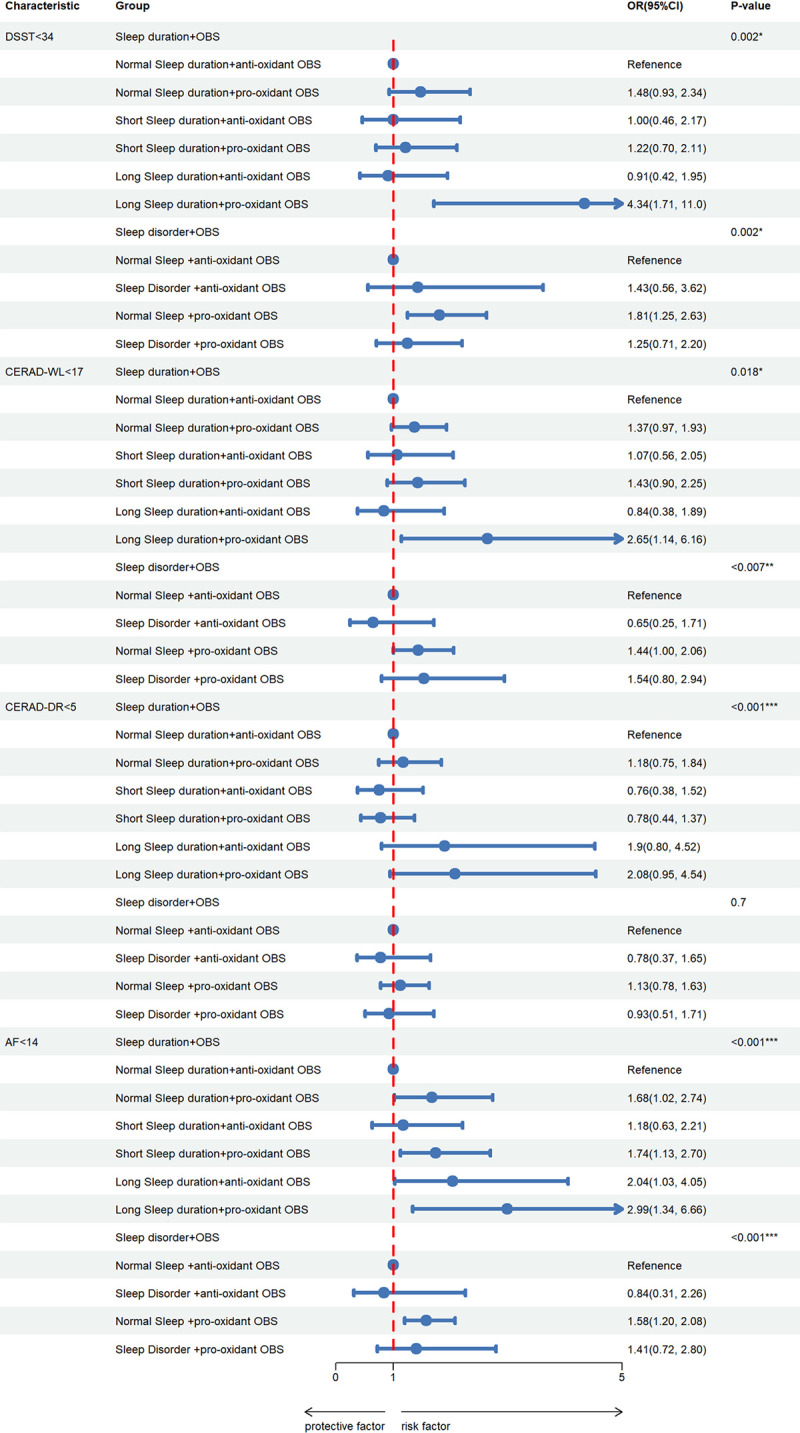
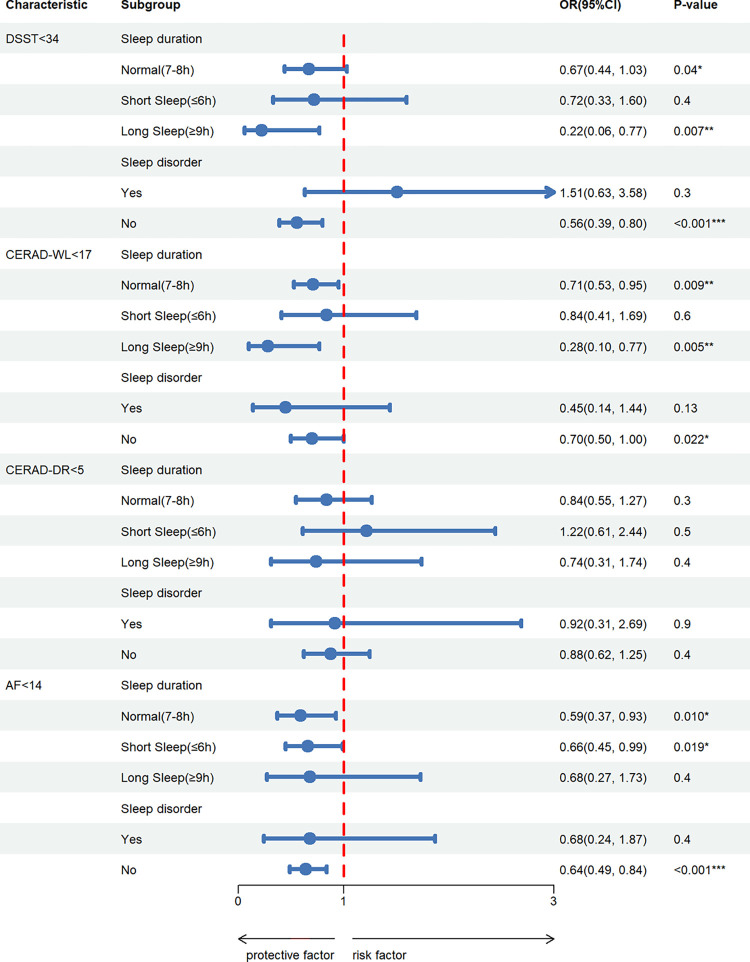
Compared to the normal sleep duration group, the long sleep duration group had a higher risk of PCP (DSST<34) (OR = 1.91, 95% CI = 1.05-3.48, P = 0.021); while OBS was negatively correlated with the risk of PCP (DSST<34) [Q4 vs Q1 (OR = 0.50, 95% CI = 0.29-0.92, P = 0.004)]. There was an interaction effect between sleep patterns (sleep duration, sleep disturbances) and OBS on PCP (DSST<34) (P = 0.002). Further stratified analysis showed that in individuals with normal sleep duration, long sleep duration, or no sleep disturbances, antioxidant exposures, compared to pro-oxidant exposures, reduced the risk of low cognitive function occurrence.
In older populations, unhealthy sleep patterns (especially excessive sleep duration) and low OBS alone or in combination increase the risk of cognitive decline. Healthy sleep and lifestyle habits rich in antioxidant factors are crucial for protecting cognitive function in older adults.
不健康的睡眠和暴露于氧化因素均与认知功能不佳(PCP)相关,但关于睡眠模式与氧化因素暴露单独或联合与PCP风险之间的关系,目前发现的证据有限。
我们分析了美国国家健康与营养检查调查(NHANES)数据库(2011 - 2014年)中2249名年龄≥60岁成年人的数据。使用自我报告问卷收集睡眠时间和睡眠障碍数据,根据回答将睡眠时间分为三组:短睡眠(每晚6小时或更少)、正常睡眠(每晚7 - 8小时)或长睡眠(每晚9小时或更多)。睡眠障碍分为两组:有睡眠障碍、无睡眠障碍。基于与饮食和生活方式因素相关的20种氧化应激暴露计算氧化平衡评分(OBS),得分越高表明抗氧化剂暴露越多。进行基于调查的多变量调整回归分析,以检验单独的睡眠模式或OBS以及它们联合与总体和PCP风险之间的关联。
与正常睡眠时间组相比,长睡眠时间组发生PCP(数字符号替换测验得分<34)的风险更高(OR = 1.91,95%CI = 1.05 - 3.48,P = 0.021);而OBS与PCP(数字符号替换测验得分<34)的风险呈负相关[第四四分位数与第一四分位数相比(OR = 0.50,95%CI = 0.29 - 0.92,P = 0.004)]。睡眠模式(睡眠时间、睡眠障碍)和OBS对PCP(数字符号替换测验得分<34)存在交互作用(P = 0.002)。进一步的分层分析表明,在睡眠时间正常、长睡眠时间或无睡眠障碍的个体中,与促氧化暴露相比,抗氧化剂暴露降低了低认知功能发生的风险。
在老年人群中,不健康的睡眠模式(尤其是睡眠时间过长)和低OBS单独或联合增加了认知能力下降的风险。健康的睡眠和富含抗氧化因素 的生活习惯对于保护老年人的认知功能至关重要。