Bottomley James, Al-Dadah Oday
Trauma and Orthopedic Surgery, South Tyneside District Hospital, South Shields, GBR.
Orthopedics, Faculty of Medical Sciences, Translational and Clinical Research Institute, Newcastle University, Newcastle upon Tyne, GBR.
Cureus. 2023 Aug 25;15(8):e44122. doi: 10.7759/cureus.44122. eCollection 2023 Aug.
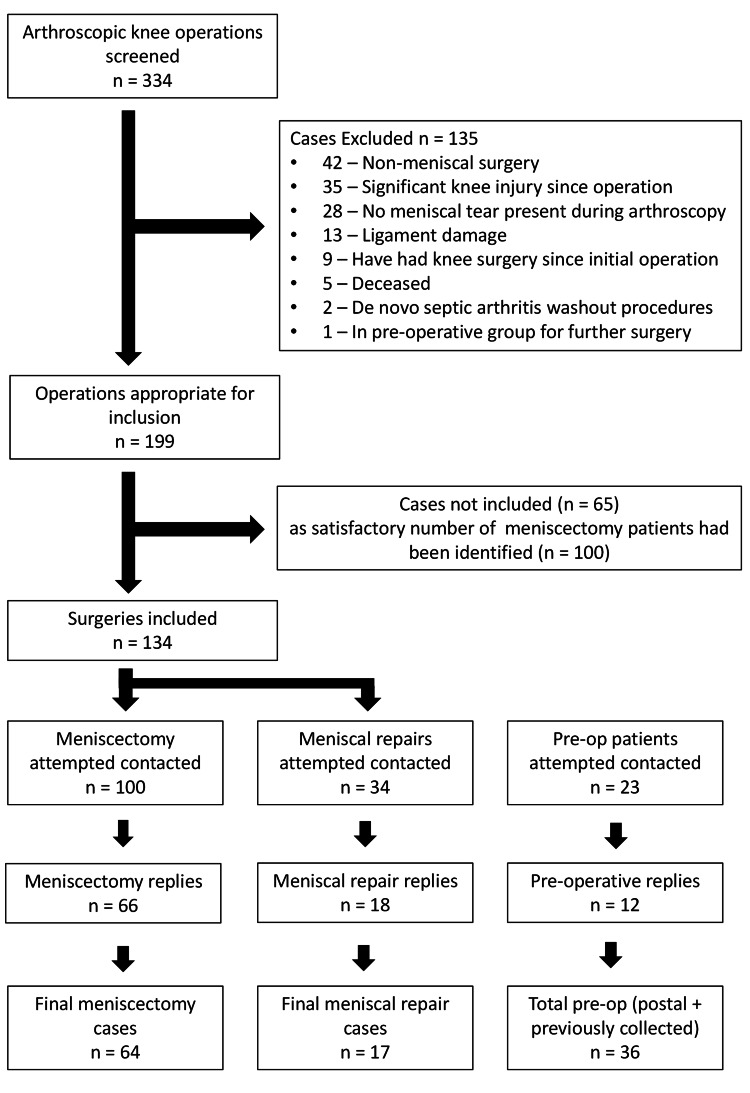
Background Meniscal tears are the most common injury of the knee. Surgical treatment has fallen into contention recently and includes arthroscopic meniscectomy and meniscal repair. The primary aim of this study was to quantitatively evaluate patients with isolated meniscal tears and compare their outcomes with patients who have undergone arthroscopic meniscus surgery. The secondary aim of this study was to compare the clinical outcomes of patients who have undergone arthroscopic meniscectomy with patients who have undergone arthroscopic meniscal repair. Methods This comparative clinical study screened 334 patients to identify subjects who underwent arthroscopic knee surgery for isolated meniscal tears and compare them to patients with symptomatic isolated meniscal tears awaiting surgery using validated patient-reported outcome measures. These included the Knee Injury and Osteoarthritis Outcome Score, International Knee Documentation Committee Subjective Knee Form, Lysholm score, Tegner score, EuroQol-5 Dimension, and the 12-Item Short Form Health Survey. Results A total of 117 patients (Meniscal Tear group (n=36), Meniscectomy group (n=64), and Meniscal Repair group (n=17)) were included in the final data analysis. Both the Meniscectomy group and the Meniscal Repair group (mean 55-month follow-up) showed significantly better clinical outcomes than patients in the Meniscal Tear group (p<0.05). Overall, the Meniscal Repair group demonstrated superior clinical outcomes when compared to the Meniscectomy group (p<0.05). Conclusion Arthroscopic knee surgery showed significant clinical benefit at medium-term follow-up in treating patients with isolated meniscal tears. When feasible, meniscal repair should be performed preferentially over meniscectomy.
半月板撕裂是膝关节最常见的损伤。手术治疗近来存在争议,包括关节镜下半月板切除术和半月板修复术。本研究的主要目的是对孤立性半月板撕裂患者进行定量评估,并将其结果与接受关节镜半月板手术的患者进行比较。本研究的次要目的是比较接受关节镜半月板切除术的患者与接受关节镜半月板修复术的患者的临床结果。方法:这项比较性临床研究筛选了334例患者,以确定接受关节镜下膝关节手术治疗孤立性半月板撕裂的受试者,并使用经过验证的患者报告结局指标将他们与有症状的孤立性半月板撕裂且等待手术的患者进行比较。这些指标包括膝关节损伤和骨关节炎结局评分、国际膝关节文献委员会主观膝关节表格、Lysholm评分、Tegner评分、欧洲五维健康量表和简明健康调查问卷12项。结果:共有117例患者(半月板撕裂组(n = 36)、半月板切除组(n = 64)和半月板修复组(n = 17))纳入最终数据分析。半月板切除组和半月板修复组(平均随访55个月)的临床结果均显著优于半月板撕裂组患者(p<0.05)。总体而言,与半月板切除组相比,半月板修复组的临床结果更佳(p<0.05)。结论:关节镜下膝关节手术在中期随访中对治疗孤立性半月板撕裂患者显示出显著的临床益处。在可行的情况下,应优先进行半月板修复而非半月板切除术。