Zhang Cunzhi, Gygi Francois, Galli Giulia
Pritzker School of Molecular Engineering, University of Chicago, Chicago, IL, USA.
Department of Computer Science, University of California Davis, Davis, CA, USA.
Nat Commun. 2023 Sep 26;14(1):5985. doi: 10.1038/s41467-023-41632-9.
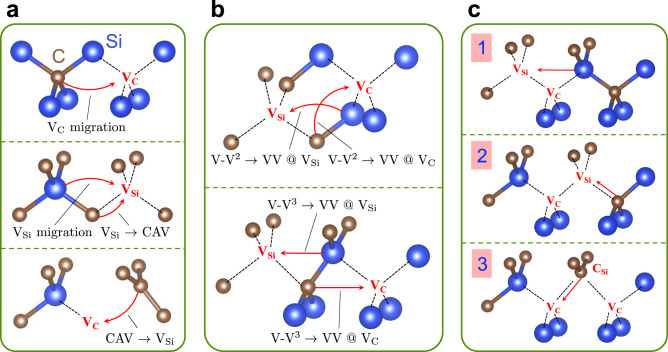
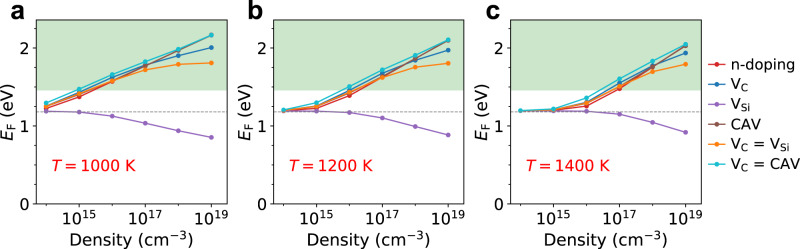
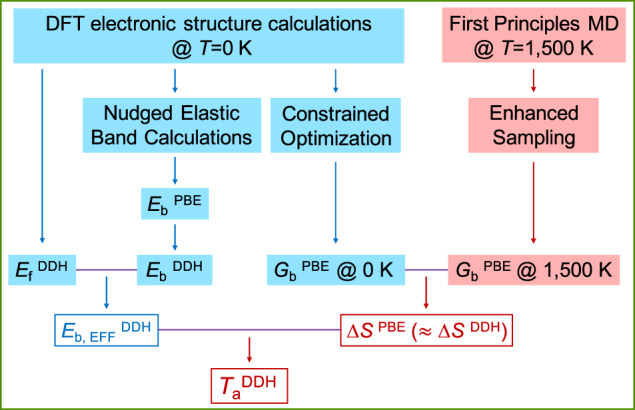
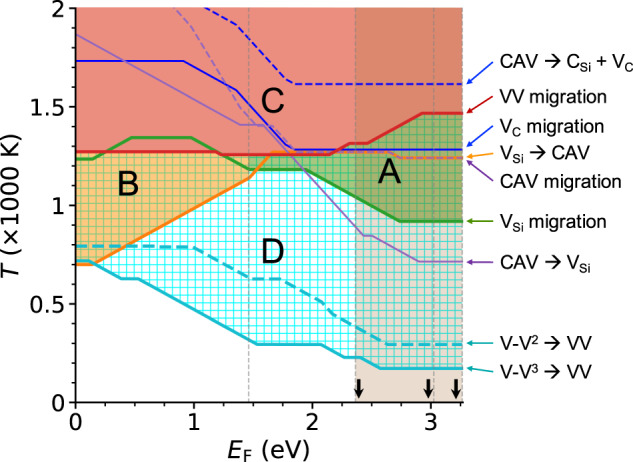
The full realization of spin qubits for quantum technologies relies on the ability to control and design the formation processes of spin defects in semiconductors and insulators. We present a computational protocol to investigate the synthesis of point-defects at the atomistic level, and we apply it to the study of a promising spin-qubit in silicon carbide, the divacancy (VV). Our strategy combines electronic structure calculations based on density functional theory and enhanced sampling techniques coupled with first principles molecular dynamics. We predict the optimal annealing temperatures for the formation of VVs at high temperature and show how to engineer the Fermi level of the material to optimize the defect's yield for several polytypes of silicon carbide. Our results are in excellent agreement with available experimental data and provide novel atomistic insights into point defect formation and annihilation processes as a function of temperature.
量子技术中自旋量子比特的全面实现依赖于控制和设计半导体及绝缘体中自旋缺陷形成过程的能力。我们提出了一种计算协议,用于在原子层面研究点缺陷的合成,并将其应用于研究碳化硅中一种很有前景的自旋量子比特——双空位(VV)。我们的策略将基于密度泛函理论的电子结构计算与增强采样技术以及第一性原理分子动力学相结合。我们预测了高温下形成双空位的最佳退火温度,并展示了如何调控材料的费米能级,以优化几种碳化硅多型体中缺陷的产率。我们的结果与现有的实验数据高度吻合,并提供了关于点缺陷形成和湮灭过程随温度变化的新颖原子层面见解。