Prado Cecília Maciel, Burgos Ferreira Paula Angélica, Alves de Lima Lucas, Gomes Trindade Erika Ketlem, Fireman Dutra Rosa
Biomedical Engineering Laboratory, Department of Biomedical Engineering, Federal University of Pernambuco, Av. Prof. Moraes Rego, 1235, Recife 50670-90, Brazil.
Biosensors (Basel). 2023 Sep 7;13(9):873. doi: 10.3390/bios13090873.
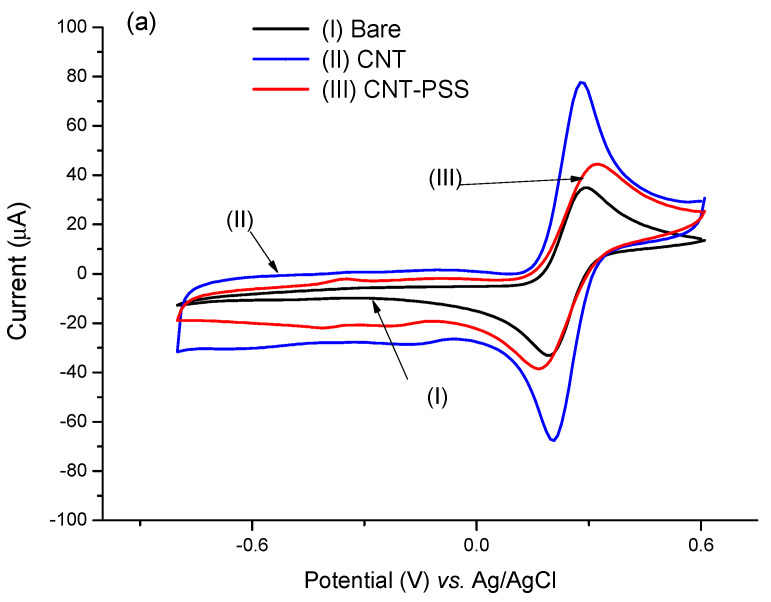
A sensitive electrochemical immunosensor for the detection of the heart-type fatty acid binding protein (HFABP), an earlier biomarker for acute myocardial infarction than Troponins, is described. The sensing platform was enhanced with methylene blue (MB) redox coupled to carbon nanotubes (CNT) assembled on a polymer film of polythionine (PTh). For this strategy, monomers of thionine rich in amine groups were electrosynthesized by cyclic voltammetry on the immunosensor's gold surface, forming an electroactive film with excellent electron transfer capacity. Stepwise sensor surface preparation was electrochemically characterized at each step and scanning electronic microscopy was carried out showing all the preparation steps. The assembled sensor platform combines MB and PTh in a synergism, allowing sensitive detection of the H-FABP in a linear response from 3.0 to 25.0 ng∙mL with a limit of detection of 1.47 ng∙mL HFABP that is similar to the clinical level range for diagnostics. H-FABP is a newer powerful biomarker for distinguishing between unstable angina and acute myocardial infarction.
本文描述了一种用于检测心脏型脂肪酸结合蛋白(HFABP)的灵敏电化学免疫传感器,HFABP是一种比肌钙蛋白更早出现的急性心肌梗死生物标志物。传感平台通过亚甲基蓝(MB)氧化还原与组装在聚硫堇(PTh)聚合物膜上的碳纳米管(CNT)耦合得到增强。对于该策略,通过循环伏安法在免疫传感器的金表面电合成富含胺基的硫堇单体,形成具有优异电子转移能力的电活性膜。在每个步骤对传感器表面制备进行电化学表征,并进行扫描电子显微镜观察以展示所有制备步骤。组装的传感器平台将MB和PTh协同结合,能够在3.0至25.0 ng∙mL的线性响应范围内灵敏检测H-FABP,检测限为1.47 ng∙mL HFABP,与临床诊断水平范围相似。H-FABP是用于区分不稳定型心绞痛和急性心肌梗死的一种更新的强大生物标志物。