Bertuccelli Margherita, Rubega Maria, Cantele Francesca, Favero Claudia, Ermolao Andrea, Formaggio Emanuela, Masiero Stefano
Padova Neuroscience Center, University of Padova, 35131 Padova, Italy.
Department of Neuroscience, Section of Neurology, University of Padova, 35128 Padova, Italy.
Eur J Investig Health Psychol Educ. 2023 Sep 18;13(9):1909-1919. doi: 10.3390/ejihpe13090138.
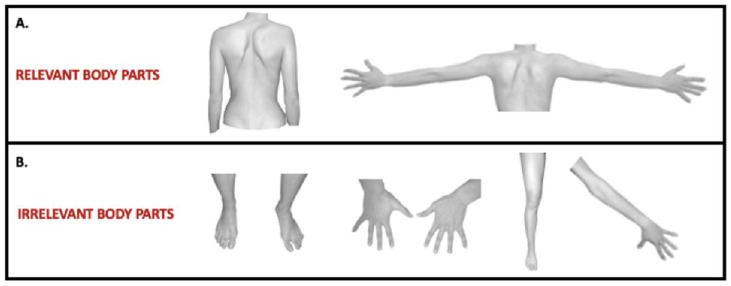
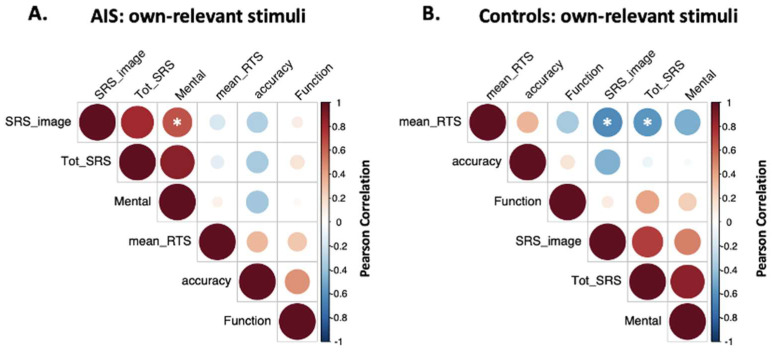
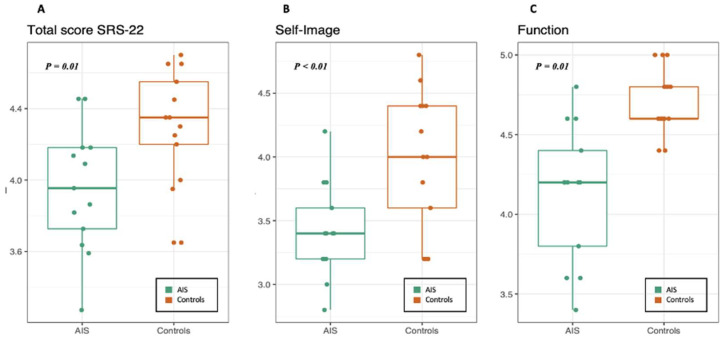
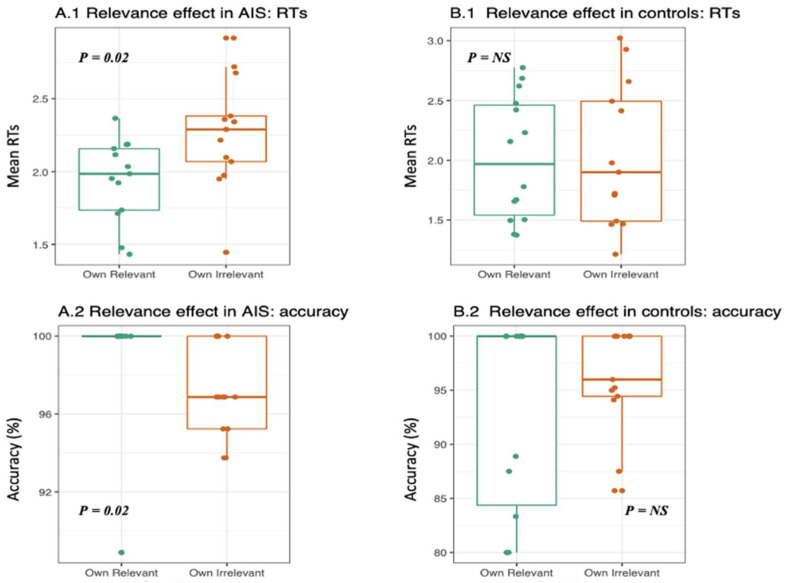
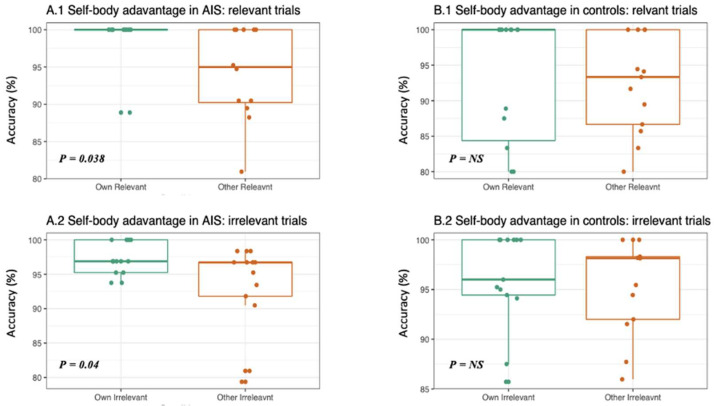
Attentional biases toward body-related information increase body dissatisfaction. This can lead at-risk populations to develop psychopathologies. This phenomenon has not been extensively studied in girls affected by idiopathic scoliosis. This work aimed to study the cognitive processes that could contribute to the worsening and maintaining of body image disorders in adolescent idiopathic scoliosis. Twenty-eight girls were recruited and tested for body image dissatisfaction through the Scoliosis-Research-Society-22-revised (SRS-22r) questionnaire. Attentional biases towards disease-related body parts were assessed using a computerized visual match-to-sample task: girls were asked to answer as fast and accurately as possible to find the picture matching a target by pressing a button on a computer keyboard. Reaction times (RTs) and accuracy were collected as outcome variables and compared within and between groups and conditions. Lower scores in SRS-22r self-image, function, and total score were observed in scoliosis compared to the control group (-value < 0.01). Faster response times (-value = 0.02) and higher accuracy (-value = 0.02) were detected in the scoliosis group when processing shoulders and backs (i.e., disease-relevant body parts). A self-body advantage effect emerged in the scoliosis group, showing higher accuracy when answering self-body stimuli compared to others' bodies stimuli (-value = 0.04). These results provide evidence of body image dissatisfaction and attentional bias towards disease-relevant body parts in girls with scoliosis, requiring clinical attention as highly predisposing to psychopathologies.
对身体相关信息的注意偏向会增加身体不满。这可能导致高危人群出现精神病理学问题。这种现象在特发性脊柱侧凸女孩中尚未得到广泛研究。这项工作旨在研究可能导致青少年特发性脊柱侧凸患者身体形象障碍恶化和维持的认知过程。招募了28名女孩,并通过脊柱侧凸研究协会22项修订版(SRS-22r)问卷对她们进行身体形象不满测试。使用计算机化视觉样本匹配任务评估对疾病相关身体部位的注意偏向:要求女孩通过按电脑键盘上的按钮,尽可能快速准确地回答以找到与目标匹配的图片。收集反应时间(RTs)和准确性作为结果变量,并在组内和组间以及不同条件下进行比较。与对照组相比,脊柱侧凸患者在SRS-22r自我形象、功能和总分方面得分更低(P值<0.01)。在处理肩膀和背部(即疾病相关身体部位)时,脊柱侧凸组检测到更快的反应时间(P值=0.02)和更高的准确性(P值=0.02)。脊柱侧凸组出现了自我身体优势效应,与他人身体刺激相比,在回答自我身体刺激时显示出更高的准确性(P值=0.04)。这些结果提供了脊柱侧凸女孩身体形象不满和对疾病相关身体部位注意偏向的证据,由于极易引发精神病理学问题,需要临床关注。