Institute for Immunity, Transplantation, and Infection, Stanford University School of Medicine, Stanford, CA.
Clinical & Data Coordinating Center, Precision Vaccines Program, Boston Children's Hospital, Boston, MA.
J Immunol. 2023 Oct 15;211(8):1224-1231. doi: 10.4049/jimmunol.2300391.
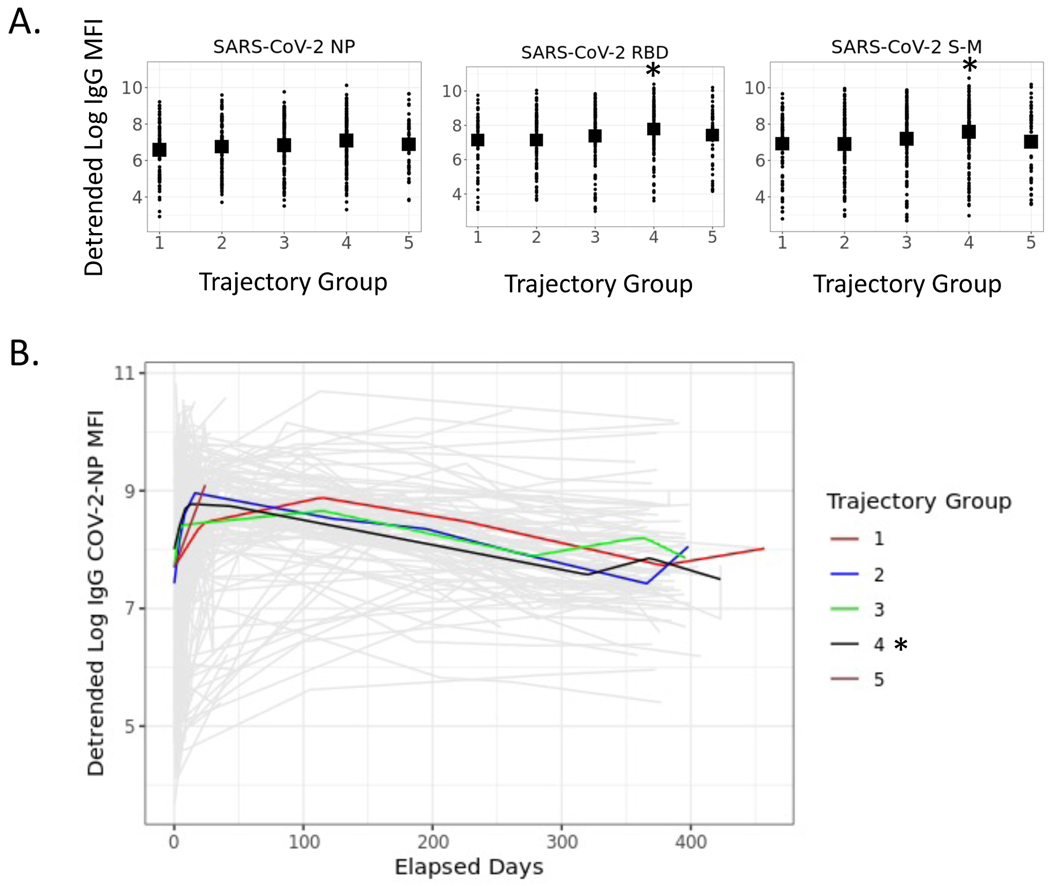
The clinical trajectory of COVID-19 may be influenced by previous responses to heterologous viruses. We examined the relationship of Abs against different viruses to clinical trajectory groups from the National Institutes of Health IMPACC (Immunophenotyping Assessment in a COVID-19 Cohort) study of hospitalized COVID-19 patients. Whereas initial Ab titers to SARS-CoV-2 tended to be higher with increasing severity (excluding fatal disease), those to seasonal coronaviruses trended in the opposite direction. Initial Ab titers to influenza and parainfluenza viruses also tended to be lower with increasing severity. However, no significant relationship was observed for Abs to other viruses, including measles, CMV, EBV, and respiratory syncytial virus. We hypothesize that some individuals may produce lower or less durable Ab responses to respiratory viruses generally (reflected in lower baseline titers in our study), and that this may carry over into poorer outcomes for COVID-19 (despite high initial SARS-CoV-2 titers). We further looked at longitudinal changes in Ab responses to heterologous viruses, but found little change during the course of acute COVID-19 infection. We saw significant trends with age for Ab levels to many of these viruses, but no difference in longitudinal SARS-CoV-2 titers for those with high versus low seasonal coronavirus titers. We detected no difference in longitudinal SARS-CoV-2 titers for CMV seropositive versus seronegative patients, although there was an overrepresentation of CMV seropositives among the IMPACC cohort, compared with expected frequencies in the United States population. Our results both reinforce findings from other studies and suggest (to our knowledge) new relationships between the response to SARS-CoV-2 and Abs to heterologous viruses.
COVID-19 的临床病程可能受到先前对异源病毒的反应影响。我们研究了美国国立卫生研究院 IMPACC(COVID-19 队列免疫表型评估)研究中住院 COVID-19 患者的临床病程组与针对不同病毒的 Abs 之间的关系。尽管 SARS-CoV-2 的初始 Abs 滴度随着严重程度的增加而升高(排除致命疾病),但季节性冠状病毒的趋势则相反。流感和副流感病毒的初始 Abs 滴度也随着严重程度的增加而降低。然而,对于其他病毒(包括麻疹、CMV、EBV 和呼吸道合胞病毒),没有观察到 Abs 与严重程度的显著关系。我们假设,一些人可能对呼吸道病毒产生较低或较不持久的 Ab 反应(这反映在我们研究中较低的基线滴度),并且这可能会对 COVID-19 的结果产生不利影响(尽管 SARS-CoV-2 的初始滴度较高)。我们进一步研究了对异源病毒的 Abs 反应的纵向变化,但在急性 COVID-19 感染过程中发现变化很小。我们观察到许多这些病毒的 Abs 水平与年龄呈显著趋势,但对于高季节性冠状病毒滴度与低季节性冠状病毒滴度的患者,纵向 SARS-CoV-2 滴度没有差异。我们检测到 CMV 血清阳性与血清阴性患者的纵向 SARS-CoV-2 滴度没有差异,尽管与美国人群的预期频率相比,IMPACC 队列中 CMV 血清阳性者的比例过高。我们的结果既加强了其他研究的发现,也提出了(据我们所知)SARS-CoV-2 反应与异源病毒 Abs 之间的新关系。