
利用器械授精进行可持续的蜜蜂养殖。
The Potential of Instrumental Insemination for Sustainable Honeybee Breeding.
机构信息
Institute for Bee Research Hohen Neuendorf, Friedrich-Engels-Str. 32, 16540 Hohen Neuendorf, Germany.
出版信息
Genes (Basel). 2023 Sep 14;14(9):1799. doi: 10.3390/genes14091799.
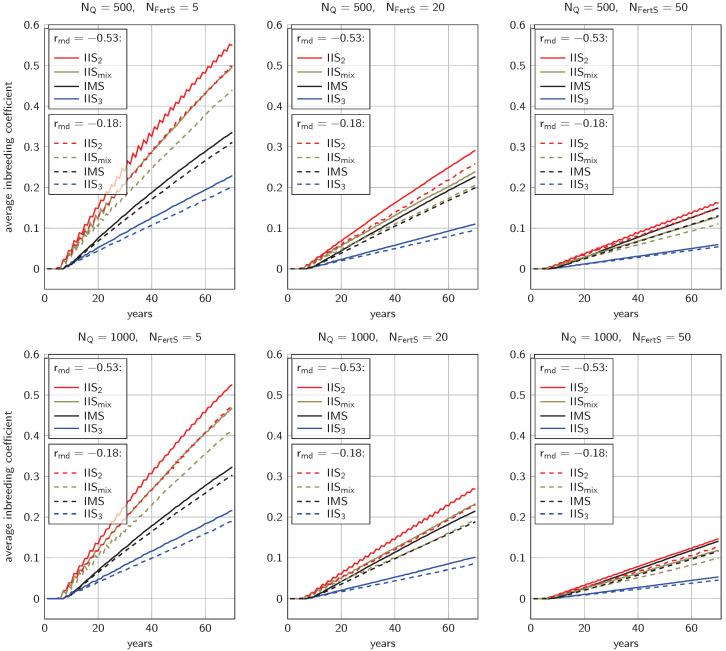
Mating control is crucial in honeybee breeding and commonly guaranteed by bringing virgin queens to isolated mating stations (IMS) for their nuptial flights. However, most breeding programs struggle to provide sufficiently many IMS. Research institutions routinely perform instrumental insemination of honeybees, but its potential to substitute IMS in breeding programs has not been sufficiently studied. We performed stochastic simulations to compare instrumental insemination strategies and mating on IMS in terms of genetic progress and inbreeding development. We focused on the role of paternal generation intervals, which can be shortened to two years with instrumental insemination in comparison to three years when using IMS. After 70 years, instrumental insemination yielded up to 42% higher genetic gain than IMS strategies-particularly with few available mating sites. Inbreeding rates with instrumental insemination and IMS were comparable. When the paternal generation interval in instrumental insemination was stretched to three years, the number of drone producers required for sustainable breeding was reduced substantially. In contrast, when shortening the interval to two years, it yielded the highest generational inbreeding rates (up to 2.28%). Overall, instrumental insemination with drones from a single colony appears as a viable strategy for honeybee breeding and a promising alternative to IMS.
交配控制在蜜蜂繁殖中至关重要,通常通过将处女蜂王带到隔离的交配站(IMS)进行婚飞来保证。然而,大多数繁殖计划难以提供足够多的 IMS。研究机构通常对蜜蜂进行仪器授精,但它在繁殖计划中替代 IMS 的潜力尚未得到充分研究。我们进行了随机模拟,以比较仪器授精策略和 IMS 上的交配在遗传进展和近交发展方面的表现。我们专注于父代世代间隔的作用,与使用 IMS 时的三年相比,仪器授精可以将其缩短至两年。在 70 年内,仪器授精比 IMS 策略产生的遗传增益高 42%,特别是在可用的交配地点较少的情况下。仪器授精和 IMS 的近交率相当。当仪器授精中的父代世代间隔延长至三年时,可持续繁殖所需的雄蜂生产者数量大大减少。相比之下,当缩短间隔至两年时,它产生了最高的世代近交率(高达 2.28%)。总体而言,来自单个蜂群的雄蜂的仪器授精似乎是一种可行的蜜蜂繁殖策略,是 IMS 的有前途的替代方案。


 Zotero 插件