Women's College Research Institute, Women's College Hospital, University of Toronto, Toronto, ON M5S 1B2, Canada.
Department of Medicine, McMaster University, Hamilton, ON L8P 1H6, Canada.
Int J Mol Sci. 2023 Sep 21;24(18):14388. doi: 10.3390/ijms241814388.
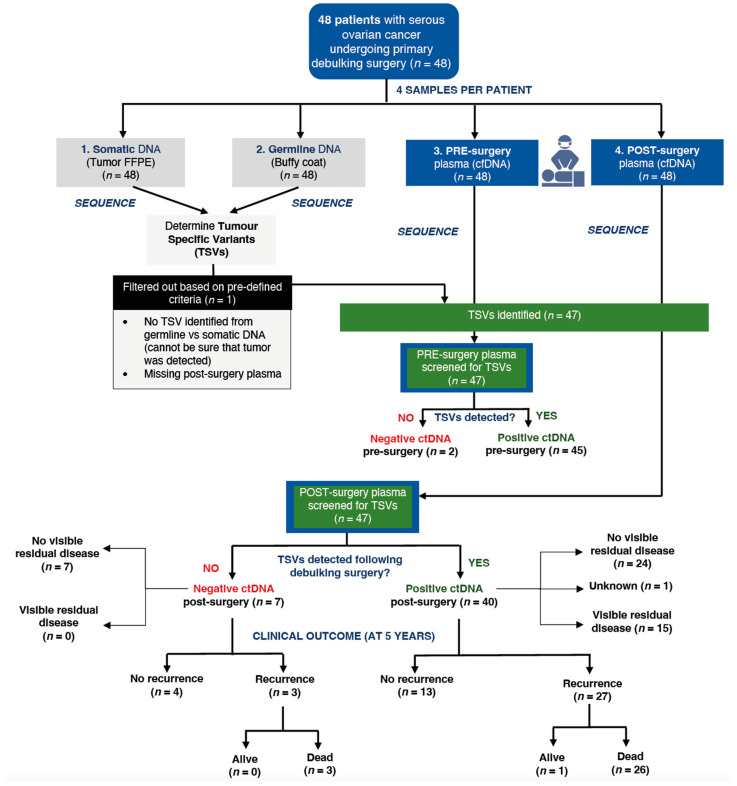
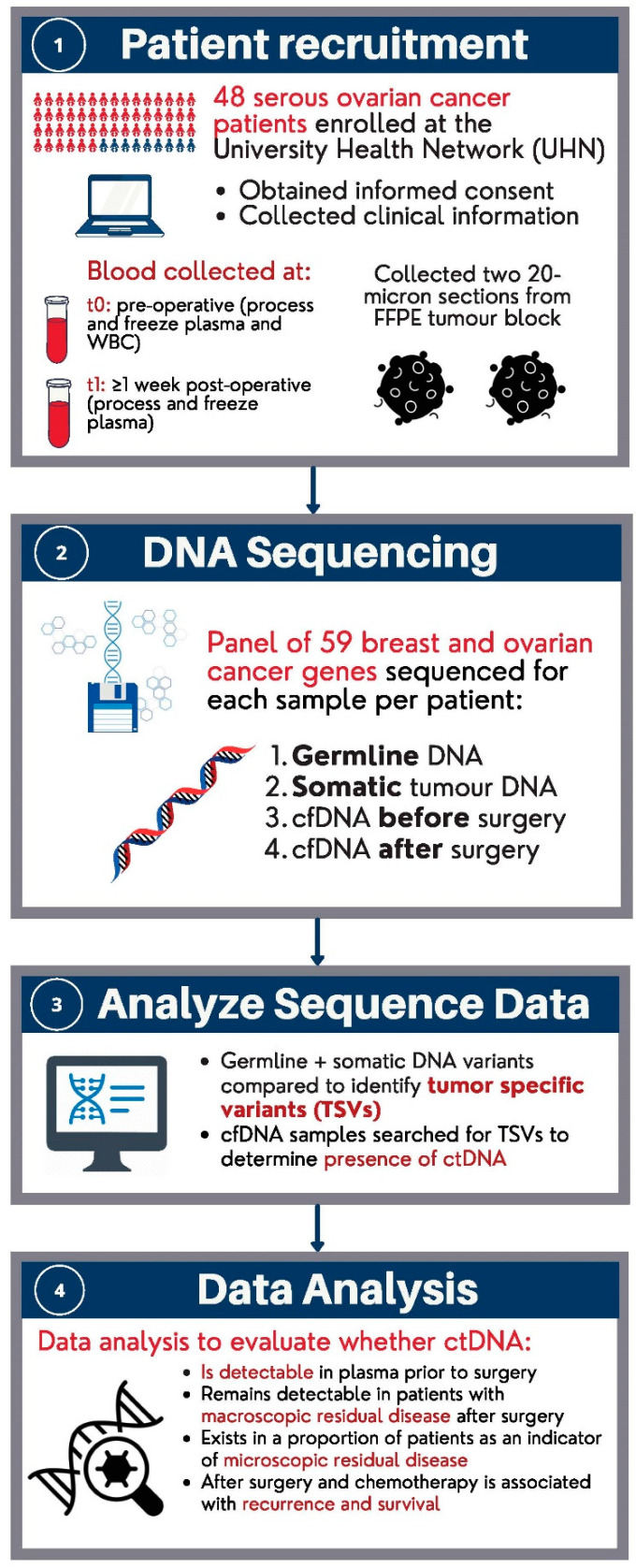
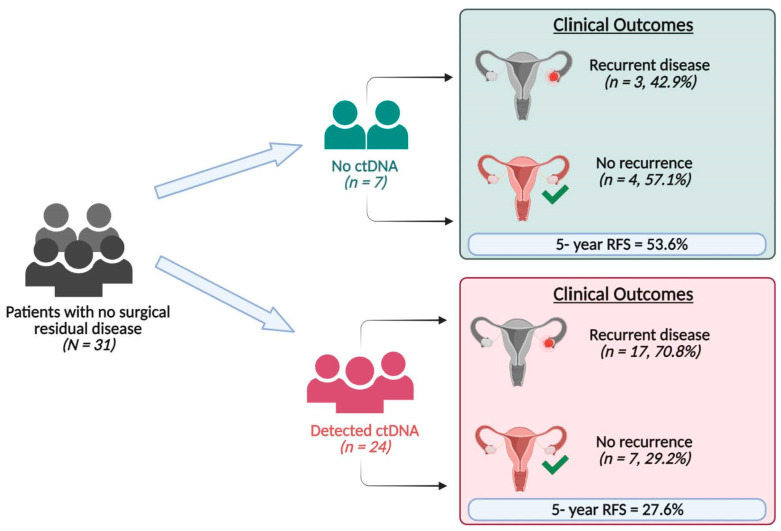
Ovarian cancer has a high case fatality rate, but patients who have no visible residual disease after surgery have a relatively good prognosis. The presence of any cancer cells left in the peritoneal cavity after treatment may precipitate a cancer recurrence. In many cases, these cells are occult and are not visible to the surgeon. Analysis of circulating tumour DNA in the blood (ctDNA) may offer a sensitive method to predict the presence of occult (non-visible) residual disease after surgery and may help predict disease recurrence. We assessed 48 women diagnosed with serous ovarian cancer (47 high-grade and 1 low-grade) for visible residual disease and for ctDNA. Plasma, formalin-fixed paraffin-embedded (FFPE) tumour tissue and white blood cells were used to extract circulating free DNA (cfDNA), tumour DNA and germline DNA, respectively. We sequenced DNA samples for 59 breast and ovarian cancer driver genes. The plasma sample was collected after surgery and before initiating chemotherapy. We compared survival in women with no residual disease, with and without a positive plasma ctDNA test. We found tumour-specific variants (TSVs) in cancer cells from 47 patients, and these variants were sought in ctDNA in their post-surgery plasma. Fifteen (31.9%) of the 47 patients had visible residual disease; of these, all 15 had detectable ctDNA. Thirty-one patients (65.9%) had no visible residual disease; of these, 24 (77.4%) patients had detectable ctDNA. Of the patients with no visible residual disease, those patients with detectable ctDNA had higher mortality (20 of 27 died) than those without detectable ctDNA (3 of 7 died) (HR 2.32; 95% CI: 0.67-8.05), although this difference was not statistically significant ( 0.18). ctDNA in post-surgical serum samples may predict the presence of microscopic residual disease and may be a predictor of recurrence among women with ovarian cancer. Larger studies are necessary to validate these findings.
卵巢癌的病死率较高,但手术后无可见残留病灶的患者预后相对较好。治疗后腹腔内仍存在任何癌细胞,可能会导致癌症复发。在许多情况下,这些细胞是隐匿的,外科医生无法看到。分析血液中的循环肿瘤 DNA(ctDNA)可能提供一种敏感的方法来预测手术后隐匿(不可见)残留疾病的存在,并有助于预测疾病复发。我们评估了 48 名诊断为浆液性卵巢癌(47 例高级别,1 例低级别)的女性的可见残留疾病和 ctDNA。血浆、福尔马林固定石蜡包埋(FFPE)肿瘤组织和白细胞分别用于提取循环游离 DNA(cfDNA)、肿瘤 DNA 和种系 DNA。我们对 59 个乳腺癌和卵巢癌驱动基因的 DNA 样本进行了测序。在手术后开始化疗前采集血浆样本。我们比较了无残留疾病、有和无阳性血浆 ctDNA 检测的女性的生存情况。我们从 47 名患者的癌细胞中发现了肿瘤特异性变体(TSV),并在术后血浆的 ctDNA 中寻找这些变体。47 名患者中的 15 名(31.9%)有可见残留病灶;其中,所有 15 名患者均有可检测的 ctDNA。31 名患者(65.9%)无可见残留病灶;其中,24 名(77.4%)患者有可检测的 ctDNA。在无可见残留病灶的患者中,有可检测 ctDNA 的患者死亡率较高(27 例死亡中有 20 例),而无可检测 ctDNA 的患者死亡率较低(7 例死亡中有 3 例)(HR 2.32;95%CI:0.67-8.05),尽管这一差异无统计学意义(0.18)。术后血清样本中的 ctDNA 可能预测微小残留病灶的存在,并且可能是卵巢癌患者复发的预测指标。需要更大规模的研究来验证这些发现。