Department of Chemical and Biological Engineering, Zhejiang University, Hangzhou 310027, China.
School of Biological and Chemical Engineering, Ningbo Tech University, Ningbo 315100, China.
Molecules. 2023 Sep 19;28(18):6699. doi: 10.3390/molecules28186699.
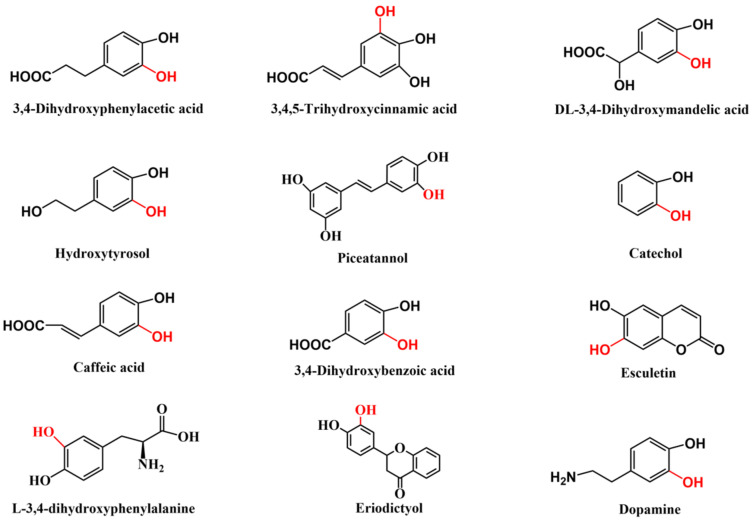
Catechols have important applications in the pharmaceutical, food, cosmetic, and functional material industries. 4-hydroxyphenylacetate-3-hydroxylase (4HPA3H), a two-component enzyme system comprising HpaB (monooxygenase) and HpaC (FAD oxidoreductase), demonstrates significant potential for catechol production because it can be easily expressed, is highly active, and exhibits -hydroxylation activity toward a broad spectrum of phenol substrates. HpaB determines the -hydroxylation efficiency and substrate spectrum of the enzyme; therefore, studying its structure-activity relationship, improving its properties, and developing a robust HpaB-conducting system are of significance and value; indeed, considerable efforts have been made in these areas in recent decades. Here, we review the classification, molecular structure, catalytic mechanism, primary efforts in protein engineering, and industrial applications of HpaB in catechol synthesis. Current trends in the further investigation of HpaB are also discussed.
儿茶酚在制药、食品、化妆品和功能材料等行业具有重要的应用。4-羟苯基乙酸-3-羟化酶(4HPA3H)是一种由 HpaB(单加氧酶)和 HpaC(FAD 氧化还原酶)组成的双组分酶系统,具有很大的儿茶酚生产潜力,因为它易于表达、活性高,并且对广泛的酚类底物具有β-羟化活性。HpaB 决定了酶的β-羟化效率和底物谱;因此,研究其结构-活性关系、改善其性质和开发稳健的 HpaB 传导系统具有重要意义和价值;事实上,近几十年来,在这些领域已经做出了相当大的努力。在这里,我们综述了 HpaB 在儿茶酚合成中的分类、分子结构、催化机制、蛋白质工程的初步努力以及工业应用。还讨论了 HpaB 进一步研究的当前趋势。