Zacaron Thiago Medeiros, Silva Mariana Leite Simões E, Costa Mirsiane Pascoal, Silva Dominique Mesquita E, Silva Allana Carvalho, Apolônio Ana Carolina Morais, Fabri Rodrigo Luiz, Pittella Frederico, Rocha Helvécio Vinícius Antunes, Tavares Guilherme Diniz
Postgraduate Program in Pharmaceutical Science, Federal University of Juiz de Fora, Juiz de Fora 36036-900, Minas Gerais, Brazil.
Faculty of Pharmacy, Federal University of Juiz de Fora, Juiz de Fora 36036-900, Minas Gerais, Brazil.
Polymers (Basel). 2023 Sep 21;15(18):3849. doi: 10.3390/polym15183849.
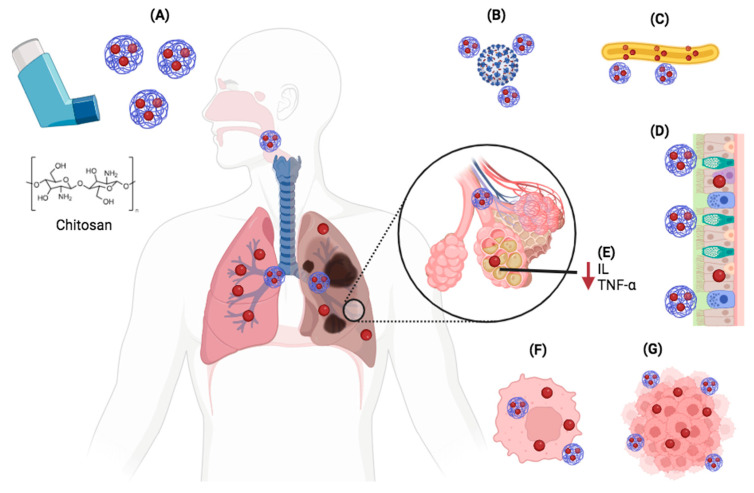
The evolution of respiratory diseases represents a considerable public health challenge, as they are among the leading causes of death worldwide. In this sense, in addition to the high prevalence of diseases such as asthma, chronic obstructive pulmonary disease, pneumonia, cystic fibrosis, and lung cancer, emerging respiratory diseases, particularly those caused by members of the coronavirus family, have contributed to a significant number of deaths on a global scale over the last two decades. Therefore, several studies have been conducted to optimize the efficacy of treatments against these diseases, focusing on pulmonary drug delivery using nanomedicine. Thus, the development of nanocarriers has emerged as a promising alternative to overcome the limitations of conventional therapy, by increasing drug bioavailability at the target site and reducing unwanted side effects. In this context, nanoparticles composed of chitosan (CS) show advantages over other nanocarriers because chitosan possesses intrinsic biological properties, such as anti-inflammatory, antimicrobial, and mucoadhesive capacity. Moreover, CS nanoparticles have the potential to enhance drug stability, prolong the duration of action, improve drug targeting, control drug release, optimize dissolution of poorly soluble drugs, and increase cell membrane permeability of hydrophobic drugs. These properties could optimize the performance of the drug after its pulmonary administration. Therefore, this review aims to discuss the potential of chitosan nanoparticles for pulmonary drug delivery, highlighting how their biological properties can improve the treatment of pulmonary diseases, including their synergistic action with the encapsulated drug.
呼吸系统疾病的演变是一项重大的公共卫生挑战,因为它们是全球主要死因之一。从这个意义上说,除了哮喘、慢性阻塞性肺疾病、肺炎、囊性纤维化和肺癌等疾病的高患病率外,新兴的呼吸系统疾病,特别是由冠状病毒家族成员引起的疾病,在过去二十年中导致了全球范围内大量的死亡。因此,已经进行了多项研究来优化针对这些疾病的治疗效果,重点是使用纳米医学进行肺部药物递送。因此,纳米载体的开发已成为一种有前景的替代方法,通过提高药物在靶部位的生物利用度并减少不良副作用来克服传统疗法的局限性。在这种背景下,由壳聚糖(CS)组成的纳米颗粒比其他纳米载体具有优势,因为壳聚糖具有内在的生物学特性,如抗炎、抗菌和粘膜粘附能力。此外,CS纳米颗粒有可能提高药物稳定性、延长作用持续时间、改善药物靶向性、控制药物释放、优化难溶性药物的溶解,并增加疏水性药物的细胞膜通透性。这些特性可以优化药物肺部给药后的性能。因此,本综述旨在讨论壳聚糖纳米颗粒用于肺部药物递送的潜力,强调其生物学特性如何改善肺部疾病的治疗,包括它们与包封药物的协同作用。