• 文献检索
  • 文档翻译
  • 深度研究
  • 学术资讯
  • Suppr Zotero 插件Zotero 插件
  • 邀请有礼
  • 套餐&价格
  • 历史记录
应用&插件
Suppr Zotero 插件Zotero 插件浏览器插件Mac 客户端Windows 客户端微信小程序
定价
高级版会员购买积分包购买API积分包
服务
文献检索文档翻译深度研究API 文档MCP 服务
关于我们
关于 Suppr公司介绍联系我们用户协议隐私条款
关注我们

Suppr 超能文献

核心技术专利:CN118964589B侵权必究
粤ICP备2023148730 号-1Suppr @ 2026

文献检索

告别复杂PubMed语法,用中文像聊天一样搜索,搜遍4000万医学文献。AI智能推荐,让科研检索更轻松。

立即免费搜索

文件翻译

保留排版,准确专业,支持PDF/Word/PPT等文件格式,支持 12+语言互译。

免费翻译文档

深度研究

AI帮你快速写综述,25分钟生成高质量综述,智能提取关键信息,辅助科研写作。

立即免费体验

一种商用无标记式头戴显示器与基于标记式运动捕捉系统在脑卒中患者手部运动学测量中的定量比较。

Quantitative Comparison of Hand Kinematics Measured with a Markerless Commercial Head-Mounted Display and a Marker-Based Motion Capture System in Stroke Survivors.

机构信息

Department of Biomedical and Dental Sciences and Morphofunctional Imaging, University of Messina, 98122 Messina, Italy.

Center of Translational Neurophysiology of Speech and Communication (CTNSC), Istituto Italiano di Tecnologia (IIT), 44121 Ferrara, Italy.

出版信息

Sensors (Basel). 2023 Sep 15;23(18):7906. doi: 10.3390/s23187906.

DOI:10.3390/s23187906
PMID:37765963
原文链接:https://pmc.ncbi.nlm.nih.gov/articles/PMC10535006/
Abstract

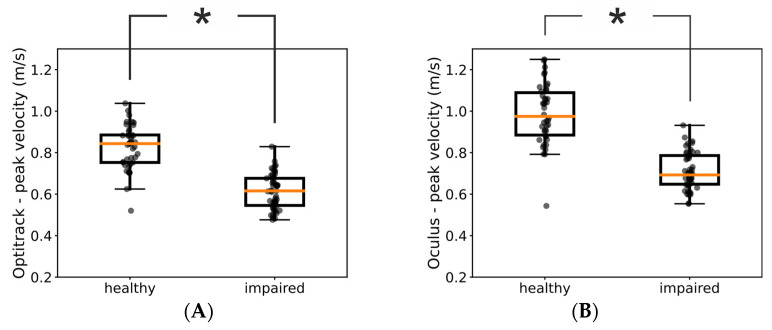
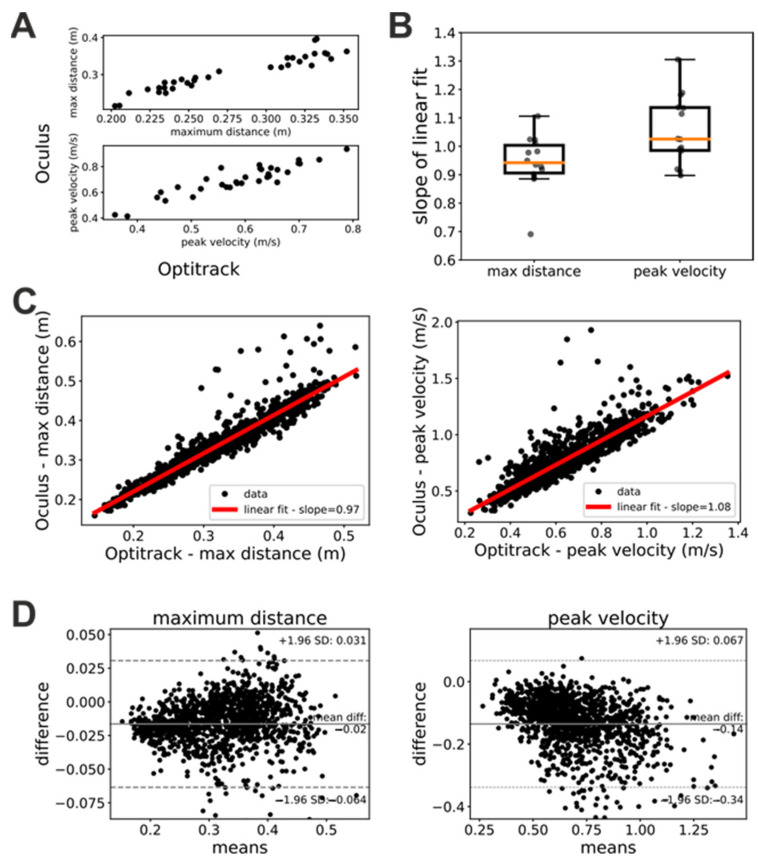
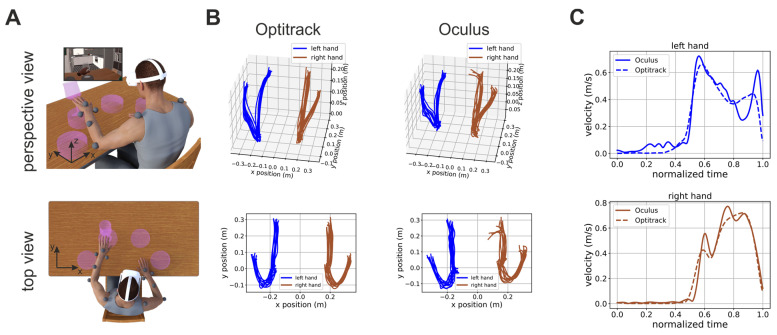
Upper-limb paresis is common after stroke. An important tool to assess motor recovery is to use marker-based motion capture systems to measure the kinematic characteristics of patients' movements in ecological scenarios. These systems are, however, very expensive and not readily available for many rehabilitation units. Here, we explored whether the markerless hand motion capabilities of the cost-effective Oculus Quest head-mounted display could be used to provide clinically meaningful measures. A total of 14 stroke patients executed ecologically relevant upper-limb tasks in an immersive virtual environment. During task execution, we recorded their hand movements simultaneously by means of the Oculus Quest's and a marker-based motion capture system. Our results showed that the markerless estimates of the hand position and peak velocity provided by the Oculus Quest were in very close agreement with those provided by a marker-based commercial system with their regression line having a slope close to 1 (maximum distance: mean slope = 0.94 ± 0.1; peak velocity: mean slope = 1.06 ± 0.12). Furthermore, the Oculus Quest had virtually the same sensitivity as that of a commercial system in distinguishing healthy from pathological kinematic measures. The Oculus Quest was as accurate as a commercial marker-based system in measuring clinically meaningful upper-limb kinematic parameters in stroke patients.

摘要

上肢瘫痪在中风后很常见。评估运动恢复的一个重要工具是使用基于标记的运动捕捉系统来测量患者在生态场景中的运动的运动学特征。然而,这些系统非常昂贵,许多康复单位都无法使用。在这里,我们探讨了价格合理的 Oculus Quest 头戴式显示器的无标记手部运动功能是否可用于提供具有临床意义的测量。共有 14 名中风患者在沉浸式虚拟环境中执行与生态相关的上肢任务。在任务执行过程中,我们通过 Oculus Quest 和基于标记的运动捕捉系统同时记录他们的手部运动。我们的结果表明,Oculus Quest 提供的手部位置和峰值速度的无标记估计值与基于标记的商业系统提供的非常吻合,其回归线斜率接近 1(最大距离:平均斜率=0.94±0.1;峰值速度:平均斜率=1.06±0.12)。此外,Oculus Quest 在区分健康和病理运动测量方面与商业系统具有相同的灵敏度。Oculus Quest 在测量中风患者的临床相关上肢运动学参数方面与商业基于标记的系统一样准确。
https://cdn.ncbi.nlm.nih.gov/pmc/blobs/6e5b/10535006/28f0d36df7bb/sensors-23-07906-g003.jpg
https://cdn.ncbi.nlm.nih.gov/pmc/blobs/6e5b/10535006/93dda094f925/sensors-23-07906-g001.jpg
https://cdn.ncbi.nlm.nih.gov/pmc/blobs/6e5b/10535006/4e2e523cd05b/sensors-23-07906-g002.jpg
https://cdn.ncbi.nlm.nih.gov/pmc/blobs/6e5b/10535006/28f0d36df7bb/sensors-23-07906-g003.jpg
https://cdn.ncbi.nlm.nih.gov/pmc/blobs/6e5b/10535006/93dda094f925/sensors-23-07906-g001.jpg
https://cdn.ncbi.nlm.nih.gov/pmc/blobs/6e5b/10535006/4e2e523cd05b/sensors-23-07906-g002.jpg
https://cdn.ncbi.nlm.nih.gov/pmc/blobs/6e5b/10535006/28f0d36df7bb/sensors-23-07906-g003.jpg

相似文献

1
Quantitative Comparison of Hand Kinematics Measured with a Markerless Commercial Head-Mounted Display and a Marker-Based Motion Capture System in Stroke Survivors.一种商用无标记式头戴显示器与基于标记式运动捕捉系统在脑卒中患者手部运动学测量中的定量比较。
Sensors (Basel). 2023 Sep 15;23(18):7906. doi: 10.3390/s23187906.
2
Virtual Reality for Shoulder Rehabilitation: Accuracy Evaluation of Oculus Quest 2.虚拟现实在肩部康复中的应用:Oculus Quest 2 的准确性评估。
Sensors (Basel). 2022 Jul 23;22(15):5511. doi: 10.3390/s22155511.
3
Commercial head-mounted display virtual reality for upper extremity rehabilitation in chronic stroke: a single-case design study.商业头戴式显示虚拟现实用于慢性脑卒中上肢康复:单病例设计研究。
J Neuroeng Rehabil. 2020 Nov 23;17(1):154. doi: 10.1186/s12984-020-00788-x.
4
Validity and Reliability of Kinect v2 for Quantifying Upper Body Kinematics during Seated Reaching.基于 Kinect v2 系统评估坐姿伸展上肢运动学的有效性和可靠性
Sensors (Basel). 2022 Apr 2;22(7):2735. doi: 10.3390/s22072735.
5
A neural tracking and motor control approach to improve rehabilitation of upper limb movements.一种用于改善上肢运动康复的神经跟踪与运动控制方法。
J Neuroeng Rehabil. 2008 Feb 5;5:5. doi: 10.1186/1743-0003-5-5.
6
Markerless motion capture estimates of lower extremity kinematics and kinetics are comparable to marker-based across 8 movements.无标记运动捕捉估计下肢运动学和动力学与基于标记的在 8 种运动中具有可比性。
J Biomech. 2023 Aug;157:111751. doi: 10.1016/j.jbiomech.2023.111751. Epub 2023 Aug 4.
7
Agreement between a markerless and a marker-based motion capture systems for balance related quantities.无标记和基于标记的运动捕捉系统在平衡相关量方面的一致性。
J Biomech. 2024 Mar;165:112018. doi: 10.1016/j.jbiomech.2024.112018. Epub 2024 Feb 21.
8
Comparison of markerless and marker-based motion capture of gait kinematics in individuals with cerebral palsy and chronic stroke: A case study series.脑瘫和慢性中风患者步态运动学的无标记和基于标记的运动捕捉比较:一项病例系列研究。
Res Sq. 2023 Feb 8:rs.3.rs-2557403. doi: 10.21203/rs.3.rs-2557403/v1.
9
Concurrent validity of lower extremity kinematics and jump characteristics captured in pre-school children by a markerless 3D motion capture system.无标记三维运动捕捉系统采集的学龄前儿童下肢运动学和跳跃特征的同时效度
Chiropr Man Therap. 2019 Aug 11;27:39. doi: 10.1186/s12998-019-0261-z. eCollection 2019.
10
Comparison of Motion Analysis Systems in Tracking Upper Body Movement of Myoelectric Bypass Prosthesis Users.比较用于跟踪肌电旁路假肢使用者上半身运动的运动分析系统。
Sensors (Basel). 2022 Apr 12;22(8):2953. doi: 10.3390/s22082953.

引用本文的文献

1
Evaluating Augmented Reality Head-Mounted Devices in Healthcare: A Review of Hardware, Software, and Usability Approaches.评估医疗保健领域的增强现实头戴式设备:硬件、软件及可用性方法综述
Med Devices (Auckl). 2025 Aug 22;18:427-445. doi: 10.2147/MDER.S541187. eCollection 2025.
2
Performance Measurement of Gesture-Based Human-Machine Interfaces Within eXtended Reality Head-Mounted Displays.扩展现实头戴式显示器中基于手势的人机界面性能测量
Sensors (Basel). 2025 Apr 30;25(9):2831. doi: 10.3390/s25092831.
3
A Sensor-Based Classification for Neuromotor Robot-Assisted Rehabilitation.

本文引用的文献

1
Validity, Reliability, and Measurement Error of the Remote Fugl-Meyer Assessment by Videoconferencing: Tele-FMA.远程 Fugl-Meyer 评估通过视频会议的有效性、可靠性和测量误差:远程 Fugl-Meyer 评估。
Phys Ther. 2023 Aug 1;103(8). doi: 10.1093/ptj/pzad054.
2
A systematic review of the applications of markerless motion capture (MMC) technology for clinical measurement in rehabilitation.基于无标记运动捕捉(MMC)技术的临床康复测量应用的系统综述。
J Neuroeng Rehabil. 2023 May 2;20(1):57. doi: 10.1186/s12984-023-01186-9.
3
Literature review of stroke assessment for upper-extremity physical function via EEG, EMG, kinematic, and kinetic measurements and their reliability.
基于传感器的神经运动机器人辅助康复分类
Bioengineering (Basel). 2025 Mar 13;12(3):287. doi: 10.3390/bioengineering12030287.
4
A quantitative assessment of the hand kinematic features estimated by the oculus Quest 2.对Oculus Quest 2估计的手部运动学特征进行定量评估。
Sci Rep. 2025 Mar 14;15(1):8842. doi: 10.1038/s41598-025-91552-5.
5
The Design and Validation of an Open-Palm Data Glove for Precision Finger and Wrist Tracking.一种用于精确手指和手腕跟踪的开放式手掌数据手套的设计与验证
Sensors (Basel). 2025 Jan 9;25(2):367. doi: 10.3390/s25020367.
6
The Use of Head-Mounted Display Systems for Upper Limb Kinematic Analysis in Post-Stroke Patients: A Perspective Review on Benefits, Challenges and Other Solutions.头戴式显示系统在中风后患者上肢运动学分析中的应用:关于益处、挑战及其他解决方案的综述
Bioengineering (Basel). 2024 May 24;11(6):538. doi: 10.3390/bioengineering11060538.
7
Remotely Assessing Motor Function and Activity of the Upper Extremity After Stroke: A Systematic Review of Validity and Clinical Utility of Tele-Assessments.远程评估脑卒中后上肢运动功能和活动:远程评估的有效性和临床实用性的系统评价。
Clin Rehabil. 2024 Sep;38(9):1214-1225. doi: 10.1177/02692155241258867. Epub 2024 Jun 5.
8
Head-Mounted Displays for Upper Limb Stroke Rehabilitation: A Scoping Review.用于上肢中风康复的头戴式显示器:一项范围综述
J Clin Med. 2023 Nov 30;12(23):7444. doi: 10.3390/jcm12237444.
9
Adherence and perceptions of a home sports video gaming program in persons with spinal cord injuries: A pilot study.脊髓损伤患者对家庭运动视频游戏计划的依从性及认知:一项试点研究。
J Spinal Cord Med. 2025 Mar;48(2):272-282. doi: 10.1080/10790268.2023.2268328. Epub 2023 Nov 17.
上肢物理功能的 EEG、EMG、运动学和动力学测量及其可靠性的中风评估文献综述。
J Neuroeng Rehabil. 2023 Feb 15;20(1):21. doi: 10.1186/s12984-023-01142-7.
4
Immersive Virtual Reality in Post-Stroke Rehabilitation: A Systematic Review.沉浸式虚拟现实在脑卒中康复中的应用:系统评价。
Sensors (Basel). 2023 Feb 3;23(3):1712. doi: 10.3390/s23031712.
5
A Pilot Study for Remote Evaluation of Upper Extremity Motor Function After Stroke: The Arm Capacity and Movement Test (ArmCAM).一项关于中风后上肢运动功能远程评估的初步研究:手臂能力与运动测试(ArmCAM)。
Am J Occup Ther. 2023 Jan 1;77(1). doi: 10.5014/ajot.2023.050020.
6
Immersion Therapy with Head-Mounted Display for Rehabilitation of the Upper Limb after Stroke-Review.沉浸式头戴显示器治疗脑卒中后上肢康复的研究进展
Sensors (Basel). 2022 Dec 17;22(24):9962. doi: 10.3390/s22249962.
7
I can see my virtual body in a mirror: The role of visual perspective in changing implicit racial attitudes using virtual reality.我能在镜子中看到自己的虚拟身体:视觉视角在利用虚拟现实改变内隐种族态度中的作用。
Front Psychol. 2022 Nov 28;13:989582. doi: 10.3389/fpsyg.2022.989582. eCollection 2022.
8
Effect of immersive virtual reality training on hand-to-mouth task performance in people with Multiple Sclerosis: A quantitative kinematic study.沉浸式虚拟现实训练对多发性硬化症患者手到口任务表现的影响:一项定量运动学研究。
Mult Scler Relat Disord. 2023 Jan;69:104455. doi: 10.1016/j.msard.2022.104455. Epub 2022 Dec 5.
9
The effectiveness of immersive virtual reality in physical recovery of stroke patients: A systematic review.沉浸式虚拟现实对中风患者身体恢复的有效性:一项系统评价。
Front Syst Neurosci. 2022 Sep 22;16:880447. doi: 10.3389/fnsys.2022.880447. eCollection 2022.
10
A novel immersive virtual reality environment for the motor rehabilitation of stroke patients: A feasibility study.一种用于中风患者运动康复的新型沉浸式虚拟现实环境:一项可行性研究。
Front Robot AI. 2022 Aug 29;9:906424. doi: 10.3389/frobt.2022.906424. eCollection 2022.