MFP UMR 5234 CNRS, Université de Bordeaux, 33076 Bordeaux, France.
IGH UMR 9002 CNRS, Université de Montpellier, 34094 Montpellier, France.
Viruses. 2023 Sep 21;15(9):1969. doi: 10.3390/v15091969.
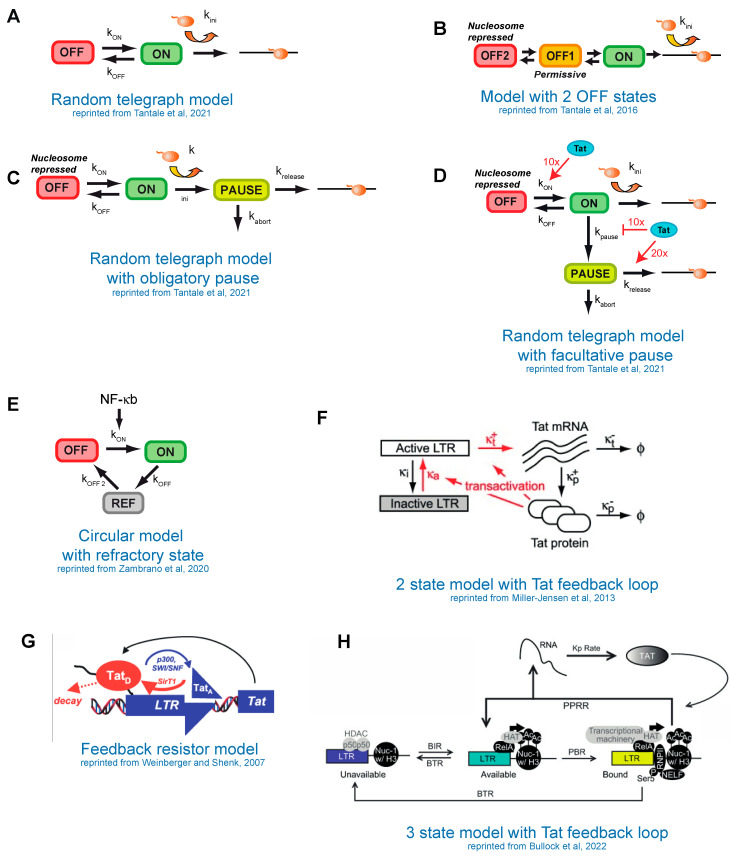
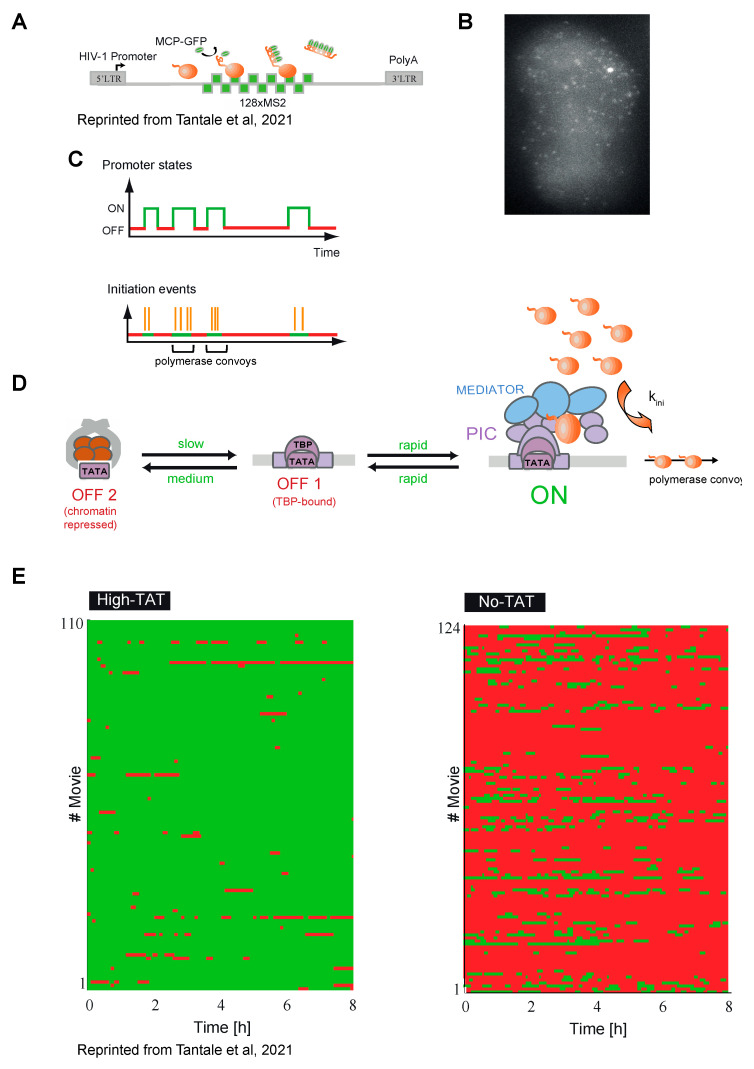
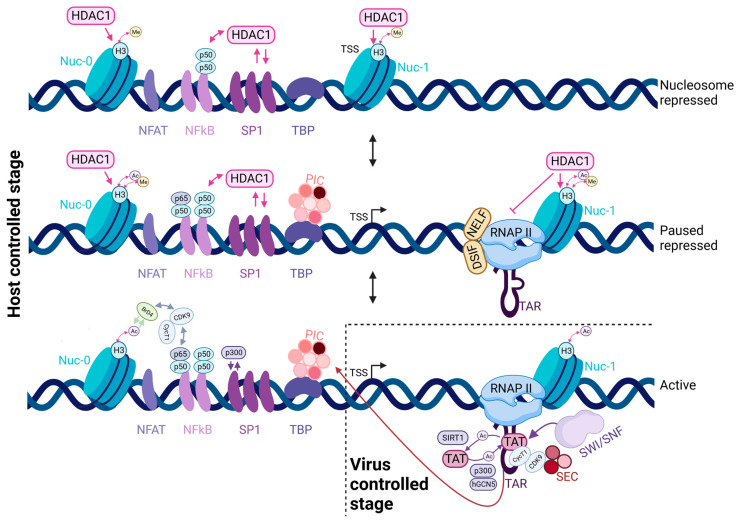
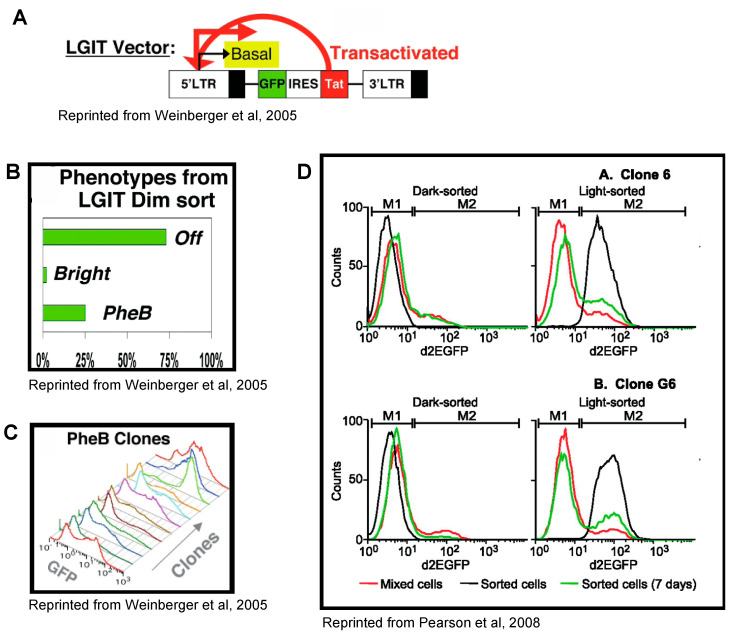
This review summarizes current advances in the role of transcriptional stochasticity in HIV-1 latency, which were possible in a large part due to the development of single-cell approaches. HIV-1 transcription proceeds in bursts of RNA production, which stem from the stochastic switching of the viral promoter between ON and OFF states. This switching is caused by random binding dynamics of transcription factors and nucleosomes to the viral promoter and occurs at several time scales from minutes to hours. Transcriptional bursts are mainly controlled by the core transcription factors TBP, SP1 and NF-κb, the chromatin status of the viral promoter and RNA polymerase II pausing. In particular, spontaneous variability in the promoter chromatin creates heterogeneity in the response to activators such as TNF-α, which is then amplified by the Tat feedback loop to generate high and low viral transcriptional states. This phenomenon is likely at the basis of the partial and stochastic response of latent T cells from HIV-1 patients to latency-reversing agents, which is a barrier for the development of shock-and-kill strategies of viral eradication. A detailed understanding of the transcriptional stochasticity of HIV-1 and the possibility to precisely model this phenomenon will be important assets to develop more effective therapeutic strategies.
本文综述了转录随机性在 HIV-1 潜伏期中的作用的最新进展,这在很大程度上要归功于单细胞方法的发展。HIV-1 转录以 RNA 产生的爆发形式进行,这源于病毒启动子在 ON 和 OFF 状态之间随机切换。这种切换是由转录因子和核小体随机结合到病毒启动子上引起的,发生在从分钟到小时的几个时间尺度上。转录爆发主要受核心转录因子 TBP、SP1 和 NF-κb、病毒启动子的染色质状态和 RNA 聚合酶 II 暂停控制。特别是,启动子染色质的自发可变性会导致对 TNF-α 等激活剂的反应产生异质性,然后被 Tat 反馈环放大,从而产生高和低的病毒转录状态。这种现象可能是 HIV-1 患者潜伏 T 细胞对潜伏逆转剂的部分和随机反应的基础,这是开发病毒清除的冲击-杀伤策略的障碍。对 HIV-1 转录随机性的深入了解以及精确模拟这种现象的可能性,将是开发更有效的治疗策略的重要资产。