da Costa-Nunes José A, Gierlinski Marek, Sasaki Takayo, Haagensen Emma J, Gilbert David M, Blow J Julian
Division of Molecular, Cell and Developmental Biology, School of Life Sciences, University of Dundee, Dundee, DD1 5EH, UK.
Data Analysis Group, School of Life Sciences, University of Dundee, Dundee, DD1 5EH, UK.
Wellcome Open Res. 2023 Aug 22;8:158. doi: 10.12688/wellcomeopenres.18742.2. eCollection 2023.
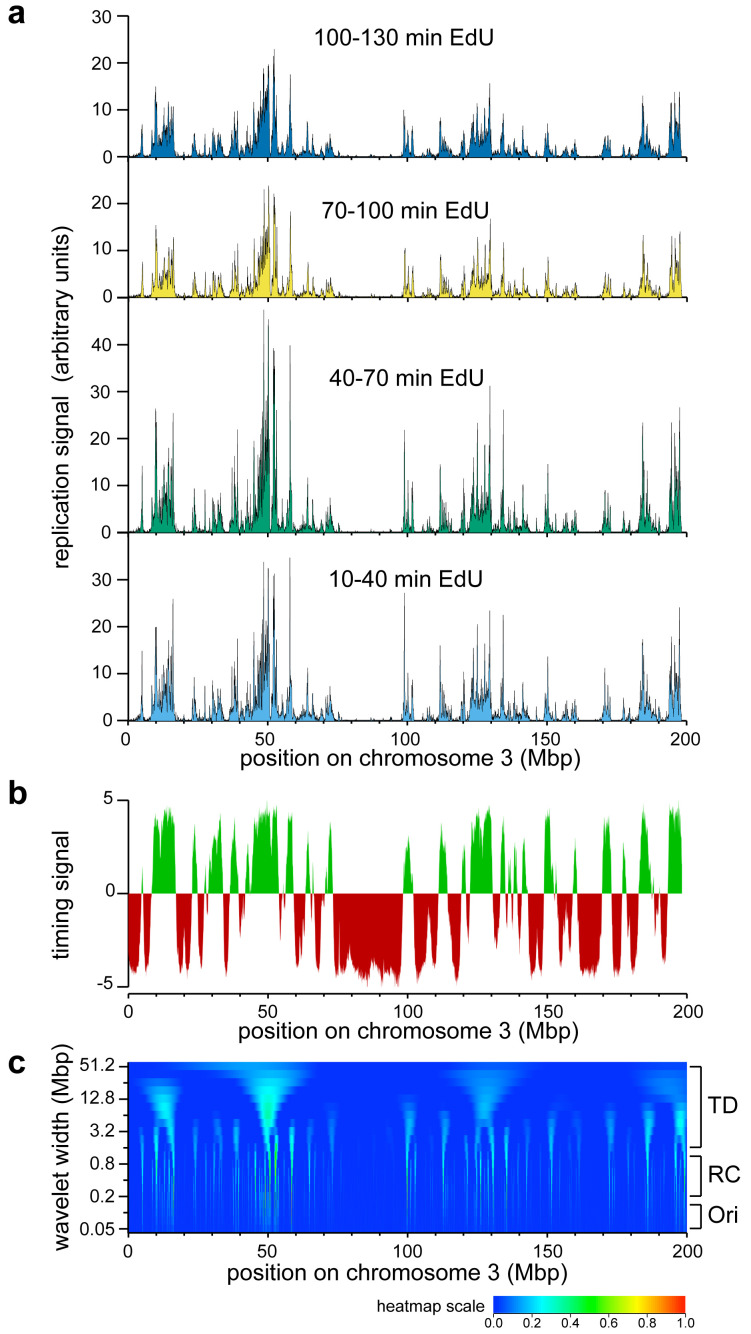
: It has been known for many years that in metazoan cells, replication origins are organised into clusters where origins within each cluster fire near-synchronously. Despite clusters being a fundamental organising principle of metazoan DNA replication, the genomic location of origin clusters has not been documented. : We synchronised human U2OS by thymidine block and release followed by L-mimosine block and release to create a population of cells progressing into S phase with a high degree of synchrony. At different times after release into S phase, cells were pulsed with EdU; the EdU-labelled DNA was then pulled down, sequenced and mapped onto the human genome. : The early replicating DNA showed features at a range of scales. Wavelet analysis showed that the major feature of the early replicating DNA was at a size of 500 kb, consistent with clusters of replication origins. Over the first two hours of S phase, these Replicon Cluster Domains broadened in width, consistent with their being enlarged by the progression of replication forks at their outer boundaries. The total replication signal associated with each Replicon Cluster Domain varied considerably, and this variation was reproducible and conserved over time. We provide evidence that this variability in replication signal was at least in part caused by Replicon Cluster Domains being activated at different times in different cells in the population. We also provide evidence that adjacent clusters had a statistical preference for being activated in sequence across a group, consistent with the 'domino' model of replication focus activation order observed by microscopy. : We show that early replicating DNA is organised into Replicon Cluster Domains that behave as expected of replicon clusters observed by DNA fibre analysis. The coordinated activation of different Replicon Cluster Domains can generate the replication timing programme by which the genome is duplicated.
多年来人们已经知道,在多细胞动物细胞中,复制起点被组织成簇,每个簇内的起点几乎同步激活。尽管簇是多细胞动物DNA复制的一个基本组织原则,但起点簇的基因组位置尚未被记录。
我们通过胸腺嘧啶核苷阻断和释放,随后进行L-含羞草碱阻断和释放来同步化人U2OS细胞,以创建一群高度同步进入S期的细胞。在释放到S期后的不同时间,用EdU脉冲处理细胞;然后拉下EdU标记的DNA,进行测序并映射到人类基因组上。
早期复制的DNA在一系列尺度上呈现出特征。小波分析表明,早期复制DNA的主要特征大小为500 kb,这与复制起点簇一致。在S期的前两个小时内,这些复制子簇结构域的宽度变宽,这与它们在外部边界处被复制叉的推进所扩大一致。与每个复制子簇结构域相关的总复制信号差异很大,并且这种差异是可重复的且随时间保守。我们提供证据表明,复制信号的这种变异性至少部分是由于复制子簇结构域在群体中的不同细胞中在不同时间被激活所致。我们还提供证据表明,相邻簇在一组中按顺序被激活具有统计学上的偏好,这与通过显微镜观察到的复制焦点激活顺序的“多米诺骨牌”模型一致。
我们表明,早期复制的DNA被组织成复制子簇结构域,其行为符合通过DNA纤维分析观察到的复制子簇的预期。不同复制子簇结构域的协同激活可以产生基因组复制所依据的复制时间程序。