Institut de Biologie de l'Ecole Normale Supérieure (IBENS), CNRS UMR8197, Inserm U1024, Paris, France.
PLoS Comput Biol. 2011 Dec;7(12):e1002322. doi: 10.1371/journal.pcbi.1002322. Epub 2011 Dec 29.
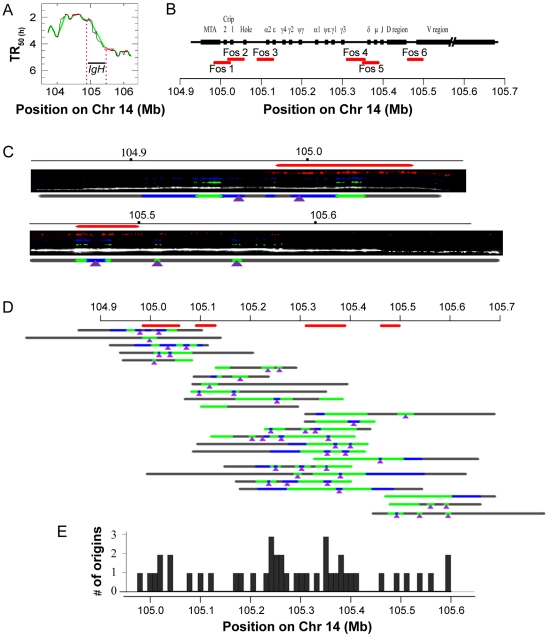
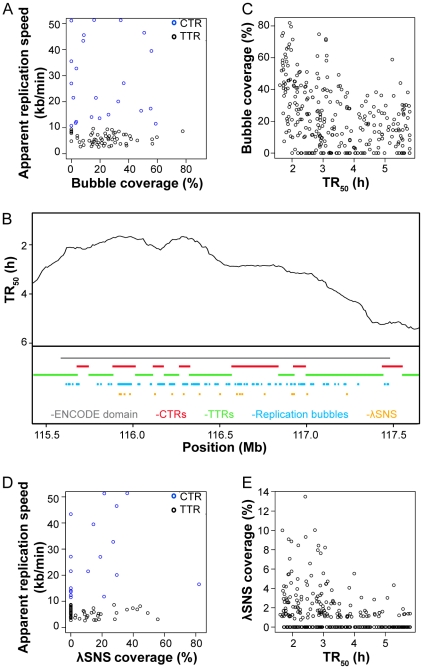
Genome-wide replication timing studies have suggested that mammalian chromosomes consist of megabase-scale domains of coordinated origin firing separated by large originless transition regions. Here, we report a quantitative genome-wide analysis of DNA replication kinetics in several human cell types that contradicts this view. DNA combing in HeLa cells sorted into four temporal compartments of S phase shows that replication origins are spaced at 40 kb intervals and fire as small clusters whose synchrony increases during S phase and that replication fork velocity (mean 0.7 kb/min, maximum 2.0 kb/min) remains constant and narrowly distributed through S phase. However, multi-scale analysis of a genome-wide replication timing profile shows a broad distribution of replication timing gradients with practically no regions larger than 100 kb replicating at less than 2 kb/min. Therefore, HeLa cells lack large regions of unidirectional fork progression. Temporal transition regions are replicated by sequential activation of origins at a rate that increases during S phase and replication timing gradients are set by the delay and the spacing between successive origin firings rather than by the velocity of single forks. Activation of internal origins in a specific temporal transition region is directly demonstrated by DNA combing of the IGH locus in HeLa cells. Analysis of published origin maps in HeLa cells and published replication timing and DNA combing data in several other cell types corroborate these findings, with the interesting exception of embryonic stem cells where regions of unidirectional fork progression seem more abundant. These results can be explained if origins fire independently of each other but under the control of long-range chromatin structure, or if replication forks progressing from early origins stimulate initiation in nearby unreplicated DNA. These findings shed a new light on the replication timing program of mammalian genomes and provide a general model for their replication kinetics.
全基因组复制时间研究表明,哺乳动物染色体由协调起始点火的兆碱基规模域组成,这些域被大的无起始过渡区域隔开。在这里,我们报告了在几种人类细胞类型中对 DNA 复制动力学的定量全基因组分析,该分析与这一观点相矛盾。在被分为 S 期四个时间区室的 HeLa 细胞中进行的 DNA 梳理显示,复制起点以 40kb 的间隔隔开,并以小簇的形式点火,这些簇的同步性在 S 期增加,并且复制叉速度(平均值 0.7kb/min,最大值 2.0kb/min)在整个 S 期保持恒定且分布狭窄。然而,对全基因组复制时间谱的多尺度分析显示,复制时间梯度的分布广泛,实际上没有大于 100kb 的区域以低于 2kb/min 的速度复制。因此,HeLa 细胞缺乏单向叉推进的大区域。时间过渡区室通过起源的顺序激活进行复制,其速率在 S 期增加,复制时间梯度由后续起源点火的延迟和间隔而不是单个叉的速度来设置。通过在 HeLa 细胞中对 IGH 基因座进行 DNA 梳理,直接证明了特定时间过渡区室内部起源的激活。对 HeLa 细胞中发表的起源图谱以及其他几种细胞类型中发表的复制时间和 DNA 梳理数据的分析证实了这些发现,有趣的是,胚胎干细胞是个例外,其中单向叉推进的区域似乎更为丰富。如果起源彼此独立但受长程染色质结构控制点火,或者如果从早期起源推进的复制叉刺激附近未复制 DNA 的起始,那么这些结果就可以得到解释。这些发现为哺乳动物基因组的复制时间程序提供了新的认识,并为它们的复制动力学提供了一个通用模型。