Nuffield Department of Orthopaedics, Rheumatology and Musculoskeletal Disorders, University of Oxford, Oxford, UK.
University of Glasgow, Glasgow, UK.
BMJ Open. 2023 Sep 28;13(9):e078539. doi: 10.1136/bmjopen-2023-078539.
Psoriatic arthritis (PsA) affects around 150 000 people in the UK of whom around 50% require treatment with biologics. The most used biologics for PsA target tumour necrosis factor (TNF) or interleukin-17A (IL-17A). About 50% of patients respond to each, but it is not currently possible to predict response for individual patients, necessitating sequential treatment steps. A recent proof of concept study in PsA suggested that using peripheral immunophenotype to choose therapy could improve time to treatment response.This study will test the hypothesis, within an open-label parallel-group biomarker-stratified multicentre randomised controlled trial, which the baseline proportion of CD4+T cells with an activated type 17 immunophenotype (Th17 levels) predicts response to IL-17A or TNF inhibitors in PsA. Additional analyses will identify if the model can be refined by combining additional clinical and immunophenotypic factors. Statistical modelling will be used to predict the likely effectiveness of these approaches compared with standard care.
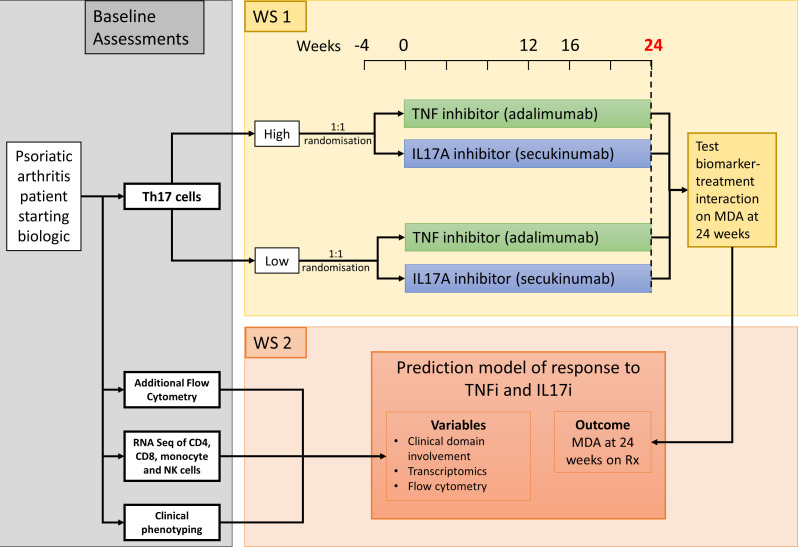
Patients with PsA eligible to start their first biologic as part of standard care are recruited and baseline blood tests are taken for immunophenotyping. Participants are stratified equally by Th17 levels and randomised 1:1 to receive either TNF (adalimumab) or IL-17A (secukinumab) inhibitors. The primary analysis will establish the interaction between baseline immunophenotype and treatment on the primary outcome (achievement of minimal disease activity criteria at week 24). In secondary analysis, modelling will identify if this prediction model can be optimised further by incorporating clinical phenotypes and additional immunophenotyping techniques.
Ethical approval for the study was granted by the North West Preston Research Ethics Committee (ref 21/NW/0016). Dissemination will be via conference presentations and peer-reviewed publications, aiming to impact on treatment guidelines.
ISRCTN17228602.
在英国,约有 15 万人患有银屑病关节炎(PsA),其中约 50%需要使用生物制剂治疗。用于治疗 PsA 的最常用生物制剂靶向肿瘤坏死因子(TNF)或白细胞介素-17A(IL-17A)。大约 50%的患者对每种药物都有反应,但目前无法预测个体患者的反应,因此需要进行连续的治疗步骤。最近一项针对 PsA 的概念验证研究表明,使用外周免疫表型来选择治疗方法可能会改善治疗反应时间。本研究将在一项开放标签、平行组、生物标志物分层、多中心随机对照试验中检验这一假设,即基线时具有激活型 17 型免疫表型(Th17 水平)的 CD4+T 细胞的比例预测 PsA 对 IL-17A 或 TNF 抑制剂的反应。进一步的分析将确定通过结合额外的临床和免疫表型因素是否可以改进该模型。统计模型将用于预测与标准护理相比,这些方法的可能有效性。
符合标准护理下开始使用第一种生物制剂条件的 PsA 患者被招募,采集基线血液进行免疫表型检测。参与者根据 Th17 水平均等分层,并随机 1:1 接受 TNF(阿达木单抗)或 IL-17A(司库奇尤单抗)抑制剂治疗。主要分析将确定基线免疫表型和治疗对主要结局(第 24 周达到最小疾病活动标准)的相互作用。在次要分析中,模型将确定通过纳入临床表型和额外的免疫表型技术,是否可以进一步优化该预测模型。
该研究获得了西北普雷斯顿研究伦理委员会的伦理批准(编号 21/NW/0016)。将通过会议报告和同行评议的出版物进行传播,旨在影响治疗指南。
ISRCTN86207717。