The Section for Cardiology, Department of Clinical Sciences Lund, Lund University, Lund, Sweden.
The Haemodynamic Lab, The Section for Heart Failure and Valvular Disease, VO Heart and Lung Medicine, Skåne University Hospital, Lund, Sweden.
ESC Heart Fail. 2023 Dec;10(6):3582-3591. doi: 10.1002/ehf2.14507. Epub 2023 Sep 29.
Patients with heart failure (HF) exhibit poor prognosis, which is further deteriorated by pulmonary hypertension (PH), with negative impact on morbidity and mortality. As PH due to left HF (LHF-PH) is among the most common causes of PH, there is an urge according to the 2021 European Society of Cardiology HF guidelines to find new biomarkers that aid in prognostication of this patient cohort. Given the role of tumour necrosis factor-alpha (TNF-α) in HF progression, we aimed to investigate the prognostic value of plasma proteins related to TNF-α in patients with LHF-PH, in relation to haemodynamic changes following heart transplantation (HT).
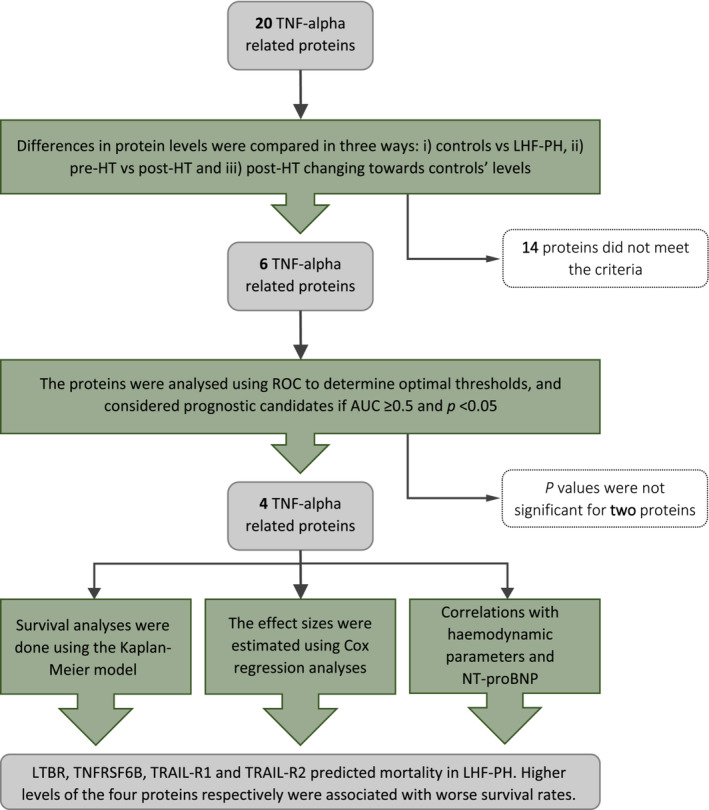
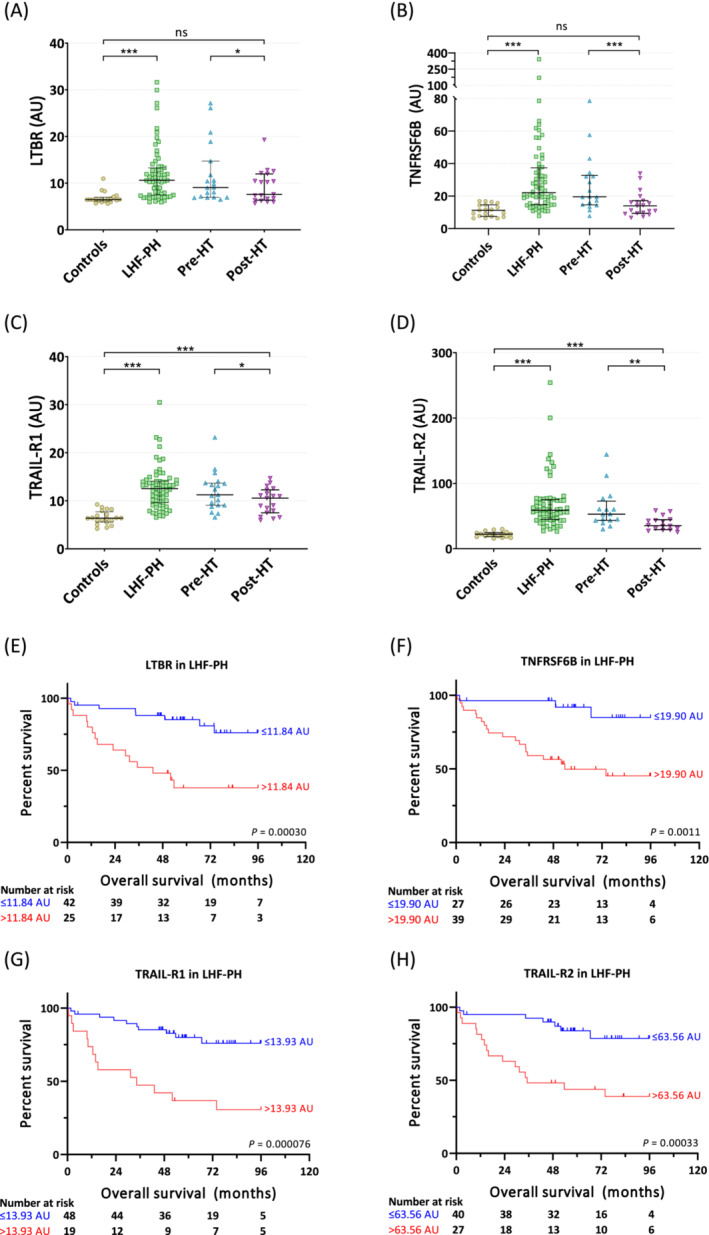
Twenty TNF-α-related plasma proteins were analysed using proximity extension assay in healthy controls (n = 20) and patients with LHF-PH (n = 67), before and 1 year after HT (n = 19). Plasma levels were compared between the groups, and the prognostic values were determined using Kaplan-Meier and Cox regression analyses. Plasma levels of lymphotoxin-beta receptor (LTBR), TNF receptor superfamily member 6B (TNFRSF6B), and TNF-related apoptosis-inducing ligand receptors 1 and 2 (TRAIL-R1 and TRAIL-R2, respectively) were higher in LHF-PH pre-HT vs. controls (P < 0.0001), as well as higher in pre-HT vs. post-HT (P < 0.001). The elevated pre-HT levels of LTBR, TNFRSF6B, TRAIL-R1, and TRAIL-R2 decreased towards the levels of healthy controls after HT. Higher preoperative levels of LTBR, TNFRSF6B, TRAIL-R1, and TRAIL-R2 in LHF-PH were associated with worse survival rates (P < 0.002). In multivariate Cox regression models, each adjusted for age and sex, LTBR, TNFRSF6B, TRAIL-R1, and TRAIL-R2 predicted mortality (P < 0.002) [hazard ratio (95% confidence interval): 1.12 (1.04-1.19), 1.01 (1.004-1.02), 1.28 (1.14-1.42), and 1.03 (1.02-1.04), respectively].
Elevated pre-HT plasma levels of the TNF-α-related proteins LTBR, TNFRSF6B, TRAIL-R1, and TRAIL-R2 in LHF-PH decreased 1 year after HT, displaying a normalization pattern towards the levels of the healthy controls. These proteins were also prognostic, where higher levels were associated with worse survival rates in LHF-PH, providing new insight in their potential role as prognostic biomarkers. Larger studies are warranted to validate our findings and to investigate their possible pathobiological mechanisms in LHF-PH.
心力衰竭(HF)患者预后不良,而肺动脉高压(PH)会进一步恶化其预后,从而导致发病率和死亡率升高。由于左心HF 所致 PH(LHF-PH)是 PH 最常见的原因之一,因此根据 2021 年欧洲心脏病学会 HF 指南的要求,迫切需要寻找新的生物标志物来辅助预测这一患者群体的预后。鉴于肿瘤坏死因子-α(TNF-α)在 HF 进展中的作用,我们旨在研究 LHF-PH 患者与左心 HF 相关的 TNF-α 相关血浆蛋白的预后价值,同时研究这些蛋白与心脏移植(HT)后血液动力学变化的关系。
采用邻近延伸分析(proximity extension assay)检测 20 名 TNF-α 相关血浆蛋白,分别在健康对照组(n=20)和 LHF-PH 患者(n=67)中进行检测,检测时间分别为 HT 前(n=19)和 HT 后 1 年(n=19)。比较各组间的血浆水平,并采用 Kaplan-Meier 和 Cox 回归分析来确定预后价值。结果显示,LHF-PH 患者 HT 前的淋巴毒素-β受体(LTBR)、TNF 受体超家族成员 6B(TNFRSF6B)和 TNF 相关凋亡诱导配体受体 1 和 2(TRAIL-R1 和 TRAIL-R2)的血浆水平高于健康对照组(P<0.0001),HT 前的血浆水平也高于 HT 后的水平(P<0.001)。LHF-PH 患者 HT 前升高的 LTBR、TNFRSF6B、TRAIL-R1 和 TRAIL-R2 水平在 HT 后逐渐接近健康对照组的水平。LHF-PH 患者术前 LTBR、TNFRSF6B、TRAIL-R1 和 TRAIL-R2 水平较高与生存率降低相关(P<0.002)。多变量 Cox 回归模型显示,在调整年龄和性别后,LTBR、TNFRSF6B、TRAIL-R1 和 TRAIL-R2 均与死亡率相关(P<0.002)[风险比(95%置信区间):1.12(1.04-1.19)、1.01(1.004-1.02)、1.28(1.14-1.42)和 1.03(1.02-1.04)]。
LHF-PH 患者 HT 前升高的 LTBR、TNFRSF6B、TRAIL-R1 和 TRAIL-R2 血浆水平在 HT 后 1 年内下降,呈现出向健康对照组水平正常化的趋势。这些蛋白也具有预后价值,其中较高的水平与 LHF-PH 患者的生存率降低相关,为其作为预后生物标志物的潜在作用提供了新的见解。需要进一步开展更大规模的研究来验证我们的发现,并研究其在 LHF-PH 中的可能病理生物学机制。