Research Institute for Sustainable Humanosphere, Kyoto University , Uji, Kyoto, Japan.
Plant Immunity Research Group, RIKEN Center for Sustainable Resource Science , Yokohama, Kanagawa, Japan.
mBio. 2023 Oct 31;14(5):e0059923. doi: 10.1128/mbio.00599-23. Epub 2023 Sep 29.
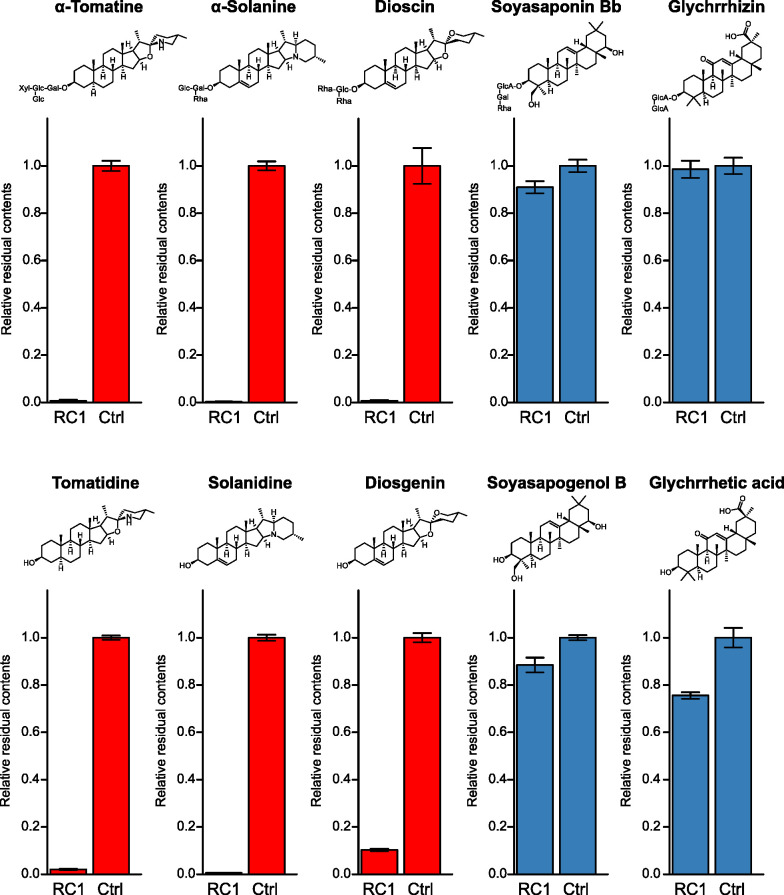
Saponins are a group of plant specialized metabolites with various bioactive properties, both for human health and soil microorganisms. Our previous works demonstrated that is enriched in both soils treated with a steroid-type saponin, such as tomatine, and in the tomato rhizosphere. Despite the importance of saponins in plant-microbe interactions in the rhizosphere, the genes involved in the catabolism of saponins and their aglycones (sapogenins) remain largely unknown. Here we identified several enzymes that catalyzed the degradation of steroid-type saponins in a isolate from tomato roots, RC1. A comparative genomic analysis of revealed the limited distribution of genes for saponin degradation in our saponin-degrading isolates and several other isolates, suggesting the possible involvement of the saponin degradation pathway in the root colonization of spp. The genes that participate in the catabolism of sapogenins could be applied to the development of new industrially valuable sapogenin molecules.
皂苷是一类具有多种生物活性的植物特化代谢物,对人类健康和土壤微生物都有影响。我们之前的工作表明,在施用甾体皂苷(如番茄苷)的土壤中和番茄根际中,都富含 。尽管皂苷在根际植物-微生物相互作用中很重要,但参与皂苷及其苷元(皂素)代谢的基因在很大程度上仍然未知。在这里,我们从番茄根中分离到的 RC1 中鉴定出了几种能够催化甾体皂苷降解的酶。对 进行的比较基因组分析表明,我们的皂苷降解分离株和其他几个分离株中,参与皂苷降解的基因分布有限,这表明皂苷降解途径可能参与了 spp. 的根定殖。参与皂素代谢的基因可以应用于新型工业价值皂素分子的开发。