Wang Lu, Zhang Tianyu, Zheng Yile, Li Yuting, Tang Xiyuan, Chen Qianping, Mao Wei, Li Weiwei, Liu Xiangsheng, Zhu Ji
Zhejiang Cancer Hospital, Hangzhou Institute of Medicine (HIM), Chinese Academy of Sciences, Hangzhou, Zhejiang, 310022, China.
Zhejiang Key Laboratory of Radiation Oncology, Hangzhou, Zhejiang, 310022, China.
Mater Today Bio. 2023 Sep 25;23:100809. doi: 10.1016/j.mtbio.2023.100809. eCollection 2023 Dec.
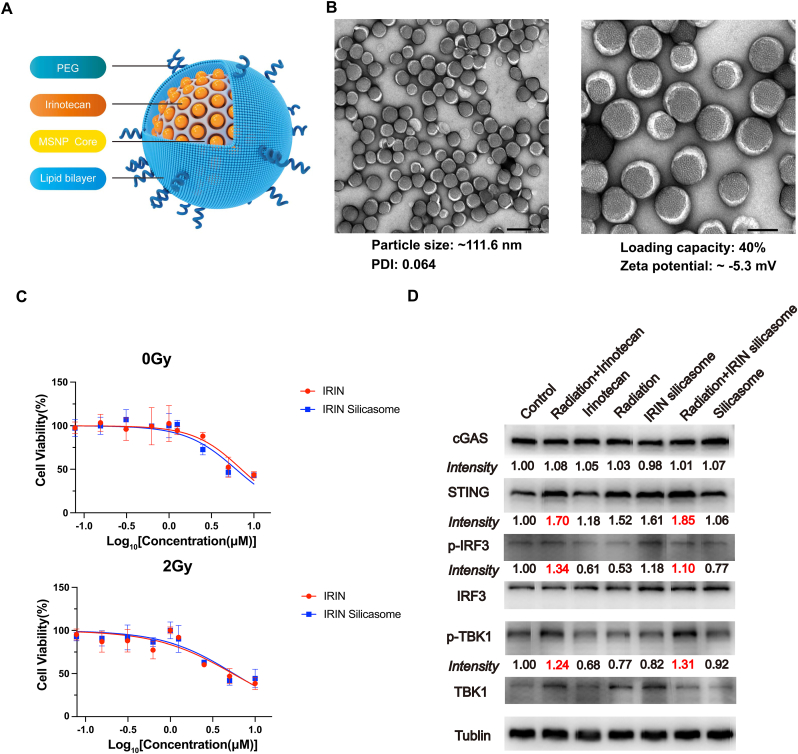
Our previous clinical trial (Identifier: NCT02605265) revealed that addition of irinotecan (IRIN) to neoadjuvant chemoradiotherapy for rectal cancer could improve the curative effect. However, the adverse effects caused by IRIN limited the wide application of IRIN chemoradiotherapy. This study aimed to explore the mechanism under the synergistic effects of IRIN plus radiation therapy in colorectal cancer (CRC) cells and optimization of IRIN delivery via a silicasome nanocarrier . Our results revealed that compared with single IRIN or radiation treatment, IRIN combined with radiation therapy remarkably activated the intracellular cGAS/STING pathway, and promoted the expression levels of major histocompatibility complex class I (MHC-I) and programmed death ligand 1 (PD-L1). Further, a silicasome (mesoporous silica nanoparticle coated with lipid bilayer) nanocarrier was utilized to improve the delivery of IRIN with enhanced efficacy and reduced side effects. In the MC38 CRC syngeneic tumor model, IRIN silicasome combined with radiation therapy demonstrated a greater antitumor efficacy than free IRIN plus radiation therapy. Flow cytometry showed the increased number of CD4 T cells, CD8 T cells, and dendritic cells (DCs) in tumor in the IRIN silicasome plus radiation group. The immunofluorescence staining further confirmed the activated immune microenvironment with the elevated interferon-γ (IFN-γ) deposition. Besides, the antitumor effect of IRIN silicasome plus radiation therapy was synergistically enhanced by -PD-1 immunotherapy. These findings indicated that the combination of IRIN silicasome with radiation therapy could sensitize immunotherapy by manipulating the cGAS/STING pathway serving as a new strategy for CRC treatment.
我们之前的临床试验(标识符:NCT02605265)显示,在直肠癌新辅助放化疗中添加伊立替康(IRIN)可提高疗效。然而,IRIN引起的不良反应限制了IRIN放化疗的广泛应用。本研究旨在探讨IRIN联合放射治疗在结直肠癌(CRC)细胞中的协同作用机制,以及通过硅质体纳米载体优化IRIN递送。我们的结果显示,与单一IRIN或放射治疗相比,IRIN联合放射治疗显著激活细胞内cGAS/STING通路,并促进主要组织相容性复合体I类(MHC-I)和程序性死亡配体1(PD-L1)的表达水平。此外,利用硅质体(脂质双层包裹的介孔二氧化硅纳米颗粒)纳米载体改善IRIN的递送,提高疗效并减少副作用。在MC38 CRC同基因肿瘤模型中,IRIN硅质体联合放射治疗显示出比游离IRIN联合放射治疗更大的抗肿瘤疗效。流式细胞术显示,IRIN硅质体加放射治疗组肿瘤中CD4 T细胞, CD8 T细胞和树突状细胞(DC)数量增加。免疫荧光染色进一步证实免疫微环境激活,干扰素-γ(IFN-γ)沉积增加。此外,-PD-1免疫疗法协同增强了IRIN硅质体加放射治疗的抗肿瘤作用。这些发现表明,IRIN硅质体与放射治疗联合可通过调控cGAS/STING通路使免疫治疗敏感化,作为CRC治疗的新策略。