Department of Rehabilitation Medicine, Erasmus MC, University Medical Center Rotterdam, Rotterdam, The Netherlands.
Department of Respiratory Medicine, Erasmus MC, University Medical Center Rotterdam, Rotterdam, The Netherlands.
BMC Med. 2023 Oct 2;21(1):380. doi: 10.1186/s12916-023-03083-3.
Currently, evidence about the long-term consequences of COVID-19 on return to work and health-related quality of life (HRQoL) is limited. We evaluated return to work and its associations with baseline characteristics and physical and mental recovery over time in patients up to 1 year after hospitalization for COVID-19. Secondly, we aimed to evaluate the association between return to work and health-related quality of life (HRQoL).
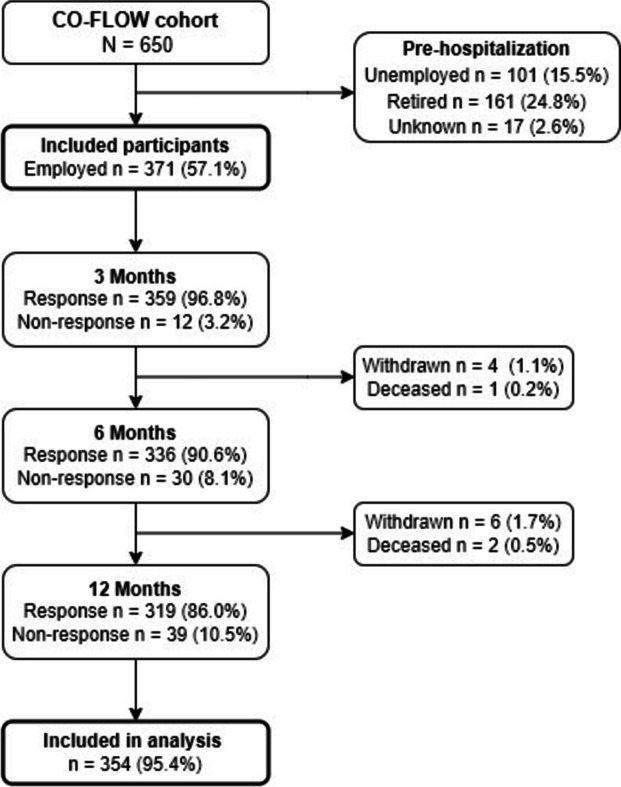
CO-FLOW, a multicenter prospective cohort study, enrolled adult participants hospitalized for COVID-19, aged ≥ 18 years within 6 months after hospital discharge. Return to work and HRQoL were collected at 3, 6, and 12 months after hospital discharge using the iMTA Productivity Cost Questionnaire and the 36-Item Short Form Health Survey, respectively. Data were collected between July 1, 2020, and September 1, 2022. Generalized estimating equations with repeated measurements were used to assess outcomes over time.
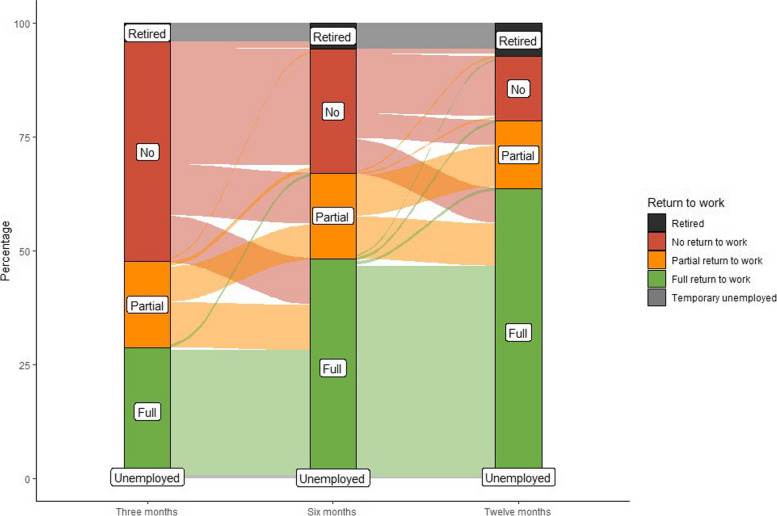
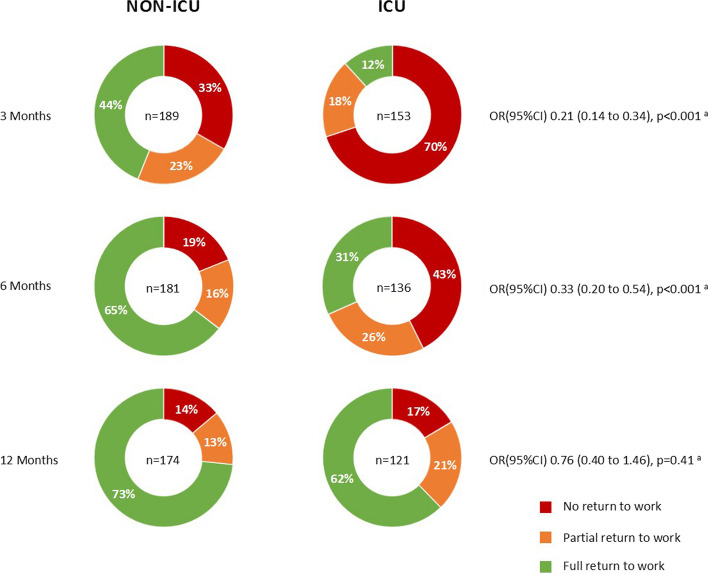
In the CO-FLOW study, 371 participants were employed pre-hospitalization. At 3, 6, and 12 months post-discharge, 50% (170/342), 29% (92/317), and 15% (44/295) of participants had not returned to work, and 21% (71/342), 21% (65/317), and 16% (48/295) only partially, respectively. ICU admission (adjusted odds ratio (95% confidence interval): 0.17 (0.10 to 0.30), p < 0.001), persistent fatigue (0.93 (0.90 to 0.97), p < 0.001), female sex (0.57 (0.36 to 0.90), p = 0.017), and older age (0.96 (0.93 to 0.98), p < 0.001) were independently associated with no return to work. ICU patients required a longer time to return to work than non-ICU patients. Patients who did not return or partially returned to work reported lower scores on all domains of HRQoL than those who fully returned.
One year after hospitalization for COVID-19, only 69% of patients fully returned to work, whereas 15% did not return and 16% partially returned to work. No or partial return to work was associated with reduced HRQoL. This study suggests that long-term vocational support might be needed to facilitate return to work.
World Health Organization International Clinical Trials Registry Platform NL8710.
目前,关于 COVID-19 对工作恢复和健康相关生活质量(HRQoL)的长期影响的证据有限。我们评估了患者在 COVID-19 住院后长达 1 年的工作恢复情况及其与基线特征以及随时间推移的身体和心理恢复之间的关联。其次,我们旨在评估工作恢复与健康相关生活质量(HRQoL)之间的关联。
CO-FLOW 是一项多中心前瞻性队列研究,招募了 COVID-19 住院患者,年龄≥18 岁,在出院后 6 个月内。使用 iMTA 生产力成本问卷和 36 项简短健康调查分别在出院后 3、6 和 12 个月时收集工作恢复和 HRQoL 情况。数据收集时间为 2020 年 7 月 1 日至 2022 年 9 月 1 日。使用广义估计方程进行重复测量,以评估随时间推移的结果。
在 CO-FLOW 研究中,371 名参与者在住院前有工作。在出院后 3、6 和 12 个月时,50%(170/342)、29%(92/317)和 15%(44/295)的参与者未恢复工作,分别为 21%(71/342)、21%(65/317)和 16%(48/295)仅部分恢复工作。入住 ICU(调整后的优势比(95%置信区间):0.17(0.10 至 0.30),p<0.001)、持续疲劳(0.93(0.90 至 0.97),p<0.001)、女性(0.57(0.36 至 0.90),p=0.017)和年龄较大(0.96(0.93 至 0.98),p<0.001)与未恢复工作独立相关。入住 ICU 的患者比非 ICU 患者需要更长的时间才能恢复工作。未完全或部分恢复工作的患者报告的所有 HRQoL 领域的评分均低于完全恢复工作的患者。
COVID-19 住院 1 年后,只有 69%的患者完全恢复工作,而 15%的患者未恢复工作,16%的患者部分恢复工作。未恢复或部分恢复工作与 HRQoL 降低有关。这项研究表明,可能需要长期的职业支持来促进工作恢复。
世界卫生组织国际临床试验注册平台 NL8710。