Huang Robert J, Wichmann Ignacio A, Su Andrew, Sathe Anuja, Shum Miranda V, Grimes Susan M, Meka Rithika, Almeda Alison, Bai Xiangqi, Shen Jeanne, Nguyen Quan, Amieva Manuel R, Hwang Joo Ha, Ji Hanlee P
Division of Gastroenterology, Department of Medicine, Stanford School of Medicine, Stanford, CA, 94305, USA.
Division of Oncology, Department of Medicine, Stanford School of Medicine, Stanford, CA, 94305, USA.
bioRxiv. 2023 Sep 22:2023.09.20.558462. doi: 10.1101/2023.09.20.558462.
Gastric intestinal metaplasia () is a precancerous lesion that increases gastric cancer () risk. The Operative Link on GIM () is a combined clinical-histopathologic system to risk-stratify patients with GIM. The identification of molecular biomarkers that are indicators for advanced OLGIM lesions may improve cancer prevention efforts.
This study was based on clinical and genomic data from four cohorts: 1) GAPS, a GIM cohort with detailed OLGIM severity scoring (N=303 samples); 2) the Cancer Genome Atlas (N=198); 3) a collation of in-house and publicly available scRNA-seq data (N=40), and 4) a spatial validation cohort (N=5) consisting of annotated histology slides of patients with either GC or advanced GIM. We used a multi-omics pipeline to identify, validate and sequentially parse a highly-refined signature of 26 genes which characterize high-risk GIM.
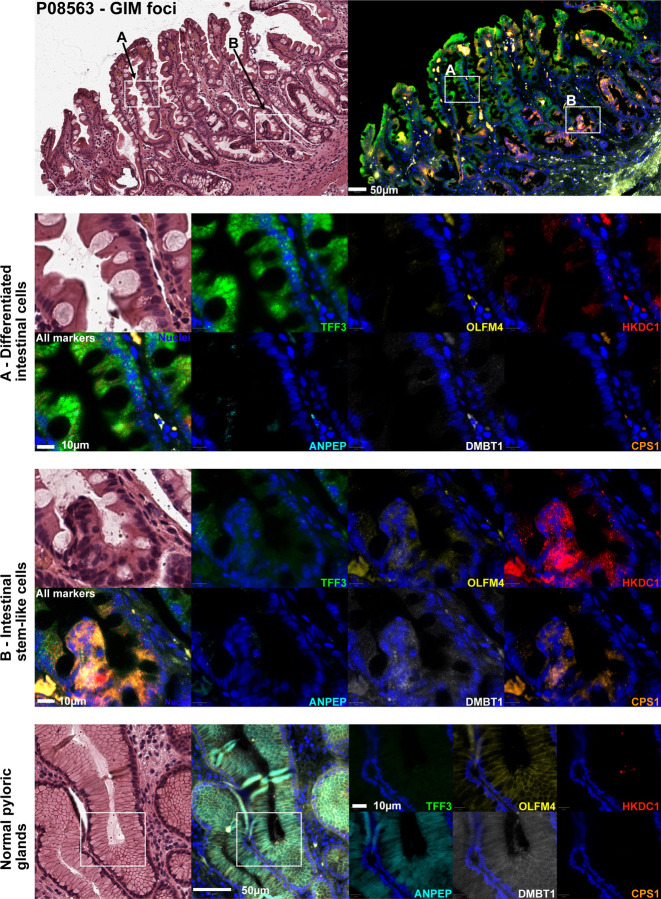
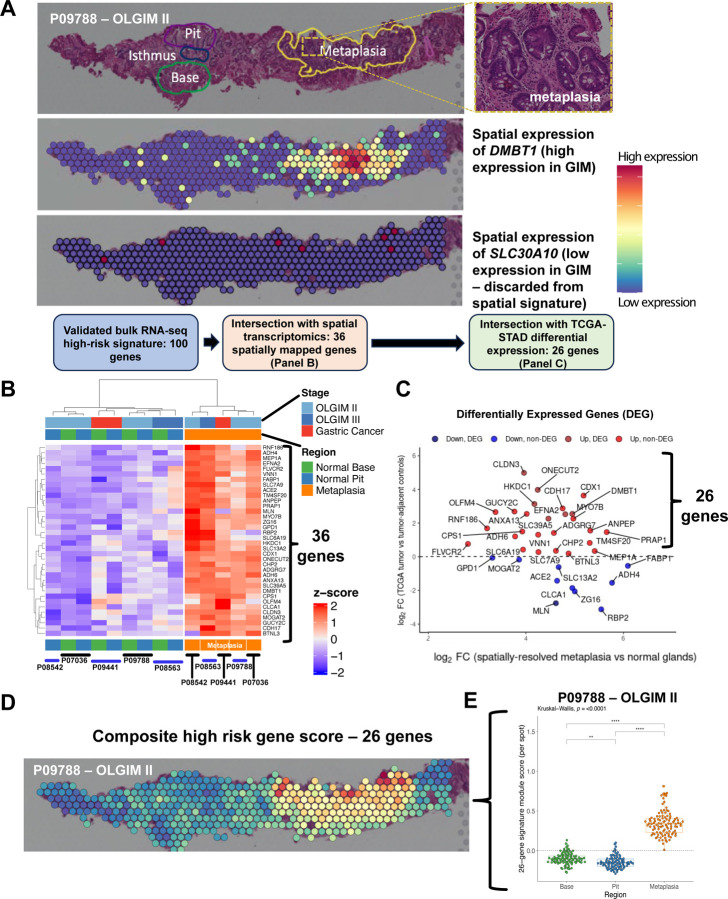
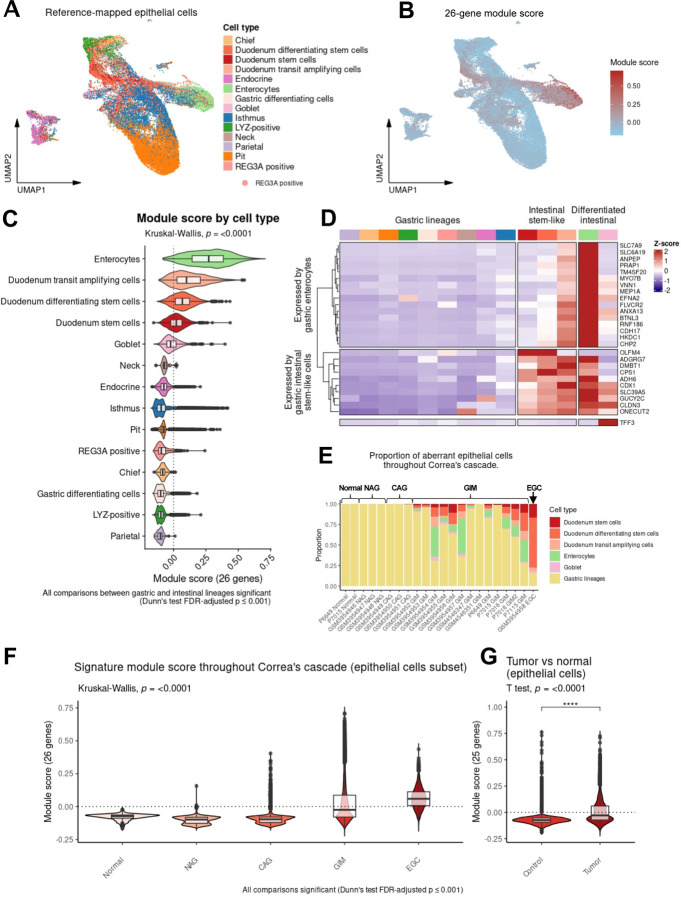
Using standard RNA-seq, we analyzed two separate, non-overlapping discovery (N=88) and validation (N=215) sets of GIM. In the discovery phase, we identified 105 upregulated genes specific for high-risk GIM (defined as OLGIM III-IV), of which 100 genes were independently confirmed in the validation set. Spatial transcriptomic profiling revealed 36 of these 100 genes to be expressed in metaplastic foci in GIM. Comparison with bulk GC sequencing data revealed 26 of these genes to be expressed in intestinal-type GC. Single-cell profiling resolved the 26-gene signature to both mature intestinal lineages (goblet cells, enterocytes) and immature intestinal lineages (stem-like cells). A subset of these genes was further validated using single-molecule multiplex fluorescence hybridization. We found certain genes ( and ) to mark differentiated intestinal lineages, whereas others ( and ) localized to immature cells in the isthmic/crypt region of metaplastic glands, consistent with the findings from scRNAseq analysis.
using an integrated multi-omics approach, we identified a novel 26-gene expression signature for high-OLGIM precursors at increased risk for GC. We found this signature localizes to aberrant intestinal stem-like cells within the metaplastic microenvironment. These findings hold important translational significance for future prevention and early detection efforts.
胃肠化生(GIM)是一种癌前病变,会增加胃癌(GC)风险。GIM手术关联(OLGIM)是一种临床与组织病理学相结合的系统,用于对GIM患者进行风险分层。识别作为高级OLGIM病变指标的分子生物标志物可能会改善癌症预防工作。
本研究基于四个队列的临床和基因组数据:1)GAPS,一个具有详细OLGIM严重程度评分的GIM队列(N = 303个样本);2)癌症基因组图谱(N = 198);3)内部和公开可用的scRNA-seq数据的整理(N = 40),以及4)一个空间验证队列(N = 5),由GC或高级GIM患者的注释组织学切片组成。我们使用多组学流程来识别、验证并依次解析一个由26个基因组成的高度精炼的特征,该特征可表征高风险GIM。
使用标准RNA-seq,我们分析了两个独立的、不重叠的GIM发现集(N = 88)和验证集(N = 215)。在发现阶段,我们鉴定出105个高风险GIM(定义为OLGIM III-IV)特有的上调基因,其中100个基因在验证集中得到独立确认。空间转录组分析显示,这100个基因中有36个在GIM的化生灶中表达。与大量GC测序数据比较显示,这些基因中有26个在肠型GC中表达。单细胞分析将这26个基因特征解析为成熟肠谱系(杯状细胞、肠上皮细胞)和未成熟肠谱系(干细胞样细胞)。使用单分子多重荧光原位杂交进一步验证了这些基因的一个子集。我们发现某些基因(和)标记分化的肠谱系,而其他基因(和)定位于化生腺峡部/隐窝区域的未成熟细胞,这与scRNAseq分析的结果一致。
通过综合多组学方法,我们为GC风险增加的高OLGIM前体鉴定了一个新的26基因表达特征。我们发现该特征定位于化生微环境内异常的肠干细胞样细胞。这些发现对未来的预防和早期检测工作具有重要的转化意义。