Bennett Aliyah N, Woolard Katherine J, Sorge Amy, Melander Christian, Gunn John S
Center for Microbial Pathogenesis, Abigail Wexner Research Institute at Nationwide Children's Hospital, Columbus, OH, USA.
Infectious Diseases Institute, The Ohio State University, Columbus, OH, USA.
Biofilm. 2023 Sep 22;6:100158. doi: 10.1016/j.bioflm.2023.100158. eCollection 2023 Dec 15.
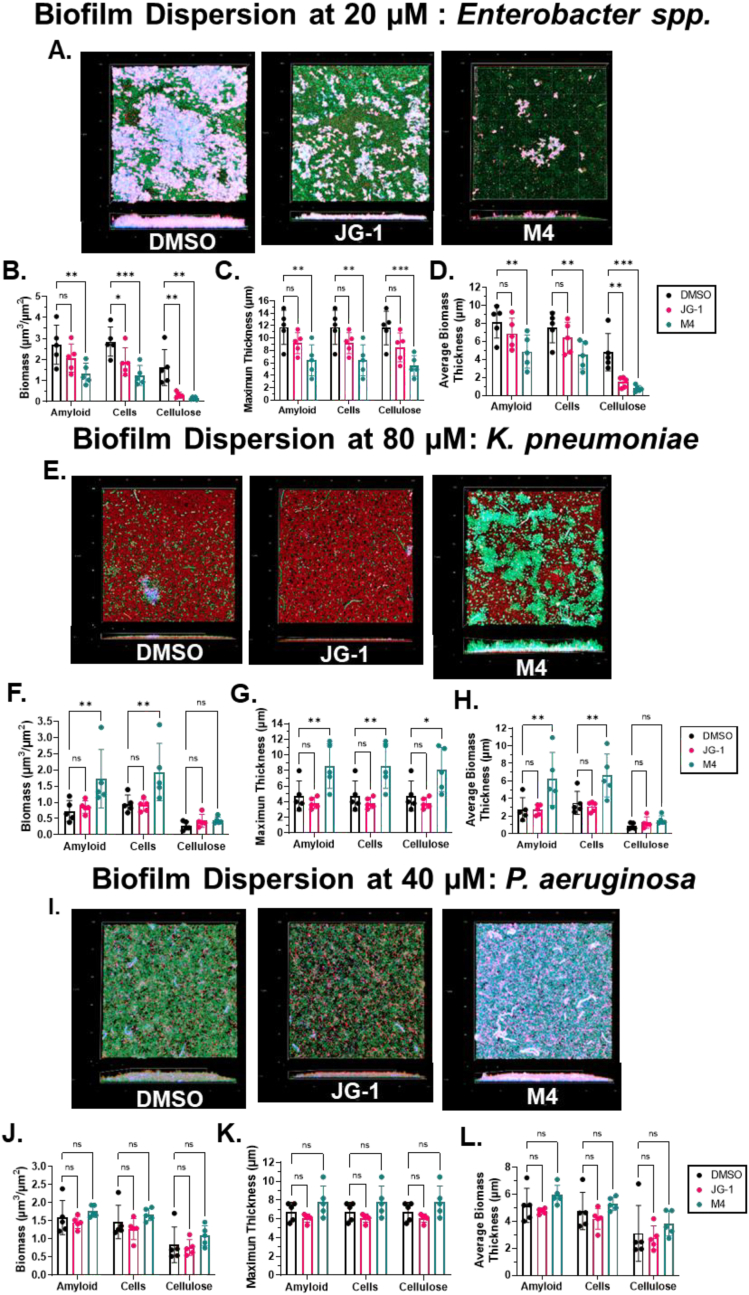
The ESKAPE pathogens are a group of bacteria that are a leading cause of health-care associated infections and are known to be agents of chronic, biofilm-mediated infections. These chronic bacterial infections often respond poorly to antibiotics and in some cases may require surgical intervention in order to cure the infection. As biofilms are often the critical mediator of a chronic infection, it is essential to develop therapies that target bacteria within the biofilm state. Herein, we report the development of a rapid, 96-well plate-based assay that employs conditions specific for each species to optimize biofilm production and allow for easy identification of differences in biofilm mass after treatment with anti-biofilm candidates. We used these ESKAPE-specific biofilm assays to test our previously identified anti-biofilm small molecule compounds, JG-1 and M4, for anti-biofilm activity. The results demonstrated that JG-1 and M4 have anti-biofilm activity against spp., , and . In addition, we identified that M4 has significant antimicrobial activity against and at concentrations >10 μM (X μg/mL). These findings support the claim that JG-1 and M4 have broad-spectrum anti-biofilm activity, while M4 has antimicrobial activity against the Gram-positive members of the ESKAPE pathogens. Thus, these compounds have the potential to have a significant impact on treating multiple types of commonly encountered biofilm-mediated infections.
ESKAPE病原体是一类细菌,是医疗保健相关感染的主要原因,并且已知是慢性生物膜介导感染的病原体。这些慢性细菌感染对抗生素的反应通常较差,在某些情况下可能需要手术干预才能治愈感染。由于生物膜通常是慢性感染的关键介质,因此开发针对生物膜状态下细菌的疗法至关重要。在此,我们报告了一种基于96孔板的快速检测方法的开发,该方法采用针对每个物种的特定条件来优化生物膜的产生,并便于在使用抗生物膜候选物处理后识别生物膜质量的差异。我们使用这些针对ESKAPE的生物膜检测方法来测试我们之前鉴定的抗生物膜小分子化合物JG-1和M4的抗生物膜活性。结果表明,JG-1和M4对[具体物种1]、[具体物种2]和[具体物种3]具有抗生物膜活性。此外,我们发现M4在浓度>10 μM(X μg/mL)时对[具体物种4]和[具体物种5]具有显著的抗菌活性。这些发现支持了JG-1和M4具有广谱抗生物膜活性的说法,而M4对ESKAPE病原体中的革兰氏阳性成员具有抗菌活性。因此,这些化合物有可能对治疗多种常见的生物膜介导感染产生重大影响。