Nieman David C, Sakaguchi Camila A, Pelleigrini Matteo, Thompson Michael J, Sumner Susan, Zhang Qibin
Human Performance Laboratory, Biology Department, Appalachian State University, North Carolina Research Campus, Kannapolis, NC, USA.
Department of Molecular, Cell, and Developmental Biology, University of California Los Angeles, Los Angeles, CA, USA.
Sci Rep. 2023 Oct 4;13(1):16728. doi: 10.1038/s41598-023-44068-9.
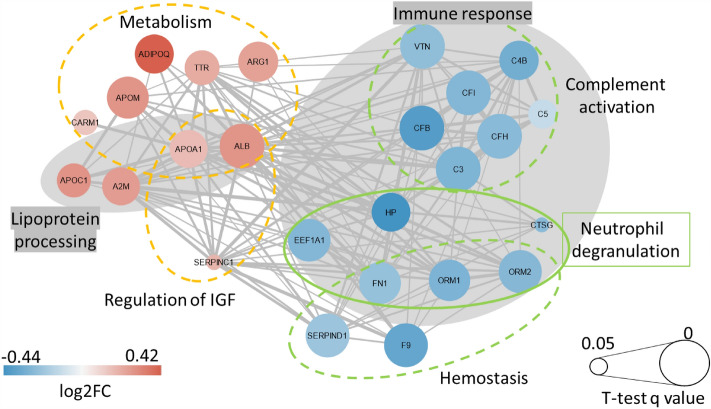
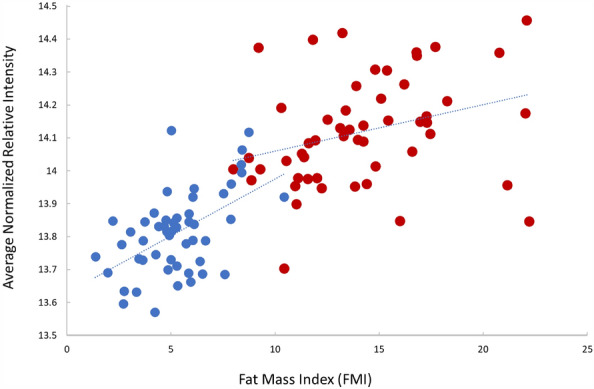
This study used untargeted proteomics to compare blood proteomic profiles in two groups of adults that differed widely in lifestyle habits. A total of 52 subjects in the lifestyle group (LIFE) (28 males, 24 females) and 52 in the control group (CON) (27 males, 25 females) participated in this cross-sectional study. Age, education level, marital status, and height did not differ significantly between LIFE and CON groups. The LIFE and CON groups differed markedly in body composition, physical activity patterns, dietary intake patterns, disease risk factor prevalence, blood measures of inflammation, triglycerides, HDL-cholesterol, glucose, and insulin, weight-adjusted leg/back and handgrip strength, and mood states. The proteomics analysis showed strong group differences for 39 of 725 proteins identified in dried blood spot samples. Of these, 18 were downregulated in the LIFE group and collectively indicated a lower innate immune activation signature. A total of 21 proteins were upregulated in the LIFE group and supported greater lipoprotein metabolism and HDL remodeling. Lifestyle-related habits and biomarkers were probed and the variance (> 50%) in proteomic profiles was best explained by group contrasts in indicators of adiposity. This cross-sectional study established that a relatively small number of proteins are associated with good lifestyle habits.
本研究采用非靶向蛋白质组学方法,比较了两组生活习惯差异很大的成年人的血液蛋白质组图谱。生活方式组(LIFE)共有52名受试者(28名男性,24名女性),对照组(CON)有52名受试者(27名男性,25名女性)参与了这项横断面研究。LIFE组和CON组在年龄、教育水平、婚姻状况和身高方面没有显著差异。LIFE组和CON组在身体成分、身体活动模式、饮食摄入模式、疾病风险因素患病率、血液炎症指标、甘油三酯、高密度脂蛋白胆固醇、葡萄糖和胰岛素、体重调整后的腿部/背部和握力以及情绪状态等方面存在明显差异。蛋白质组学分析显示,在干血斑样本中鉴定出的725种蛋白质中有39种存在显著的组间差异。其中,18种在LIFE组中下调,共同表明较低的先天免疫激活特征。LIFE组共有21种蛋白质上调,支持更高的脂蛋白代谢和高密度脂蛋白重塑。对与生活方式相关的习惯和生物标志物进行了探究,蛋白质组图谱中超过50%的差异最好由肥胖指标的组间对比来解释。这项横断面研究表明,相对少量的蛋白质与良好的生活习惯有关。