Post Eric G, Rivera Matthew J, Doss Darleesa, Eberman Lindsey E
Department of Applied Medicine and Rehabilitation Indiana State University.
College for Public Health and Social Justice Saint Louis University.
Int J Sports Phys Ther. 2023 Oct 1;18(5):1196-1205. doi: 10.26603/001c.86127. eCollection 2023.
While previous studies have examined the impact of family socioeconomic characteristics on a child's sport specialization behaviors, this research has been limited to affluent communities with limited sociodemographic diversity.
HYPOTHESIS/PURPOSE: The purpose of this study was to examine associations of parent income and education with child sport specialization behaviors among a nationally representative sample of youth sport parents in the United States.
Cross-sectional.
Parents of youth athletes in the United States (n=236, age: 39.2±8.1 years, 57.2% female) were recruited to complete an online questionnaire by Qualtrics Online Samples (Qualtrics, Provo, UT) using a combination of actively managed, double-opt-in market research panels. The questionnaire used for this study consisted of: 1) parent demographics (including parent age, race/ethnicity, biological sex, gender identity, household income, and educational status), and 2) child sport participation characteristics and sport specialization behaviors.
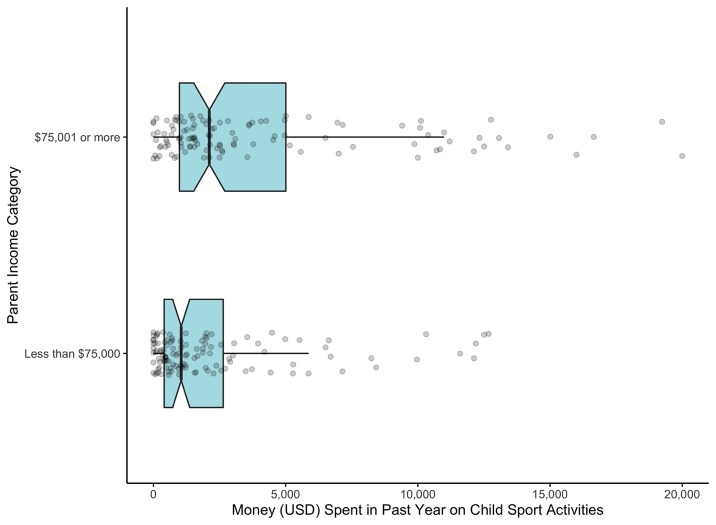
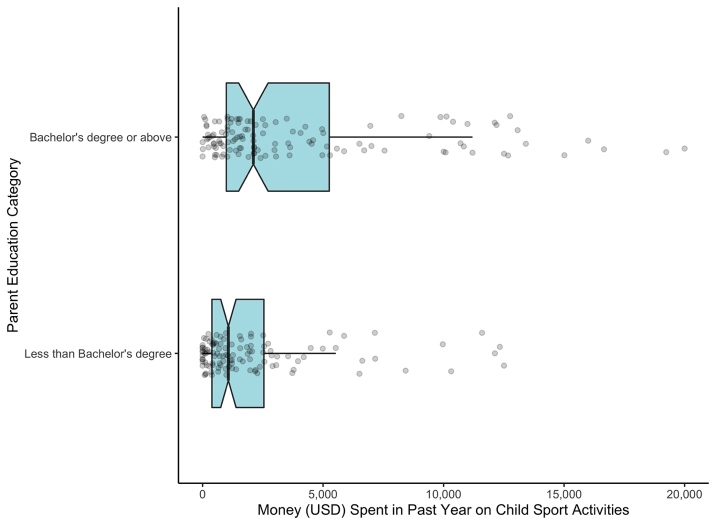
Parents who reported an annual household income of $75,001 or more were more likely than parents making less than $75,000 to report that their child participated on an organized club team (OR [95%CI]: 1.94 [1.15-3.27]), participated on multiple organized teams at the same time (OR [95%CI]: 1.85 [1.10-3.11]), or specialized in a single sport (OR [95%CI]: 2.45 [1.45-4.14]). Parents who reported receiving a Bachelor's degree or higher were more likely than parents who did not to report that their child participated on an organized club team (OR [95%CI]: 3.04 [1.78-5.18]), participated on multiple organized teams at the same time (OR [95%CI]: 2.42 [1.43-4.10]), or specialized in a single sport (OR [95%CI]: 1.94 [1.15-3.26]).
Thes results suggest that in the modern youth sport culture, family resources may serve as a major determining factor in the type of experiences available for a youth athlete.
III.
虽然先前的研究已经考察了家庭社会经济特征对儿童运动专项化行为的影响,但这些研究仅限于社会人口多样性有限的富裕社区。
假设/目的:本研究的目的是在美国全国代表性的青少年运动家长样本中,考察父母收入和教育程度与儿童运动专项化行为之间的关联。
横断面研究。
通过Qualtrics在线样本(Qualtrics,普罗沃,犹他州),利用主动管理的双重选择加入市场研究小组的组合,招募了美国青少年运动员的家长(n = 236,年龄:39.2±8.1岁,57.2%为女性)来完成一份在线问卷。本研究使用的问卷包括:1)家长人口统计学信息(包括家长年龄、种族/民族、生理性别、性别认同、家庭收入和教育程度),以及2)儿童运动参与特征和运动专项化行为。
报告家庭年收入在75,001美元或以上的家长,比年收入低于75,000美元的家长更有可能报告他们的孩子参加了有组织的俱乐部球队(比值比[95%置信区间]:1.94[1.15 - 3.27]),同时参加多个有组织的球队(比值比[95%置信区间]:1.85[1.10 - 3.11]),或专门从事一项运动(比值比[95%置信区间]:2.45[1.45 - 4.14])。报告拥有学士学位或更高学历的家长,比没有学士学位的家长更有可能报告他们的孩子参加了有组织的俱乐部球队(比值比[95%置信区间]:3.04[1.78 - 5.18]),同时参加多个有组织的球队(比值比[95%置信区间]:2.42[1.43 - 4.10]),或专门从事一项运动(比值比[95%置信区间]:1.94[1.15 - 3.26])。
这些结果表明,在现代青少年运动文化中,家庭资源可能是青少年运动员可获得的经历类型的主要决定因素。
三级。