Zhao Deqiang, Wang Yibei, Zhang Aoyu, He Jin, Gao Yibo, Chen Xiaoxiao, Jiang Lupei, Zhang Yanfeng
China Institute of Sport Science, Beijing, China.
Front Public Health. 2024 Nov 18;12:1473775. doi: 10.3389/fpubh.2024.1473775. eCollection 2024.
Health behaviors of older people are influenced by many factors, and physical activity are important lifestyle behaviors that promote healthy aging.
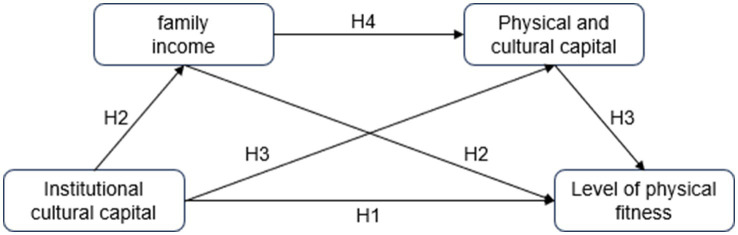
This study is to analyze the intrinsic mechanism of the influence of cultural capital on the physical fitness level of older people, and to provide a theoretical basis for the improvement of the differences in physical fitness level caused by the differences in physical fitness concepts of the classes brought about by cultural capital, and the unequal distribution of resources.
The subjects of this study were derived from people over 60 years old in the 2020 China National Fitness Activity Status Survey, and a total of 20,896 samples were obtained using the principle of multi-stage stratified random sampling. The dependent variable was assessed by the Physical Activity Rating Scale (PARS-3) to calculate the physical activity level score of the older adult population. Pearson correlation analysis and stratified regression methods were used to analyze and explore the factors influencing the physical fitness level of sport older adult people, followed by quantile regression to explore the distribution of the influence of institutional cultural capital in different physical fitness levels. The use of quantile regression not only provided a robust test of the results of stratified linear regression, but also analyzed the differential effects of institutional cultural capital among individuals with different fitness levels. Finally, Bootstrap methods were used to test the mediating effects of household income and physical cultural capital.
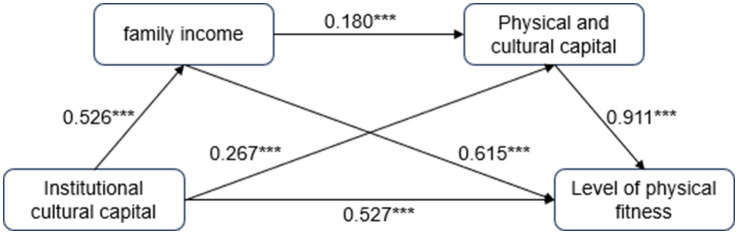
Institutional cultural capital ( < 0.01), household income ( < 0.01), physical cultural capital ( < 0.01), and health status ( < 0.01) are all conducive to improving fitness levels among older people. Family income (95%CI = [0.467, 0.235]) and material cultural capital (95%CI = [0.199, 0.291]) play a chain mediating role.
Cultural capital has a positive impact on the health of older people, mediated by household income and stocks of sporting goods. An increase in the level of cultural capital of older persons is beneficial to the improvement of health perception. Therefore, it is possible to promote the improvement of physical fitness among older people through the enhancement of their cultural capital and to realize healthy aging.
老年人的健康行为受多种因素影响,体育活动是促进健康老龄化的重要生活方式行为。
本研究旨在分析文化资本对老年人身体素质水平影响的内在机制,为改善文化资本所带来的阶层体育健身观念差异及资源分配不均导致的身体素质水平差异提供理论依据。
本研究的对象来源于2020年中国全民健身活动状况调查中60岁以上人群,采用多阶段分层随机抽样原则共获得20896个样本。通过体育活动评分量表(PARS-3)评估因变量,计算老年人群的体育活动水平得分。采用Pearson相关分析和分层回归方法分析探讨影响老年体育人群身体素质水平的因素,随后采用分位数回归探讨制度文化资本在不同身体素质水平中的影响分布。分位数回归的使用不仅对分层线性回归结果进行了稳健检验,还分析了制度文化资本在不同健康水平个体间的差异效应。最后,采用Bootstrap方法检验家庭收入和体育文化资本的中介效应。
制度文化资本(<0.01)、家庭收入(<0.01)、体育文化资本(<0.01)和健康状况(<0.01)均有助于提高老年人的身体素质水平。家庭收入(95%CI = [0.467, 0.235])和物质文化资本(95%CI = [0.199, 0.291])起链式中介作用。
文化资本对老年人的健康有积极影响,通过家庭收入和体育用品存量起中介作用。提高老年人的文化资本水平有利于健康认知的改善。因此,有可能通过增强老年人的文化资本来促进其身体素质的提高,实现健康老龄化。