Department of Molecular Medicine, Department of Neuroscience, Scripps Research Institute, La Jolla, United States.
Elife. 2023 Oct 5;12:e76465. doi: 10.7554/eLife.76465.
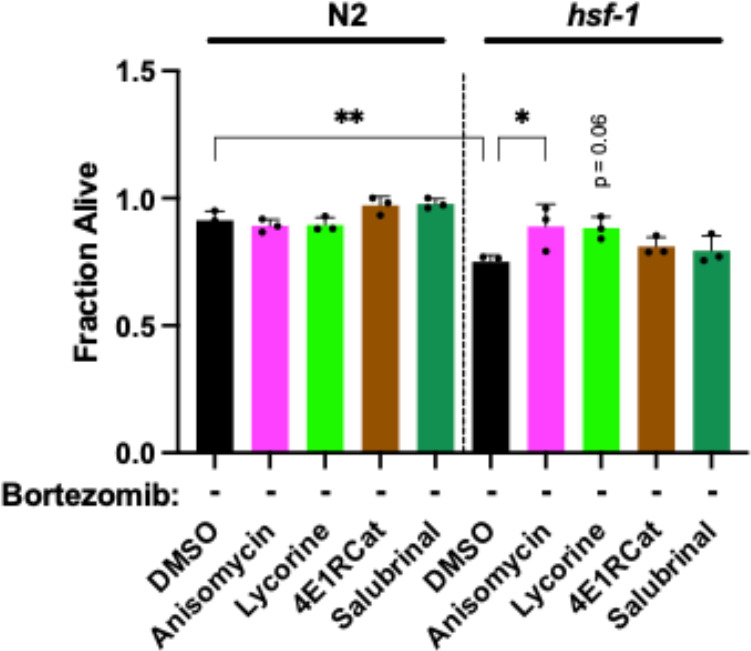
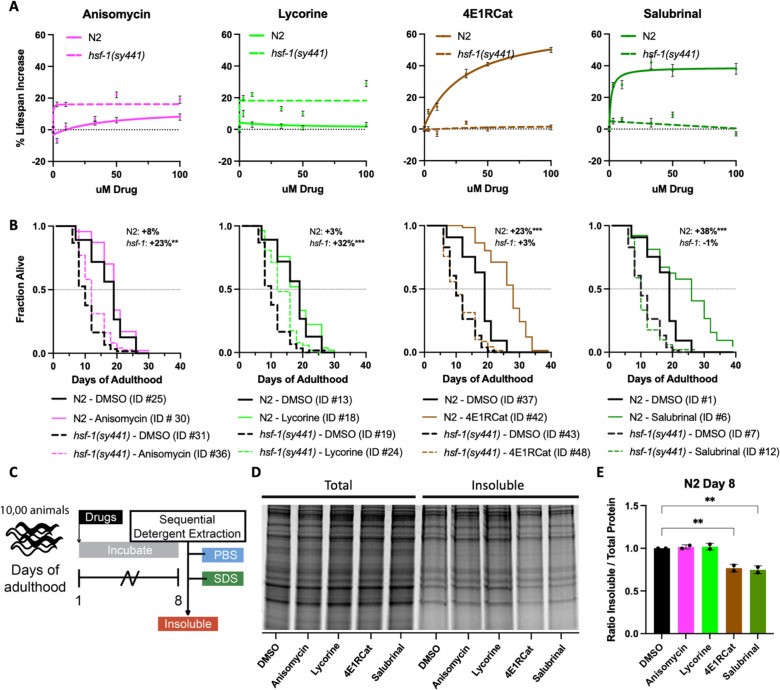
Recent work has revealed an increasingly important role for mRNA translation in maintaining proteostasis. Here, we use chemical inhibitors targeting discrete steps of translation to compare how lowering the concentration of all or only translation initiation-dependent proteins rescues from proteotoxic stress. We systematically challenge proteostasis and show that pharmacologically inhibiting translation initiation or elongation elicits a distinct protective profile. Inhibiting elongation protects from heat and proteasome dysfunction independently from HSF-1 but does not protect from age-associated protein aggregation. Conversely, inhibition of initiation protects from heat and age-associated protein aggregation and increases lifespan, dependent on , but does not protect from proteotoxicity caused by proteasome dysfunction. Surprisingly, we find that the ability of the translation initiation machinery to control the concentration of newly synthesized proteins depends on HSF-1. Inhibition of translation initiation in wild-type animals reduces the concentration of newly synthesized proteins but increases it in mutants. Our findings suggest that the HSF-1 pathway is not only a downstream target of translation but also directly cooperates with the translation initiation machinery to control the concentration of newly synthesized proteins to restore proteostasis.
最近的研究揭示了 mRNA 翻译在维持蛋白质稳态中越来越重要的作用。在这里,我们使用针对翻译离散步骤的化学抑制剂来比较降低所有或仅依赖翻译起始的蛋白质浓度如何挽救蛋白质毒性应激。我们系统地挑战蛋白质稳态,并表明药理学抑制翻译起始或延伸会产生不同的保护作用。抑制延伸可以独立于 HSF-1 保护免受热和蛋白酶体功能障碍的影响,但不能保护免受与年龄相关的蛋白质聚集。相反,抑制起始可以保护免受热和与年龄相关的蛋白质聚集,并延长寿命,依赖于 ,但不能保护免受蛋白酶体功能障碍引起的蛋白质毒性。令人惊讶的是,我们发现翻译起始机制控制新合成蛋白质浓度的能力取决于 HSF-1。在野生型动物中抑制翻译起始会降低新合成蛋白质的浓度,但在 突变体中会增加。我们的研究结果表明,HSF-1 途径不仅是翻译的下游靶点,而且还直接与翻译起始机制合作,以控制新合成蛋白质的浓度,从而恢复蛋白质稳态。