Bruyère Research Institute, Ottawa, Ontario, Canada.
Clinical Epidemiology Program, Ottawa Hospital Research Institute, Ottawa, Ontario, Canada.
JAMA Netw Open. 2023 Oct 2;6(10):e2336113. doi: 10.1001/jamanetworkopen.2023.36113.
The impact of adult-use cannabis legalization and subsequent commercialization (ie, increasing store and product access) on hospitalizations in Canada is unclear.
To examine changes in overall and subtypes of hospitalizations due to cannabis and associated factors following legalization in Canada and to compare changes between provinces.
DESIGN, SETTING, AND PARTICIPANTS: This repeated cross-sectional analysis included all acute hospitalizations for individuals aged 15 to 105 years in Canada's 4 most populous provinces (Ontario, Quebec, Alberta and British Columbia, population 26.9 million individuals in 2018). Data were obtained from routinely collected health administrative databases. Immediate and gradual changes in the age- and sex-standardized rates of hospitalizations due to cannabis were compared using an interrupted time series design over 3 time periods: prelegalization (January 2015 to September 2018), legalization with product and store restrictions (October 2018 to February 2020), and commercialization, which overlapped with the COVID-19 pandemic (March 2020 to March 2021).
Rates of hospitalizations due to cannabis per 100 000 individuals and per 1000 all-cause hospital admissions.
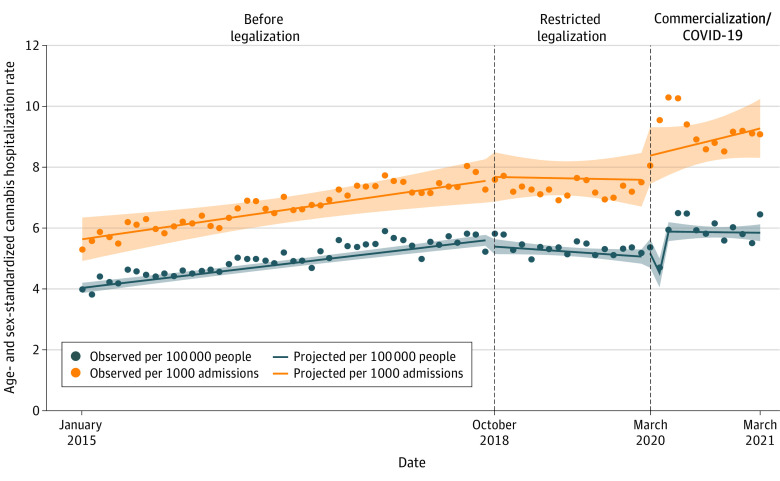
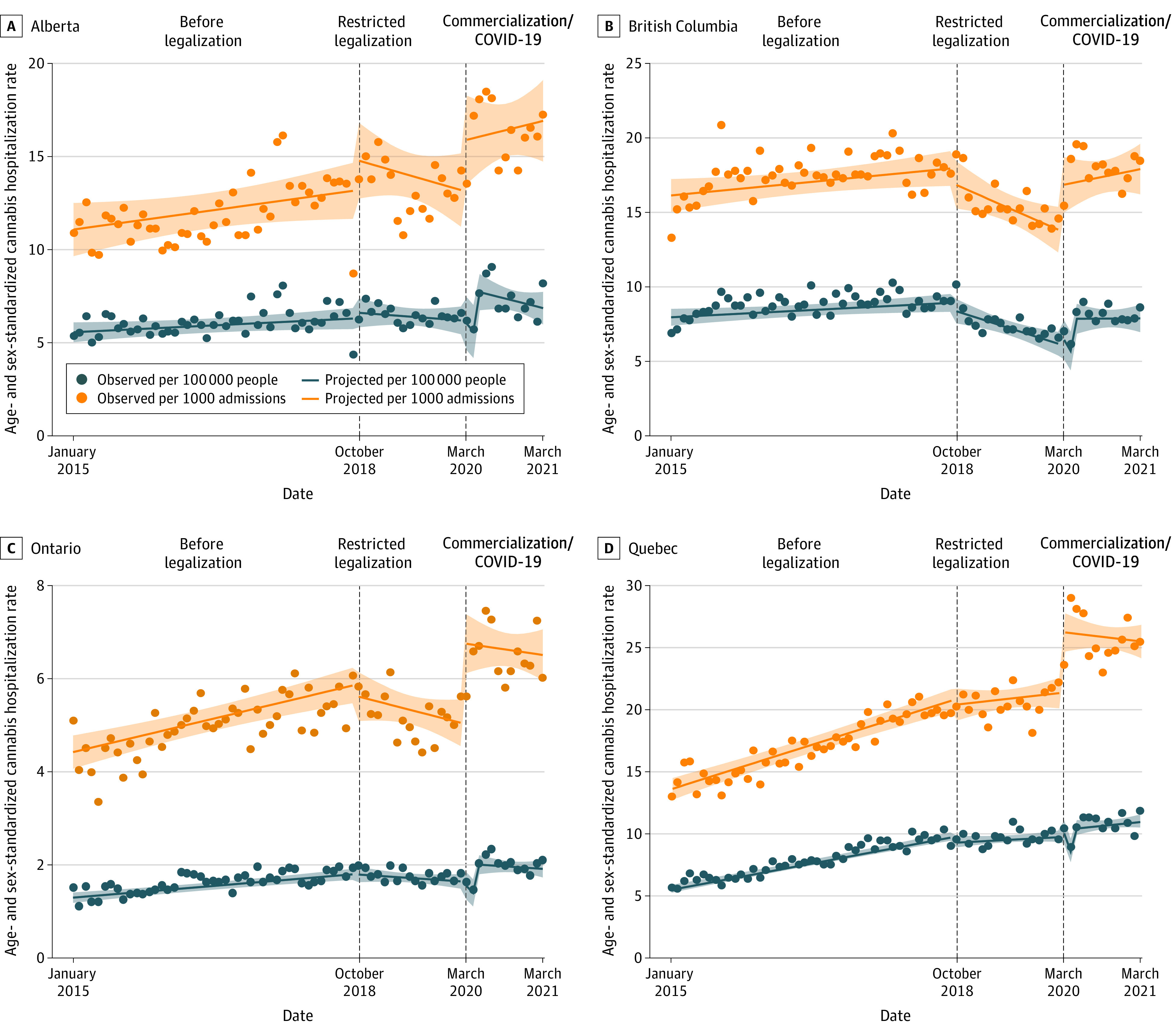
There were 105 203 hospitalizations due to cannabis over the 7-year study period, 69 192 of which (65.8%) were among male individuals, and 34 678 (33%) of which were among individuals aged 15 to 24 years. Overall, the age- and sex-standardized rate of hospitalizations increased 1.62 times between January 2015 (3.99 per 100 000 individuals) and March 2021 (6.46 per 100 000 individuals). The largest relative increase in hospitalizations was for cannabis-induced psychosis (rate ratio, 1.40; 95% CI, 1.34 to 1.47 during the commercialization period relative to the prelegalization period). Nationally, legalization with restrictions was associated with a gradual monthly decrease of -0.06 (95% CI -0.08 to -0.03) in hospitalizations due to cannabis per 100 000 individuals. Commercialization and the COVID-19 pandemic were associated with an immediate increase of 0.83 (95% CI, 0.30 to 1.30) hospitalizations due to cannabis per 100 000 individuals. There was provincial variation in changes, with provinces with less mature legal markets experiencing the greatest declines immediately following legalization.
This cross-sectional study found that legalization with restrictions was not associated with an increase in hospitalizations due to cannabis but commercialization was. The findings suggest that commercialization of cannabis may be associated with increases in cannabis-related health harms, including cannabis-induced psychosis.
成人使用大麻合法化及其随后的商业化(即增加商店和产品的可获得性)对加拿大住院治疗的影响尚不清楚。
在加拿大合法化后,检查因大麻而导致的总体和亚型住院治疗的变化以及相关因素,并比较各省之间的变化。
设计、地点和参与者:这项重复的横截面分析包括加拿大四个人口最多的省份(安大略省、魁北克省、艾伯塔省和不列颠哥伦比亚省,2018 年人口为 2690 万人)15 至 105 岁的所有急性住院患者。数据来自常规收集的健康管理数据库。使用中断时间序列设计,在三个时间段内比较因大麻而导致的住院治疗的年龄和性别标准化率的即时和逐渐变化:合法化前(2015 年 1 月至 2018 年 9 月)、有产品和商店限制的合法化(2018 年 10 月至 2020 年 2 月)以及商业合法化,这与 COVID-19 大流行同时发生(2020 年 3 月至 2021 年 3 月)。
每 100000 人因大麻住院的人数和每 1000 人因所有原因住院的人数。
在 7 年的研究期间,共有 105203 例因大麻住院的病例,其中 69192 例(65.8%)为男性,34678 例(33%)为 15 至 24 岁的人群。总体而言,2015 年 1 月(每 100000 人 3.99 人)和 2021 年 3 月(每 100000 人 6.46 人)之间,因大麻而住院的年龄和性别标准化率增加了 1.62 倍。因大麻引起的精神病住院的相对增幅最大(比率,1.40;95%CI,1.34 至 1.47 在商业化期间相对于合法化前期间)。在全国范围内,限制条件下的合法化与每 100000 人因大麻住院人数每月逐渐减少 0.06(95%CI,0.08 至 0.03)有关。商业化和 COVID-19 大流行与每 100000 人因大麻住院人数立即增加 0.83(95%CI,0.30 至 1.30)有关。各省之间存在变化,合法市场不够成熟的省份在合法化后立即出现最大幅度的下降。
这项横截面研究发现,限制条件下的合法化并没有导致因大麻而导致的住院治疗增加,但商业化确实如此。研究结果表明,大麻的商业化可能与大麻相关的健康危害增加有关,包括大麻引起的精神病。