Imtiaz Sameer, Nigatu Yeshambel T, Ali Farihah, Elton-Marshall Tara, Rehm Jürgen, Rueda Sergio, Hamilton Hayley A
Institute for Mental Health Policy Research, Centre for Addiction and Mental Health, 33 Russell Street, Toronto, Ontario M5S 2S1, Canada.
School of Epidemiology and Public Health, Faculty of Medicine, University of Ottawa, 600 Peter Morand Crescent, Ottawa, Ontario K1G 5Z3, Canada.
Prev Med Rep. 2024 Jun 22;44:102805. doi: 10.1016/j.pmedr.2024.102805. eCollection 2024 Aug.
We characterized trends in medical cannabis use; examined characteristics associated with medical cannabis use without medical authorization; and examined the association between recreational cannabis legalization and medical cannabis use in Ontario, Canada.
Data were from a repeated, population-based, cross-sectional survey of adults (N = 19,543; 2014-2019). Cannabis use was categorized as either medical cannabis use, recreational cannabis use or no cannabis use. The analytical strategy included jointpoint regression, logistic regression and multinomial logistic regression.
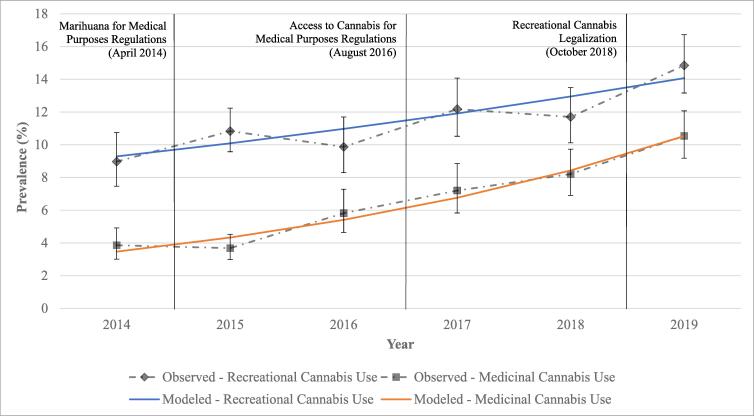
Medical cannabis use increased from 4 % to 11 % (Annual Percentage Change [APC]: 25 %, 95 % Confidence Interval [CI]: 17 %-33 %) and recreational cannabis use increased from 9 % to 15 % (APC: 9 %, 95 % CI: 3 %-15 %) between 2014 and 2019. Being 18 to 29 years old compared with being 65+ years old was associated with an increased likelihood of medical cannabis use without medical authorization (Odds Ratio [OR]: 4.05, 95 % CI: 2.12-7.72), while being of fair or poor self-perceived health compared with excellent, very good or good self-perceived health (OR: 0.61, 95 % CI: 0.40-0.95) was associated with a decreased likelihood of medical cannabis use without medical authorization. Recreational cannabis legalization was associated with an increased likelihood of medical cannabis use compared with no cannabis use (OR: 1.48, 95 % CI: 1.19-1.85) and of recreational cannabis use compared with no cannabis use (OR: 1.35, 95 % CI: 1.11-1.65).
Although medical cannabis use increased, it was largely used without medical authorization. Guidance and education that encourages medical usage under clinical supervision is recommended, and mitigation of known barriers to medical cannabis authorization.
我们描述了医用大麻使用的趋势;研究了未经医学授权使用医用大麻的相关特征;并考察了加拿大安大略省娱乐用大麻合法化与医用大麻使用之间的关联。
数据来自一项针对成年人的重复、基于人群的横断面调查(N = 19543;2014 - 2019年)。大麻使用被分类为医用大麻使用、娱乐用大麻使用或不使用大麻。分析策略包括连接点回归、逻辑回归和多项逻辑回归。
2014年至2019年间,医用大麻使用从4%增至11%(年度百分比变化[APC]:25%,95%置信区间[CI]:17% - 33%),娱乐用大麻使用从9%增至15%(APC:9%,95% CI:3% - 15%)。与65岁及以上人群相比,18至29岁人群未经医学授权使用医用大麻的可能性增加(优势比[OR]:4.05,95% CI:2.12 - 7.72),而与自我感觉健康状况极佳、非常好或良好的人群相比,自我感觉健康状况一般或较差的人群未经医学授权使用医用大麻的可能性降低(OR:0.61,95% CI:0.40 - 0.95)。与不使用大麻相比,娱乐用大麻合法化与使用医用大麻的可能性增加相关(OR:1.48,95% CI:1.19 - 1.85),与使用娱乐用大麻的可能性增加相关(OR:1.35,95% CI:1.11 - 1.65)。
尽管医用大麻使用有所增加,但很大一部分是在未经医学授权的情况下使用的。建议提供鼓励在临床监督下进行医用的指导和教育,并减轻医用大麻授权方面已知的障碍。