Department of Neuroscience, Psychology, Drug Research and Child Health, University of Florence, Florence, Italy.
Research and Innovation Centre for Dementia-CRIDEM, Azienda Ospedaliero-Universitaria Careggi, Florence, Italy.
Eur J Neurol. 2024 Jan;31(1):e16089. doi: 10.1111/ene.16089. Epub 2023 Oct 5.
We aimed to evaluate the accuracy of plasma neurofilament light chain (NfL) in predicting Alzheimer's disease (AD) and the progression of cognitive decline in patients with subjective cognitive decline (SCD) and mild cognitive impairment (MCI).
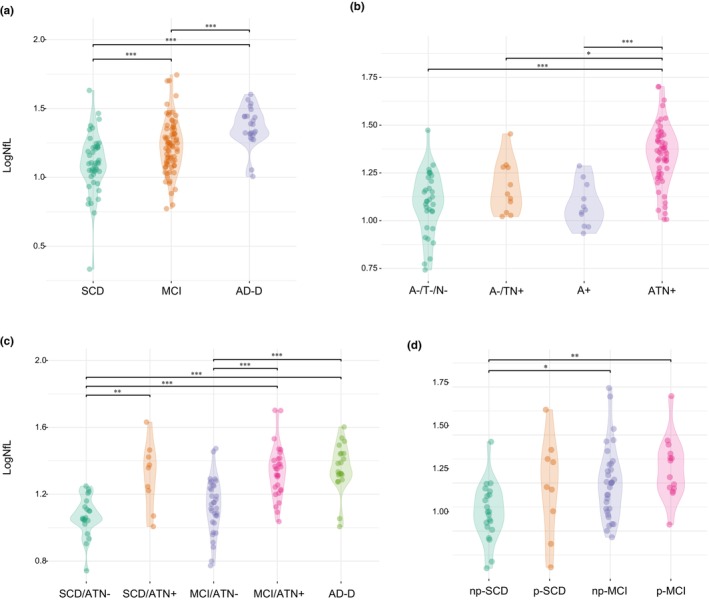
This longitudinal cohort study involved 140 patients (45 with SCD, 73 with MCI, and 22 with AD dementia [AD-D]) who underwent plasma NfL and AD biomarker assessments (cerebrospinal fluid, amyloid positron emission tomography [PET], and F-fluorodeoxyglucose-PET) at baseline. The patients were rated according to the amyloid/tau/neurodegeneration (A/T/N) system and followed up for a mean time of 2.72 ± 0.95 years to detect progression from SCD to MCI and from MCI to AD. Forty-eight patients (19 SCD, 29 MCI) also underwent plasma NfL measurements 2 years after baseline.
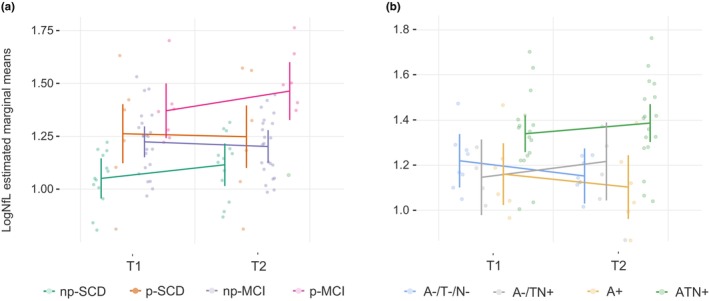
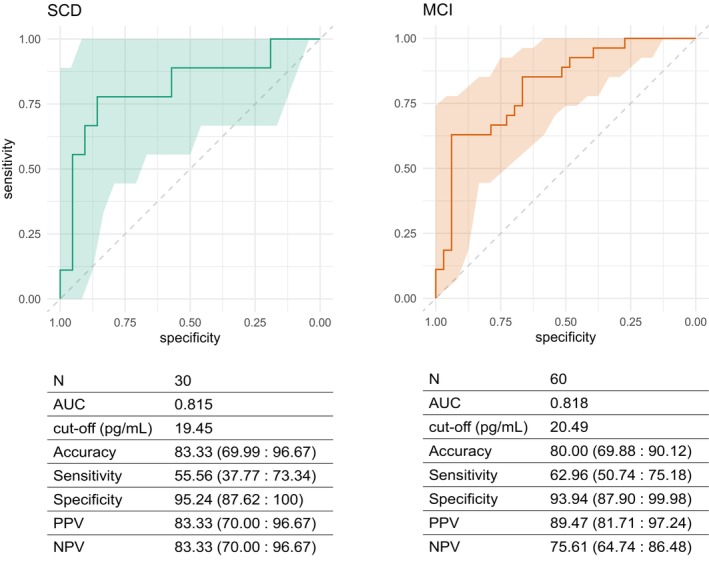
At baseline, plasma NfL detected patients with biomarker profiles consistent with AD (A+/T+/N+ or A+/T+/N-) with high accuracy (area under the curve [AUC] 0.82). We identified cut-off values of 19.45 pg/mL for SCD and 20.45 pg/mL for MCI. During follow-up, nine SCD patients progressed to MCI (progressive SCD [p-SCD]), and 14 MCI patients developed AD dementia (progressive MCI [p-MCI]). The previously identified cut-off values provided good accuracy in identifying p-SCD (80% [95% confidence interval 65.69: 94.31]). The rate of NfL change was higher in p-MCI (3.52 ± 4.06 pg/mL) compared to non-progressive SCD (0.81 ± 1.25 pg/mL) and non-progressive MCI (-0.13 ± 3.24 pg/mL) patients. A rate of change lower than 1.64 pg/mL per year accurately excluded progression from MCI to AD (AUC 0.954).
Plasma NfL concentration and change over time may be a reliable, non-invasive tool to detect AD and the progression of cognitive decline at the earliest stages of the disease.
本研究旨在评估血浆神经丝轻链(NfL)在预测主观认知下降(SCD)和轻度认知障碍(MCI)患者发生阿尔茨海默病(AD)和认知下降进展中的准确性。
这是一项纵向队列研究,共纳入 140 名患者(45 名 SCD、73 名 MCI 和 22 名 AD 痴呆[AD-D]),他们在基线时接受了血浆 NfL 和 AD 生物标志物评估(脑脊液、淀粉样蛋白正电子发射断层扫描[PET]和 F-氟脱氧葡萄糖-PET)。根据淀粉样蛋白/tau/神经退行性变(A/T/N)系统对患者进行评分,并平均随访 2.72±0.95 年,以检测 SCD 向 MCI 和 MCI 向 AD 的进展。48 名患者(19 名 SCD、29 名 MCI)还在基线后 2 年进行了血浆 NfL 测量。
基线时,血浆 NfL 对具有 AD 生物标志物特征的患者(A+/T+/N+或 A+/T+/N-)具有较高的准确性(曲线下面积[AUC]0.82)。我们确定了 SCD 的 19.45pg/mL 和 MCI 的 20.45pg/mL 的截断值。随访期间,9 名 SCD 患者进展为 MCI(进展性 SCD[p-SCD]),14 名 MCI 患者发展为 AD 痴呆(进展性 MCI[p-MCI])。之前确定的截断值在识别 p-SCD 方面具有较好的准确性(80%[95%置信区间 65.69:94.31])。p-MCI 患者的 NfL 变化率较高(3.52±4.06pg/mL),而 p-SCD 患者(0.81±1.25pg/mL)和非进展性 MCI 患者(-0.13±3.24pg/mL)则较低。每年低于 1.64pg/mL 的变化率可准确排除 MCI 向 AD 的进展(AUC 0.954)。
血浆 NfL 浓度及其随时间的变化可能是一种可靠的、非侵入性的工具,可在疾病的最早阶段检测 AD 和认知下降的进展。