Department of Radiology and Nuclear Medicine, University Medical Center Mannheim, Heidelberg University, Theodor-Kutzer-Ufer 1-3, 68167, Mannheim, Germany.
German Cancer Research Center, E010 Radiology, Im Neuenheimer Feld 280, 69120, Heidelberg, Germany.
Cancer Imaging. 2023 Oct 5;23(1):95. doi: 10.1186/s40644-023-00612-4.
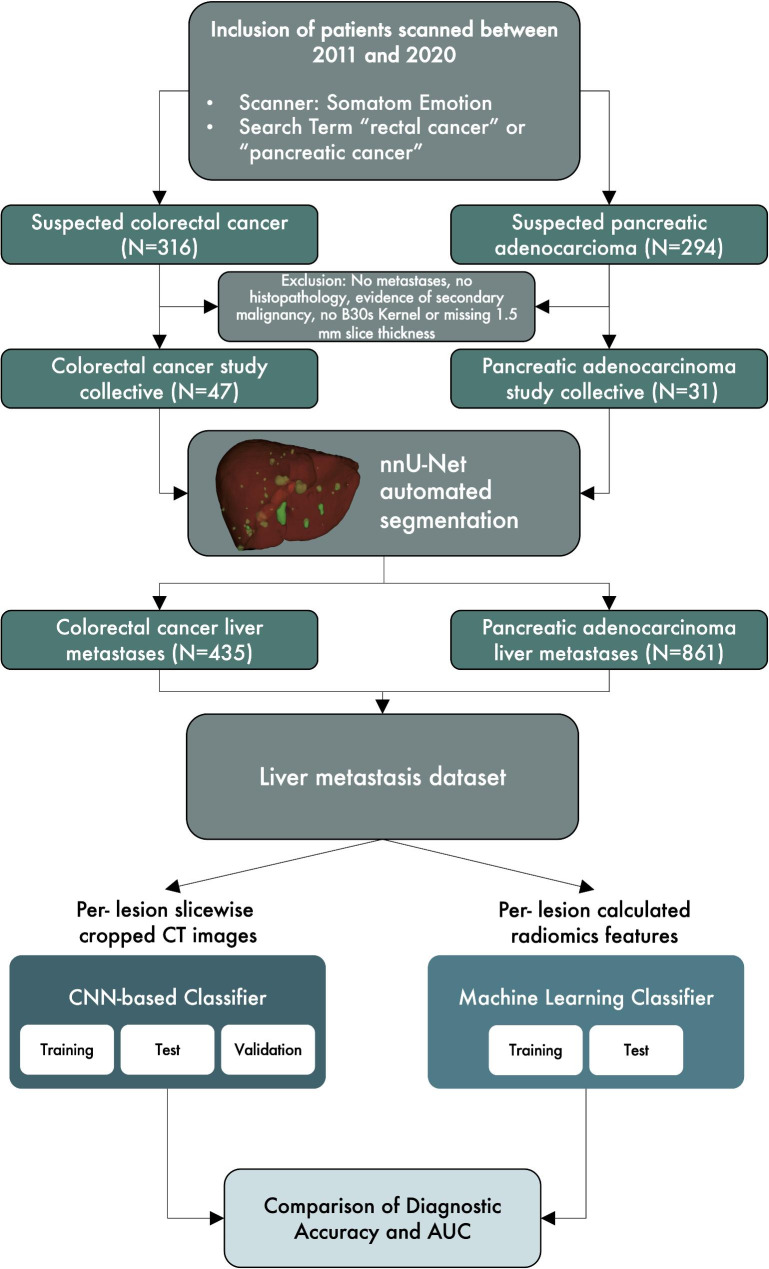
The goal of this study is to demonstrate the performance of radiomics and CNN-based classifiers in determining the primary origin of gastrointestinal liver metastases for visually indistinguishable lesions.
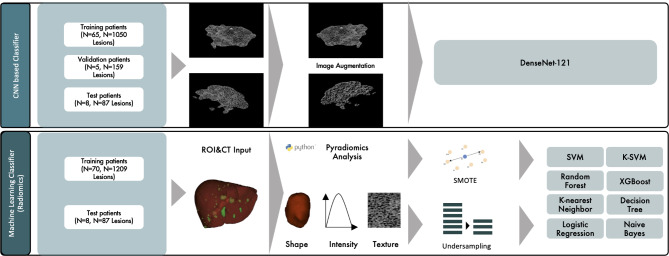
In this retrospective, IRB-approved study, 31 pancreatic cancer patients with 861 lesions (median age [IQR]: 65.39 [56.87, 75.08], 48.4% male) and 47 colorectal cancer patients with 435 lesions (median age [IQR]: 65.79 [56.99, 74.62], 63.8% male) were enrolled. A pretrained nnU-Net performed automated segmentation of 1296 liver lesions. Radiomics features for each lesion were extracted using pyradiomics. The performance of several radiomics-based machine-learning classifiers was investigated for the lesions and compared to an image-based deep-learning approach using a DenseNet-121. The performance was evaluated by AUC/ROC analysis.
The radiomics-based K-nearest neighbor classifier showed the best performance on an independent test set with AUC values of 0.87 and an accuracy of 0.67. In comparison, the image-based DenseNet-121-classifier reached an AUC of 0.80 and an accuracy of 0.83.
CT-based radiomics and deep learning can distinguish the etiology of liver metastases from gastrointestinal primary tumors. Compared to deep learning, radiomics based models showed a varying generalizability in distinguishing liver metastases from colorectal cancer and pancreatic adenocarcinoma.
本研究旨在展示基于放射组学和 CNN 的分类器在确定视觉上无法区分的胃肠道肝转移病灶的原发来源方面的性能。
在这项回顾性的、经 IRB 批准的研究中,纳入了 31 名胰腺癌患者的 861 个病灶(中位年龄 [IQR]:65.39 [56.87,75.08],48.4%为男性)和 47 名结直肠癌患者的 435 个病灶(中位年龄 [IQR]:65.79 [56.99,74.62],63.8%为男性)。预训练的 nnU-Net 对 1296 个肝脏病变进行了自动分割。使用 pyradiomics 提取每个病变的放射组学特征。研究了几种基于放射组学的机器学习分类器在病变中的性能,并与基于 DenseNet-121 的图像深度学习方法进行了比较。通过 AUC/ROC 分析评估了性能。
基于放射组学的 K-最近邻分类器在独立测试集上表现最佳,AUC 值为 0.87,准确率为 0.67。相比之下,基于图像的 DenseNet-121 分类器达到了 0.80 的 AUC 和 0.83 的准确率。
基于 CT 的放射组学和深度学习可以区分胃肠道原发肿瘤和肝转移瘤的病因。与深度学习相比,基于放射组学的模型在区分结直肠癌和胰腺腺癌肝转移瘤方面表现出不同的泛化能力。