Sokol Deborah K, Lahiri Debomoy K
Department of Neurology, Section of Pediatrics, Indiana University School of Medicine, Indianapolis, IN, United States.
Department of Psychiatry, Indiana University School of Medicine, Indianapolis, IN, United States.
Front Mol Neurosci. 2023 Sep 20;16:1201744. doi: 10.3389/fnmol.2023.1201744. eCollection 2023.
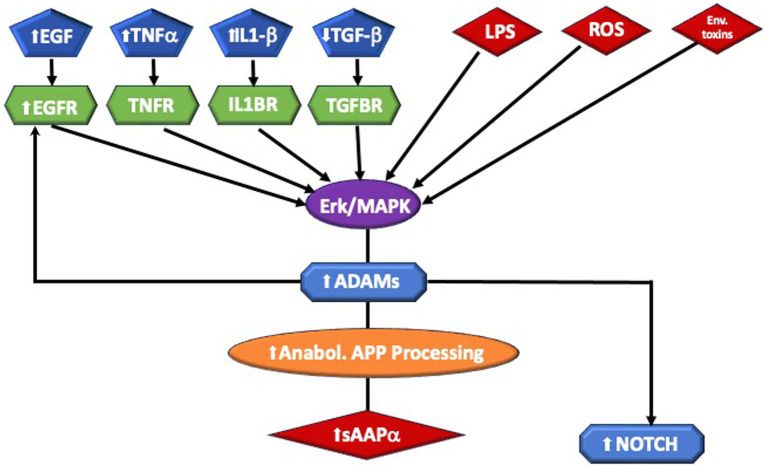
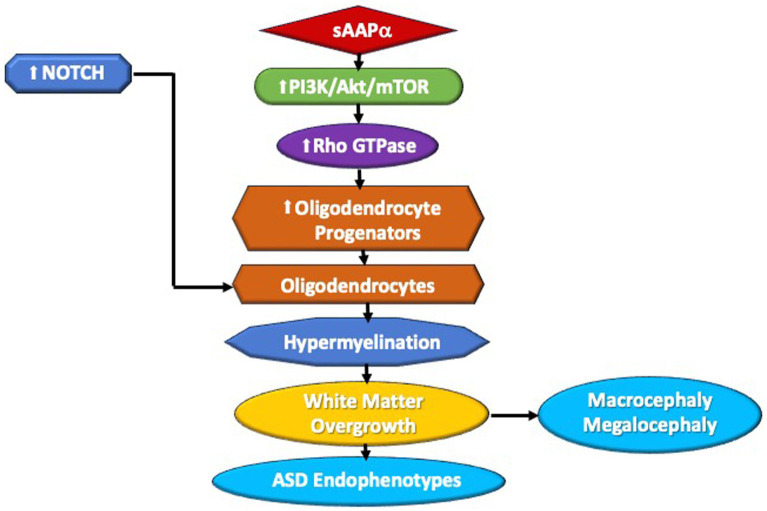
Metabolites of the Amyloid-β precursor protein (APP) proteolysis may underlie brain overgrowth in Autism Spectrum Disorder (ASD). We have found elevated APP metabolites (total APP, secreted (s) APPα, and α-secretase adamalysins in the plasma and brain tissue of children with ASD). In this review, we highlight several lines of evidence supporting APP metabolites' potential contribution to macrocephaly in ASD. First, APP appears early in corticogenesis, placing APP in a prime position to accelerate growth in neurons and glia. APP metabolites are upregulated in neuroinflammation, another potential contributor to excessive brain growth in ASD. APP metabolites appear to directly affect translational signaling pathways, which have been linked to single gene forms of syndromic ASD (Fragile X Syndrome, PTEN, Tuberous Sclerosis Complex). Finally, APP metabolites, and microRNA, which regulates APP expression, may contribute to ASD brain overgrowth, particularly increased white matter, through ERK receptor activation on the PI3K/Akt/mTOR/Rho GTPase pathway, favoring myelination.
淀粉样前体蛋白(APP)蛋白水解产物的代谢物可能是自闭症谱系障碍(ASD)中大脑过度生长的潜在原因。我们发现,患有ASD的儿童的血浆和脑组织中APP代谢物(总APP、分泌型(s)APPα和α-分泌酶解整合素金属蛋白酶)水平升高。在这篇综述中,我们重点介绍了几条证据,支持APP代谢物对ASD患儿巨头症的潜在影响。首先,APP在皮质发生早期出现,使其处于加速神经元和神经胶质细胞生长的首要位置。APP代谢物在神经炎症中上调,而神经炎症是ASD中大脑过度生长的另一个潜在因素。APP代谢物似乎直接影响翻译信号通路,而这些信号通路与综合征性ASD(脆性X综合征、PTEN、结节性硬化症复合体)的单基因形式有关。最后,APP代谢物以及调节APP表达的微小RNA,可能通过PI3K/Akt/mTOR/Rho GTPase途径上的ERK受体激活,促进髓鞘形成,从而导致ASD患者大脑过度生长,尤其是白质增加。