Orhan Kaan, Aktuna Belgin Ceren, Manulis David, Golitsyna Maria, Bayrak Seval, Aksoy Secil, Sanders Alex, Önder Merve, Ezhov Matvey, Shamshiev Mamat, Gusarev Maxim, Shlenskii Vladislav
Department of Dentomaxillofacial Radiology, Faculty of Dentistry, Ankara University, Ankara, Turkey.
Department of Dentomaxillofacial Radiology, Faculty of Dentistry, Hatay Mustafa Kemal University, Hatay, Turkey.
Imaging Sci Dent. 2023 Sep;53(3):199-208. doi: 10.5624/isd.20230109. Epub 2023 Aug 2.
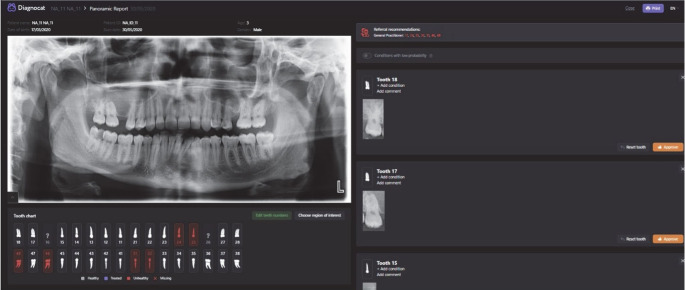
The objective of this study was to evaluate the accuracy and effectiveness of an artificial intelligence (AI) program in identifying dental conditions using panoramic radiographs (PRs), as well as to assess the appropriateness of its treatment recommendations.
PRs from 100 patients (representing 4497 teeth) with known clinical examination findings were randomly selected from a university database. Three dentomaxillofacial radiologists and the Diagnocat AI software evaluated these PRs. The evaluations were focused on various dental conditions and treatments, including canal filling, caries, cast post and core, dental calculus, fillings, furcation lesions, implants, lack of interproximal tooth contact, open margins, overhangs, periapical lesions, periodontal bone loss, short fillings, voids in root fillings, overfillings, pontics, root fragments, impacted teeth, artificial crowns, missing teeth, and healthy teeth.
The AI demonstrated almost perfect agreement (exceeding 0.81) in most of the assessments when compared to the ground truth. The sensitivity was very high (above 0.8) for the evaluation of healthy teeth, artificial crowns, dental calculus, missing teeth, fillings, lack of interproximal contact, periodontal bone loss, and implants. However, the sensitivity was low for the assessment of caries, periapical lesions, pontic voids in the root canal, and overhangs.
Despite the limitations of this study, the synthesized data suggest that AI-based decision support systems can serve as a valuable tool in detecting dental conditions, when used with PR for clinical dental applications.
本研究的目的是评估一种人工智能(AI)程序在使用全景X线片(PR)识别牙齿状况方面的准确性和有效性,并评估其治疗建议的合理性。
从一所大学数据库中随机选取100例有已知临床检查结果的患者的PR(代表4497颗牙齿)。三名口腔颌面放射科医生和Diagnocat AI软件对这些PR进行评估。评估集中在各种牙齿状况和治疗方面,包括根管充填、龋齿、铸造桩核、牙结石、充填物、根分叉病变、种植体、邻牙间接触缺失、边缘开放、悬突、根尖周病变、牙周骨丧失、短充填物、根管充填中的空隙、超充、桥体、牙根碎片、阻生牙、人工牙冠、缺失牙和健康牙齿。
与真实情况相比,AI在大多数评估中显示出几乎完美的一致性(超过0.81)。在评估健康牙齿、人工牙冠、牙结石、缺失牙、充填物、邻牙间接触缺失、牙周骨丧失和种植体时,敏感性非常高(高于0.8)。然而,在评估龋齿、根尖周病变、根管桥体空隙和悬突时,敏感性较低。
尽管本研究存在局限性,但综合数据表明,基于AI的决策支持系统在与PR一起用于临床牙科应用时,可作为检测牙齿状况的有价值工具。