Easwaran Sreesankar, Montell Denise J
Molecular, Cellular, and Developmental Biology Department, University of California, Santa Barbara, CA 93106, U.S.A.
Biochem Soc Trans. 2023 Oct 31;51(5):1847-1856. doi: 10.1042/BST20221431.
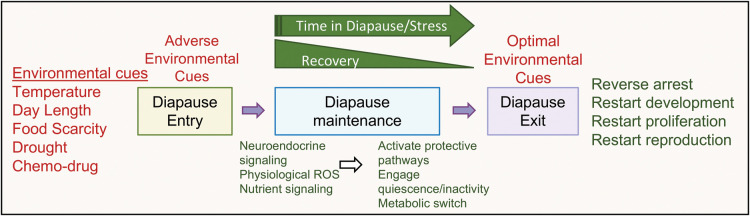
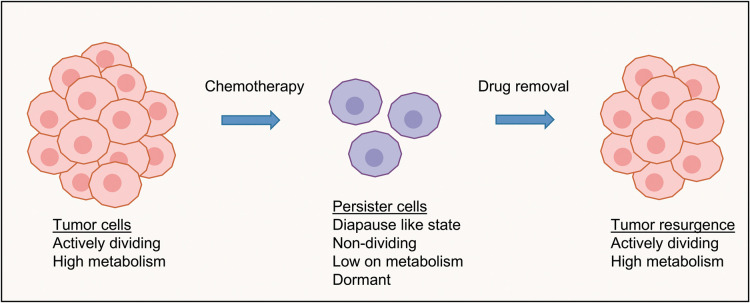
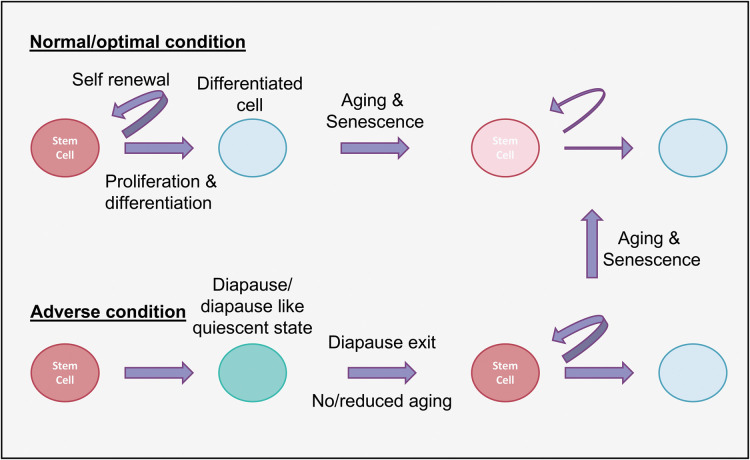
Diapause is a protective mechanism that many organisms deploy to overcome environmental adversities. Diapause extends lifespan and fertility to enhance the reproductive success and survival of the species. Although diapause states have been known and employed for commercial purposes, for example in the silk industry, detailed molecular and cell biological studies are an exciting frontier. Understanding diapause-like protective mechanisms will shed light on pathways that steer organisms through adverse conditions. One hope is that an understanding of the mechanisms that support diapause might be leveraged to extend the lifespan and/or health span of humans as well as species threatened by climate change. In addition, recent findings suggest that cancer cells that persist after treatment mimic diapause-like states, implying that these programs may facilitate cancer cell survival from chemotherapy and cause relapse. Here, we review the molecular mechanisms underlying diapause programs in a variety of organisms, and we discuss pathways supporting diapause-like states in tumor persister cells.
滞育是许多生物体用来克服环境逆境的一种保护机制。滞育可延长寿命和生育能力,以提高物种的繁殖成功率和生存率。尽管滞育状态已为人所知并用于商业目的,例如在丝绸行业,但详细的分子和细胞生物学研究仍是一个令人兴奋的前沿领域。了解类似滞育的保护机制将有助于揭示引导生物体度过不利条件的途径。一个希望是,对支持滞育的机制的理解可能会被用来延长人类以及受气候变化威胁的物种的寿命和/或健康寿命。此外,最近的研究结果表明,治疗后持续存在的癌细胞模拟类似滞育的状态,这意味着这些程序可能有助于癌细胞在化疗后存活并导致复发。在这里,我们回顾了多种生物体中滞育程序的分子机制,并讨论了肿瘤持续细胞中支持类似滞育状态的途径。