Division of Infectious Diseases, Department of Medicine, Stanford University, Stanford, CA, USA.
Virology Unit, Institut Pasteur du Cambodge, Pasteur Network, Phnom Penh, Cambodia.
J Gen Virol. 2023 Oct;104(10). doi: 10.1099/jgv.0.001898.
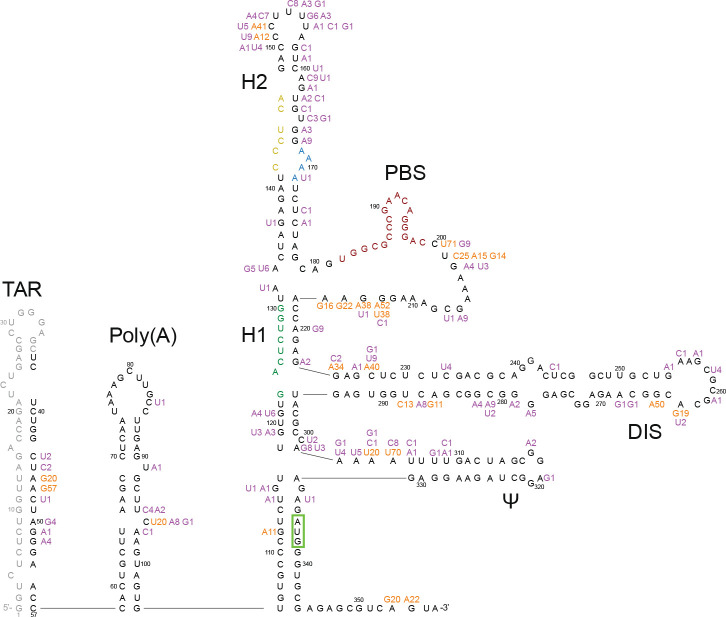
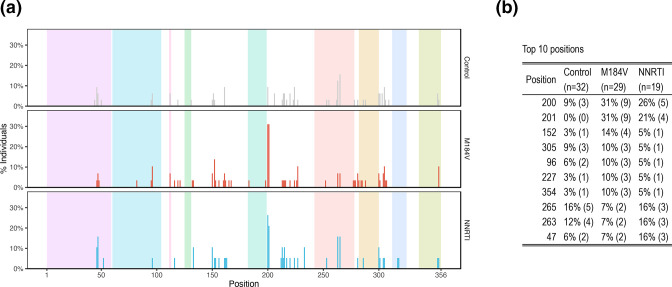
Human immunodeficiency virus 1 (HIV-1) reverse transcriptase (RT) initiation depends on interaction between viral 5'-leader RNA, RT and host tRNA3. Therefore, we sought to identify co-evolutionary changes between the 5'-leader and RT in viruses developing RT-inhibitor resistance mutations. We sequenced 5'-leader positions 37-356 of paired plasma virus samples from 29 individuals developing the nucleoside RT inhibitor (NRTI)-resistance mutation M184V, 19 developing a non-nucleoside RT inhibitor (NNRTI)-resistance mutation and 32 untreated controls. 5'-Leader variants were defined as positions where ≥20 % of next-generation sequencing (NGS) reads differed from the HXB2 sequence. Emergent mutations were defined as nucleotides undergoing a ≥4-fold change in proportion between baseline and follow-up. Mixtures were defined as positions containing ≥2 nucleotides each present in ≥20 % of NGS reads. Among 80 baseline sequences, 87 positions (27.2 %) contained a variant; 52 contained a mixture. Position 201 was the only position more likely to develop a mutation in the M184V (9/29 vs 0/32; =0.0006) or NNRTI-resistance (4/19 vs 0/32; =0.02; Fisher's exact test) groups than the control group. Mixtures at positions 200 and 201 occurred in 45.0 and 28.8 %, respectively, of baseline samples. Because of the high proportion of mixtures at these positions, we analysed 5'-leader mixture frequencies in two additional datasets: five publications reporting 294 dideoxyterminator clonal GenBank sequences from 42 individuals and six National Center for Biotechnology Information (NCBI) BioProjects reporting NGS datasets from 295 individuals. These analyses demonstrated position 200 and 201 mixtures at proportions similar to those in our samples and at frequencies several times higher than at all other 5'-leader positions. Although we did not convincingly document co-evolutionary changes between RT and 5'-leader sequences, we identified a novel phenomenon, wherein positions 200 and 201 immediately downstream of the HIV-1 primer binding site exhibited an extraordinarily high likelihood of containing a nucleotide mixture. Possible explanations for the high mixture rates are that these positions are particularly error-prone or provide a viral fitness advantage.
人类免疫缺陷病毒 1(HIV-1)逆转录酶(RT)的起始取决于病毒 5'-leader RNA、RT 和宿主 tRNA3 之间的相互作用。因此,我们试图确定在发生 RT 抑制剂耐药突变的病毒中 5'-leader 和 RT 之间的共同进化变化。我们对 29 名个体的血浆病毒样本进行了配对测序,这些个体分别发生了核苷逆转录酶抑制剂(NRTI)耐药突变 M184V、19 名发生了非核苷逆转录酶抑制剂(NNRTI)耐药突变和 32 名未治疗对照。5'-leader 变体定义为下一个 20%的下一代测序(NGS)读片与 HXB2 序列不同的位置。出现的突变定义为在基线和随访之间比例发生≥4 倍变化的核苷酸。混合物定义为每个位置包含≥2 个核苷酸,这些核苷酸在≥20%的 NGS 读片中存在。在 80 个基线序列中,87 个位置(27.2%)包含一个变体;52 个包含一个混合物。位置 201 是唯一一个在 M184V(9/29 与 0/32;=0.0006)或 NNRTI 耐药组(4/19 与 0/32;=0.02;Fisher 精确检验)中比对照组更有可能发生突变的位置(9/29 与 0/32;=0.0006)。在基线样本中,200 和 201 位置的混合物分别占 45.0%和 28.8%。由于这些位置的混合物比例很高,我们在另外两个数据集分析了 5'-leader 混合物频率:五项出版物报告了来自 42 名个体的 294 个双脱氧终止子克隆 GenBank 序列,六项国家生物技术信息中心(NCBI)BioProjects 报告了来自 295 名个体的 NGS 数据集。这些分析表明,位置 200 和 201 的混合物比例与我们样本中的比例相似,频率比其他所有 5'-leader 位置高几倍。尽管我们没有令人信服地证明 RT 和 5'-leader 序列之间的共同进化变化,但我们发现了一个新现象,即在 HIV-1 引物结合位点下游的位置 200 和 201 特别有可能包含核苷酸混合物。高混合物率的可能解释是这些位置特别容易出错或提供病毒适应性优势。