Department of Structural Biology, Stanford University School of Medicine, Stanford, CA, USA.
Department of Molecular and Cellular Physiology, Stanford University School of Medicine, Stanford, CA, USA.
Nat Commun. 2021 May 4;12(1):2500. doi: 10.1038/s41467-021-22628-9.
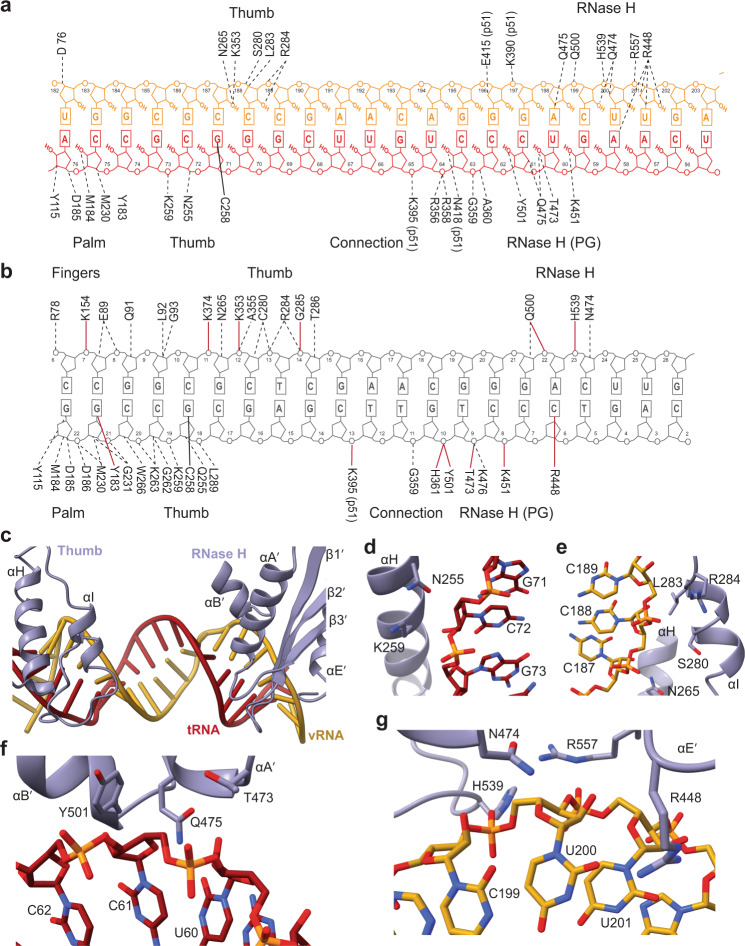
Reverse transcription of the HIV-1 viral RNA genome (vRNA) is an integral step in virus replication. Upon viral entry, HIV-1 reverse transcriptase (RT) initiates from a host tRNA primer bound to the vRNA genome and is the target of key antivirals, such as non-nucleoside reverse transcriptase inhibitors (NNRTIs). Initiation proceeds slowly with discrete pausing events along the vRNA template. Despite prior medium-resolution structural characterization of reverse transcriptase initiation complexes (RTICs), higher-resolution structures of the RTIC are needed to understand the molecular mechanisms that underlie initiation. Here we report cryo-EM structures of the core RTIC, RTIC-nevirapine, and RTIC-efavirenz complexes at 2.8, 3.1, and 2.9 Å, respectively. In combination with biochemical studies, these data suggest a basis for rapid dissociation kinetics of RT from the vRNA-tRNA initiation complex and reveal a specific structural mechanism of nucleic acid conformational stabilization during initiation. Finally, our results show that NNRTIs inhibit the RTIC and exacerbate discrete pausing during early reverse transcription.
HIV-1 病毒 RNA 基因组(vRNA)的逆转录是病毒复制的一个重要步骤。在病毒进入后,HIV-1 逆转录酶(RT)从与 vRNA 基因组结合的宿主 tRNA 引物开始,并成为关键抗病毒药物的靶点,如非核苷逆转录酶抑制剂(NNRTIs)。启动过程非常缓慢,vRNA 模板上有离散的暂停事件。尽管之前对逆转录酶起始复合物(RTIC)进行了中等分辨率的结构特征描述,但需要更高分辨率的 RTIC 结构来了解启动所依据的分子机制。在这里,我们报告了核心 RTIC、RTIC-奈韦拉平、RTIC-依非韦伦复合物的冷冻电镜结构,分辨率分别为 2.8、3.1 和 2.9 Å。结合生化研究,这些数据表明 RT 从 vRNA-tRNA 起始复合物快速解离的动力学基础,并揭示了起始过程中核酸构象稳定的特定结构机制。最后,我们的结果表明,NNRTIs 抑制 RTIC 并在早期逆转录过程中加剧离散暂停。