Mullowney Michael W, Fiebig Aretha, Schnizlein Matthew K, McMillin Mary, Rose Amber R, Koval Jason, Rubin David, Dalal Sushila, Sogin Mitchell L, Chang Eugene B, Sidebottom Ashley M, Crosson Sean
Duchossois Family Institute, University of Chicago, 900 E. 57th St, Chicago, IL, 60637, USA.
Department of Microbiology and Molecular Genetics, Michigan State University, East Lansing, Michigan, USA.
bioRxiv. 2023 Dec 13:2023.09.25.559407. doi: 10.1101/2023.09.25.559407.
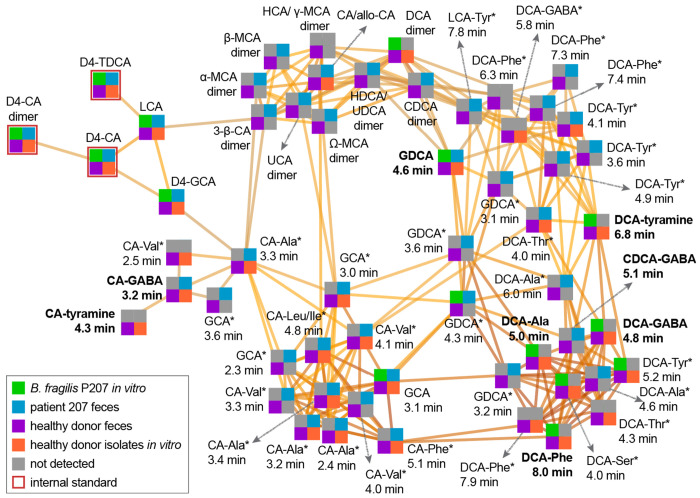
Bile acids (BAs) are cholesterol-derived molecules that aid in digestion and nutrient absorption, regulate host metabolic processes, and influence physiology of the gut microbiota. Both the host and its microbiome contribute to enzymatic modifications that shape the chemical diversity of BAs in the gut. Several bacterial species have been reported to conjugate standard amino acids to BAs, but it was not known if bacteria conjugate BAs to other amine classes. Here, we show that strain P207, isolated from a bacterial bloom in the J-pouch of a patient with ulcerative colitis (UC) pouchitis, conjugates standard amino acids and the neuroactive amines γ-aminobutyric acid (GABA) and tyramine to deoxycholic acid. We extended this analysis to other human gut isolates and identified species that are competent to conjugate GABA and tyramine to primary and secondary BAs, and further identified diverse BA-GABA and BA-tyramine amides in human stool. A longitudinal metabolomic analysis of J-pouch contents of the patient from whom P207 was isolated revealed highly reduced levels of secondary bile acids and a shifting BA amide profile before, during, and after onset of pouchitis, including temporal changes in several BA-GABA amides. Treatment of pouchitis with ciprofloxacin was associated with a marked reduction of nearly all BA amides in the J-pouch. Our study expands the known repertoire of conjugated bile acids produced by bacteria to include BA conjugates to GABA and tyramine and demonstrates that these molecules are present in the human gut.
胆汁酸(BAs)是胆固醇衍生的分子,有助于消化和营养吸收,调节宿主代谢过程,并影响肠道微生物群的生理学。宿主及其微生物群都参与了酶促修饰,这些修饰塑造了肠道中胆汁酸的化学多样性。据报道,几种细菌物种可将标准氨基酸与胆汁酸结合,但尚不清楚细菌是否会将胆汁酸与其他胺类结合。在这里,我们表明,从一名患有溃疡性结肠炎(UC)袋炎患者的J袋中的细菌大量繁殖中分离出的P207菌株,可将标准氨基酸以及神经活性胺γ-氨基丁酸(GABA)和酪胺与脱氧胆酸结合。我们将这一分析扩展到其他人类肠道分离株,鉴定出能够将GABA和酪胺与初级和次级胆汁酸结合的物种,并进一步在人类粪便中鉴定出多种胆汁酸-GABA和胆汁酸-酪胺酰胺。对分离出P207的患者的J袋内容物进行的纵向代谢组学分析显示,在袋炎发作之前、期间和之后,次级胆汁酸水平大幅降低,胆汁酸酰胺谱发生变化,包括几种胆汁酸-GABA酰胺的时间变化。用环丙沙星治疗袋炎与J袋中几乎所有胆汁酸酰胺的显著减少有关。我们的研究扩展了已知的细菌产生的结合胆汁酸种类,包括与GABA和酪胺结合的胆汁酸共轭物,并证明这些分子存在于人类肠道中。