Liu Ping, Yang Jianli, Chen Yu, Zhu Yifan, Tang Yuyan, Xu Xudong, He Haidong
Department of Nephrology, Minhang Hospital, Fudan University, Shanghai, PR China.
East China University of Science and Technology, Shanghai, China.
Heliyon. 2023 Sep 20;9(9):e20328. doi: 10.1016/j.heliyon.2023.e20328. eCollection 2023 Sep.
This study aims to investigate the changes in gut microbiota and metabolism of patients with chronic kidney disease (CKD) stage 1-2, as well as the potential impact of hyperuricemia (HUA) on these factors in CKD stage 1-2 patients.
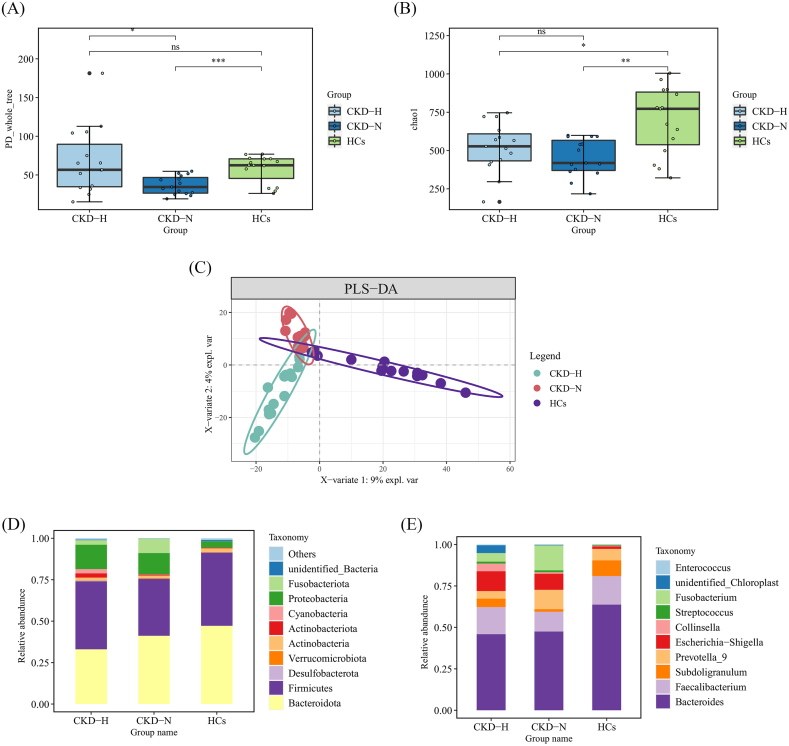
In this study, fecal samples were collected from CKD stage 1-2 without HUA patients (CKD-N group), CKD stage 1-2 with HUA patients (CKD-H group), and healthy people controls (HCs group). The samples were then subjected to the microbiome (16S rRNA gene sequencing) and metabolome (liquid chromatography-tandem mass spectrometry) analyses. The multi-omics datasets were analyzed individually and integrated for combined analysis using various bioinformatics approaches.
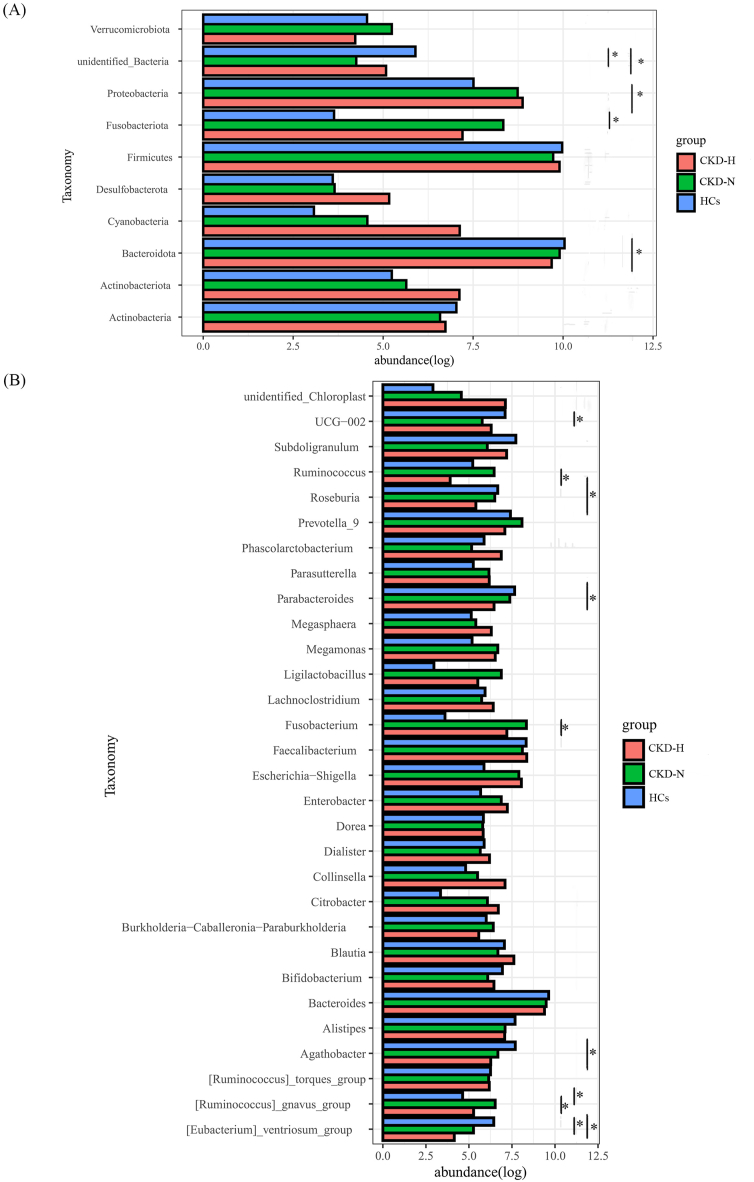
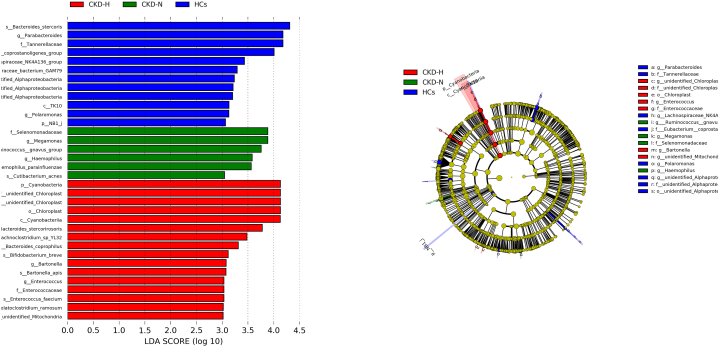
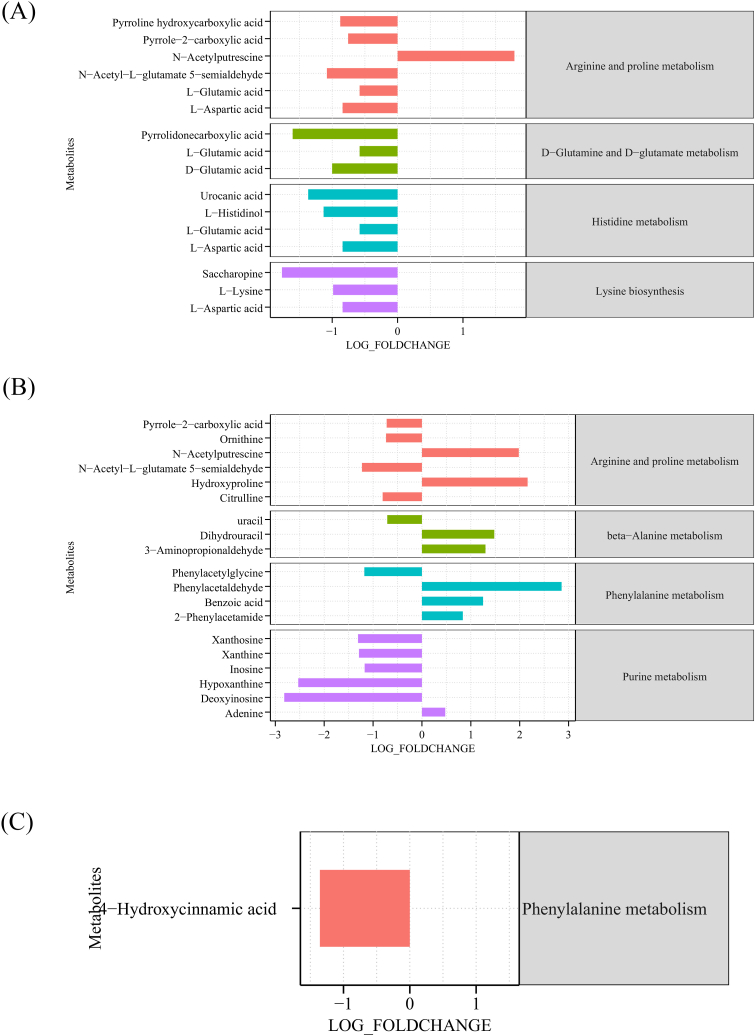
Gut microbial dysbiosis was found in CKD-N and CKD-H patients. At the phylum level, compared to HCs group, decreased but increased in CKD-H group significantly. in CKD-N group was significantly lower than HCs group. At genus level, , , and significantly changed in CKD groups. was significantly lower in CKD-H group than CKD-N group. Moreover, the fecal metabolome of CKD-N and CKD-H altered significantly. d-glutamine and d-glutamate metabolism, arginine and proline metabolism, histidine metabolism, and lysine biosynthesis were down-regulated in the CKD-N group. Phenylalanine metabolism, arginine and proline metabolism, purine metabolism, and beta-alanine metabolism were up-regulated in the CKD-H group. There was a significant difference between the two CKD groups in phenylalanine metabolism. The abundance change of , , , , and had a close correlation with differential metabolites.
The gut microbiota and metabolic status undergo significant changes in CKD patients compared to healthy people. Additionally, HUA has been found to impact the gut microbiota of CKD patients, as well as their metabolism. The close association between gut microbiota and metabolites suggests that the former plays a crucial role in metabolism.
本研究旨在调查1 - 2期慢性肾脏病(CKD)患者的肠道微生物群和代谢变化,以及高尿酸血症(HUA)对1 - 2期CKD患者这些因素的潜在影响。
在本研究中,收集了无HUA的1 - 2期CKD患者(CKD - N组)、有HUA的1 - 2期CKD患者(CKD - H组)和健康对照者(HCs组)的粪便样本。然后对样本进行微生物组(16S rRNA基因测序)和代谢组(液相色谱 - 串联质谱)分析。使用各种生物信息学方法对多组学数据集进行单独分析并整合以进行联合分析。
在CKD - N和CKD - H患者中发现肠道微生物群失调。在门水平上,与HCs组相比,CKD - H组中 减少但 增加。CKD - N组中的 显著低于HCs组。在属水平上,CKD组中 、 、 和 显著变化。CKD - H组中的 显著低于CKD - N组。此外,CKD - N和CKD - H的粪便代谢组发生了显著改变。CKD - N组中d - 谷氨酰胺和d - 谷氨酸代谢、精氨酸和脯氨酸代谢、组氨酸代谢以及赖氨酸生物合成下调。CKD - H组中苯丙氨酸代谢、精氨酸和脯氨酸代谢、嘌呤代谢以及β - 丙氨酸代谢上调。两个CKD组在苯丙氨酸代谢方面存在显著差异。 、 、 、 和 的丰度变化与差异代谢物密切相关。
与健康人相比,CKD患者的肠道微生物群和代谢状态发生了显著变化。此外,已发现HUA会影响CKD患者的肠道微生物群及其代谢。肠道微生物群与代谢物之间的密切关联表明前者在代谢中起关键作用。