Zahedi Asiyeh Sadat, Daneshpour Maryam Sadat, Akbarzadeh Mahdi, Hedayati Mehdi, Azizi Fereidoun, Zarkesh Maryam
Cellular and Molecular Endocrine Research Center, Research Institute for Endocrine Sciences, Shahid Beheshti University of Medical Sciences, Tehran, Iran.
Endocrine Research Center, Research Institute for Endocrine Sciences, Shahid Beheshti University of Medical Sciences, Tehran, Iran.
Heliyon. 2023 Sep 6;9(9):e19911. doi: 10.1016/j.heliyon.2023.e19911. eCollection 2023 Sep.
Metabolic syndrome (MetS) is accompanied by chronic low-grade inflammation, and inflammatory markers like high-sensitivity C-reactive protein(hs-CRP), interleukin-6(IL-6), and homocysteine(Hcy) contribute to inflammation, obesity, and insulin resistance. Adiponectin(AdipoQ) and interleukin-10(IL-10) are anti-inflammatory markers that play protective roles in MetS. This study aimed to investigate the association between these biochemical marker changes and MetS in a sample of the Tehranian population during six years of follow-up.
In this longitudinal study, 340 adults at baseline and after a six-year follow-up, aged ≥18 years, were selected randomly from the Tehran Lipid and Glucose Study (TLGS). MetS was defined according to the Joint Interim Statement (JIS) criteria. Individuals were categorized into four groups based on their MetS status at baseline and follow-up: 1) non-MetS: participants who did not have MetS at both baseline and follow-up; 2) incident MetS: participants who did not have MetS at baseline but developed MetS during the follow-up ; 3) recovery MetS: participants who had MetS at baseline but no longer had MetS during the follow-up; 4) persistent MetS: participants who had MetS both at baseline and follow-up.
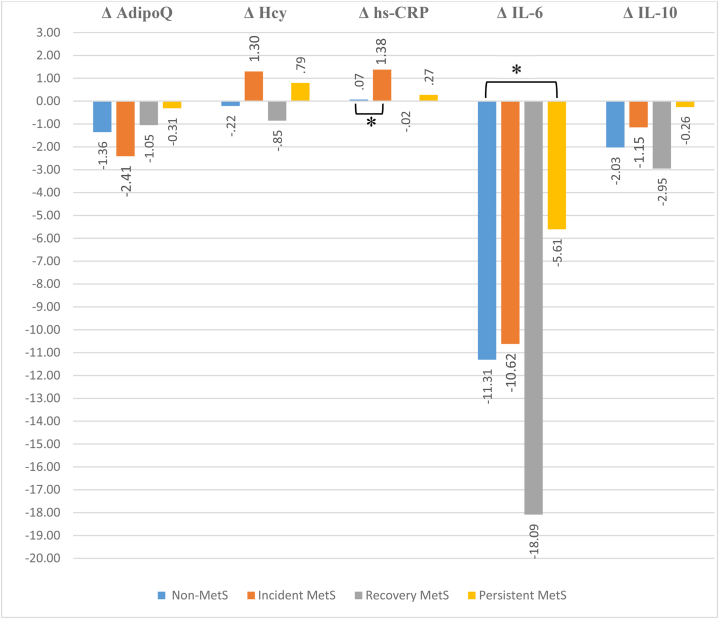
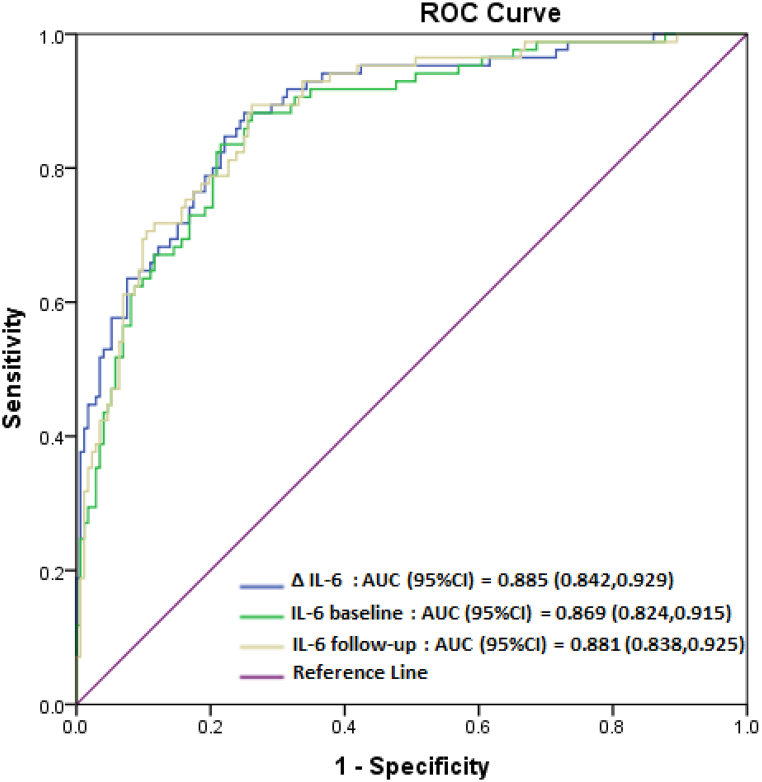
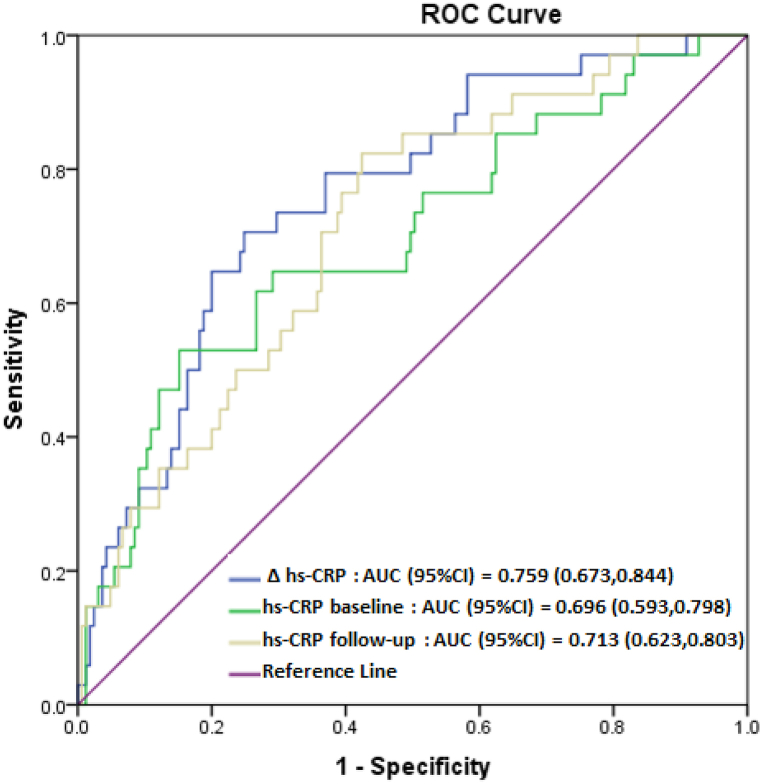
The mean follow-up time was 6.1 years. There were 176 subjects in the non-MetS group, 35 in the incident MetS group, 41 in the recovery MetS group, and 88 in the persistent MetS group. Increases in the levels of both hs-CRP 1.40 (95% CI: 1.15, 1.71, = 0.001) and IL-6 1.09 (95% CI: 1.03, 1.17, = 0.004) significantly increased the odds of the incident and persistent MetS, respectively. The area under the ROC curve (AUC) was more than 0.69 ( < 0.000) for hs-CRP in predicting MetS incidence and more than 0.86 ( < 0.000) for IL-6 in predicting MetS persistence.
After a six-year average follow-up, hs-CRP and IL-6 levels were deemed more reliable predictors of MetS incidence and persistence, respectively.
代谢综合征(MetS)伴有慢性低度炎症,高敏C反应蛋白(hs-CRP)、白细胞介素-6(IL-6)和同型半胱氨酸(Hcy)等炎症标志物会导致炎症、肥胖和胰岛素抵抗。脂联素(AdipoQ)和白细胞介素-10(IL-10)是抗炎标志物,在代谢综合征中起保护作用。本研究旨在调查德黑兰人群样本在六年随访期间这些生化标志物变化与代谢综合征之间的关联。
在这项纵向研究中,从德黑兰脂质与葡萄糖研究(TLGS)中随机选取340名年龄≥18岁的成年人作为基线样本,并在六年随访后进行观察。根据联合临时声明(JIS)标准定义代谢综合征。根据个体在基线和随访时的代谢综合征状态将其分为四组:1)非代谢综合征组:在基线和随访时均无代谢综合征的参与者;2)新发代谢综合征组:基线时无代谢综合征但在随访期间发生代谢综合征的参与者;3)恢复代谢综合征组:基线时有代谢综合征但在随访期间不再患有代谢综合征的参与者;4)持续性代谢综合征组:在基线和随访时均患有代谢综合征的参与者。
平均随访时间为6.1年。非代谢综合征组有176名受试者,新发代谢综合征组有35名,恢复代谢综合征组有41名,持续性代谢综合征组有88名。hs-CRP水平升高1.40(95%CI:1.15,1.71,P = 0.001)和IL-6水平升高1.09(95%CI:1.03,1.17,P = 0.004)分别显著增加了新发和持续性代谢综合征的几率。hs-CRP预测代谢综合征发病率的ROC曲线下面积(AUC)大于0.69(P < 0.000),IL-6预测代谢综合征持续性的AUC大于0.86(P < 0.000)。
经过平均六年的随访,hs-CRP和IL-6水平分别被认为是代谢综合征发病率和持续性更可靠的预测指标。