Cellular and Molecular Endocrine Research Center, Research Institute for Endocrine Sciences, Shahid Beheshti University of Medical Sciences, P.O. Box 19195-4763, Tehran, Iran.
Department of Internal Medicine, Erasmus MC, University Medical Center Rotterdam, Rotterdam, The Netherlands.
Eur J Epidemiol. 2023 Jun;38(6):699-711. doi: 10.1007/s10654-023-01008-1. Epub 2023 May 12.
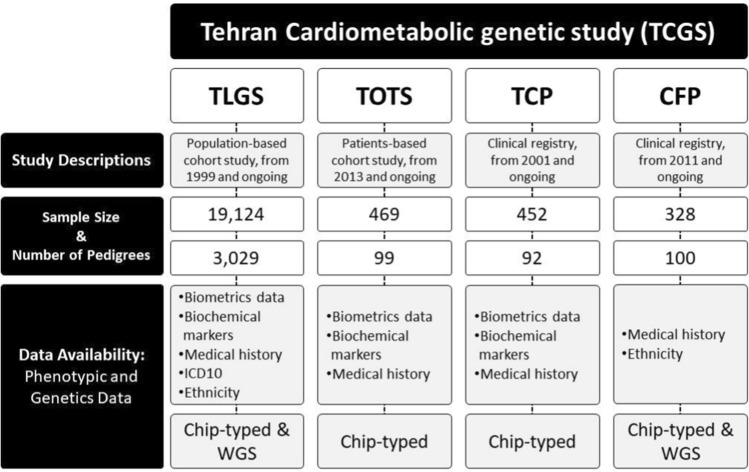
The Tehran cardiometabolic genetic study (TCGS) is a large population-based cohort study that conducts periodic follow-ups. TCGS has created a comprehensive database comprising 20,367 participants born between 1911 and 2015 selected from four main ongoing studies in a family-based longitudinal framework. The study's primary goal is to identify the potential targets for prevention and intervention for non-communicable diseases that may develop in mid-life and late life. TCGS cohort focuses on cardiovascular, endocrine, metabolic abnormalities, cancers, and some inherited diseases. Since 2017, the TCGS cohort has augmented by encoding all health-related complications, including hospitalization outcomes and self-reports according to ICD11 coding, and verifying consanguineous marriage using genetic markers. This research provides an update on the rationale and design of the study, summarizes its findings, and outlines the objectives for precision medicine.
德黑兰心脏代谢遗传学研究(TCGS)是一项大型的基于人群的队列研究,进行定期随访。TCGS 创建了一个综合数据库,其中包含 20367 名参与者,他们出生于 1911 年至 2015 年之间,选自四个主要的以家庭为基础的纵向框架中的正在进行的研究。该研究的主要目标是确定可能在中年和晚年发展的非传染性疾病的预防和干预的潜在目标。TCGS 队列主要关注心血管、内分泌、代谢异常、癌症和一些遗传性疾病。自 2017 年以来,TCGS 队列通过根据 ICD11 编码编码所有与健康相关的并发症,包括住院结果和自我报告,并使用遗传标记验证近亲结婚,得到了扩充。本研究更新了研究的原理和设计,总结了研究结果,并概述了精准医学的目标。