Songue Same Olivier, Nobosse Pierre, Ngolong Ngea Guillaume Legrand, Piveteau Catherine, Lemdani Mohamed, Kamga Richard, Deprez Benoit
Centre Pasteur du Cameroun, Physicochemical Section of Hygiene and Environment Department, PO Box 1274, Yaounde, Cameroon.
University of Ngaoundere, National School of Agro-Industrial Sciences, Department of Applied Chemistry, P.O. Box 455, Ngaoundere, Cameroon.
Heliyon. 2023 Sep 9;9(9):e20002. doi: 10.1016/j.heliyon.2023.e20002. eCollection 2023 Sep.
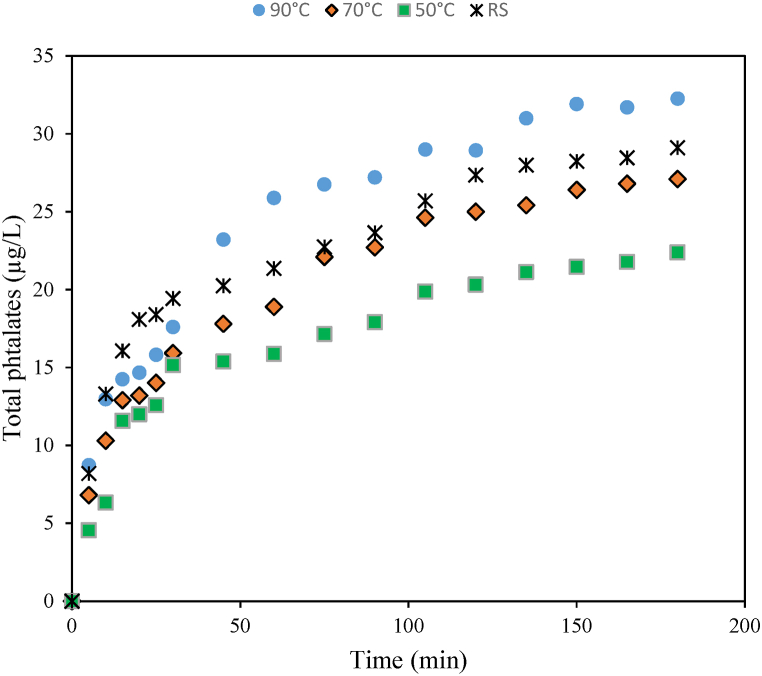
Phthalate acid esters (PAE) are used as additives in the formulation of plastics, to increase their flexibility and transparency. They can migrate from plastic packaging to food, then cause endocrine disruption in consumers. This migration depends on the conditions of use defined for each plastic. Non-food plastics are likely to release more PAE than food-grade plastics. In Cameroon, non-food grade plastics such as old paint buckets are used by people to preserve liquid food. The present work aimed at studying the conditions and mechanism of migration of total PAE from paint buckets to pap. For this purpose, the effects of seven factors were determined through Plackett-Burman experimental design. The interactions of the most influential factors were determined through a full factorial design. The conditions of the migration of total PAE were obtained via face-centered composite design. Then experimental results of migration kinetics were modelled according to equations of pseudo-first order, pseudo-second order and intra-particle diffusion. The results revealed that the most influential factors were pH, temperature and contact time. The effects of these factors are non-linear, and their interactions have to be considered. When pap is preserved in paint buckets according to the conditions: temperature of pap >70 °C, pH of pap ≤4 or ≥10 and contact time > 2 h, as is the case in donut shops in Cameroon, the amount of total PAE released is greater than 50 μg/L. Migration of total PAE from paint buckets to pap is best described by the pseudo-second order model.
邻苯二甲酸酯(PAE)被用作塑料配方中的添加剂,以增加其柔韧性和透明度。它们可从塑料包装迁移至食品中,进而对消费者造成内分泌干扰。这种迁移取决于为每种塑料所定义的使用条件。非食品用塑料可能比食品级塑料释放更多的PAE。在喀麦隆,人们使用诸如旧油漆桶之类的非食品级塑料来保存液体食品。本研究旨在探讨总PAE从油漆桶迁移至玉米粥的条件及机制。为此,通过Plackett-Burman实验设计确定了七个因素的影响。通过全因子设计确定了最具影响力因素之间的相互作用。通过面心复合设计获得了总PAE的迁移条件。然后根据伪一级、伪二级和颗粒内扩散方程对迁移动力学的实验结果进行建模。结果表明,最具影响力的因素是pH值、温度和接触时间。这些因素的影响是非线性的,必须考虑它们之间的相互作用。当按照喀麦隆甜甜圈店的情况,在如下条件下将玉米粥保存在油漆桶中时:玉米粥温度>70°C、玉米粥pH值≤4或≥10且接触时间>2小时,释放的总PAE量大于50μg/L。总PAE从油漆桶向玉米粥的迁移用伪二级模型描述最为合适。