Clinical Microbiology Laboratory, "Attikon" University General Hospital, Medical School, National and Kapodistrian University of Athens, Athens, Greece.
J Antimicrob Chemother. 2023 Dec 1;78(12):2830-2839. doi: 10.1093/jac/dkad306.
Because of the high inoculum (105 cfu/mL) used in the EUCAST susceptibility testing of Aspergillus spp., determination of the minimal effective concentration (MEC) of echinocandins is challenging as the morphological differences are subtle.
The MECs of 10 WT and 4 non-WT Aspergillus fumigatus isolates were determined with the EUCAST E.Def 9.4. Plates were inoculated with increasing inocula (102-105 cfu/mL) and after 24 and 48 h of incubation, MECs were determined macroscopically (magnifying mirror) and microscopically (inverted microscope) by two observers, spectrophotometrically (OD at 405 nm) and colorimetrically (absorbance at 450/630 nm after 2 h incubation with 400 mg/L XTT/6.25 μM menadione). The interobserver (between observers)/intermethod (compared with the microscopic method) essential agreement (EA, ±1 2-fold dilution) and categorical agreement (CA) were determined for each inoculum.
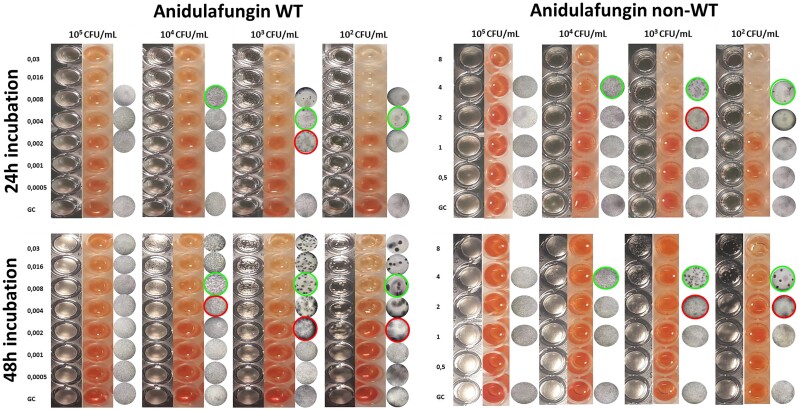
Echinocandin-induced microscopic hyphal alterations or macroscopic changes in turbidity were subtle with a 105 cfu/mL inoculum compared with the lower inocula of 103 and 102 cfu/mL, where more distinct changes in turbidity and formation of characteristic rosettes were obvious at the MEC after 48 h. A 105 cfu/mL inoculum resulted in wider MEC distributions (3-6 dilutions) and lower interobserver EA (69%), macroscopic-microscopic EA (26%) and CA (71%) compared with a 103 cfu/mL inoculum (2-3 dilutions, 100%, 100% and 100%, respectively). Spectrophotometric readings using a 103 cfu/mL inoculum showed good EA (57-93%) and excellent CA (86%-100%), while the XTT assay demonstrated excellent EA (93%) and CA (100%).
A 48 h incubation using a 103 cfu/mL inoculum improved echinocandin MEC determination for A. fumigatus with the EUCAST method, while the colorimetric assay could allow automation.
由于欧盟药敏试验中曲霉菌属的接种量较高(105cfu/mL),因此确定棘白菌素的最低有效浓度(MEC)具有挑战性,因为形态学差异很细微。
采用欧盟药敏试验折点(E.Def 9.4)确定了 10 株野生型和 4 株非野生型烟曲霉分离株的 MEC 值。接种物浓度逐渐增加(102-105cfu/mL),接种后 24 和 48 小时,由两位观察者通过肉眼(放大镜)和显微镜(倒置显微镜)、分光光度法(405nm 处的 OD 值)和比色法(孵育 2 小时后 450/630nm 处的吸光度,用 400mg/L XTT/6.25μM 甲萘醌)来确定 MEC 值。对于每种接种量,评估了两位观察者之间(观察者间)和两种方法之间(与显微镜方法比较)的关键一致性(EA,±1 倍稀释)和分类一致性(CA)。
与较低的 103 和 102cfu/mL 接种量相比,105cfu/mL 接种量时,棘白菌素诱导的微观菌丝改变或浊度的宏观变化较细微,而在 48 小时后,MEC 处的浊度变化更明显,并且形成特征性玫瑰花结。与 103cfu/mL 接种量(2-3 倍稀释,EA 为 100%、EA 为 100%和 CA 为 100%)相比,105cfu/mL 接种量导致 MEC 分布范围更宽(3-6 倍稀释),并且观察者间 EA 降低(69%)、宏观-微观 EA(26%)和 CA(71%)。使用 103cfu/mL 接种量的分光光度读数显示出良好的 EA(57-93%)和极好的 CA(86%-100%),而 XTT 检测显示出极好的 EA(93%)和 CA(100%)。
采用 103cfu/mL 接种量孵育 48 小时可改善欧盟药敏试验方法中烟曲霉的棘白菌素 MEC 测定,而比色法可实现自动化。