Henan Key Laboratory of Children's Genetics and Metabolic Diseases, Children's Hospital Affiliated to Zhengzhou University, Henan Children's Hospital, Zhengzhou, 450018, China.
Henan International Joint Laboratory for Prevention and Treatment of Pediatric Disease, Children's Hospital Affiliated to Zhengzhou University, Henan Children's Hospital, Zhengzhou, 450018, China.
Sci Rep. 2023 Oct 9;13(1):16991. doi: 10.1038/s41598-023-43988-w.
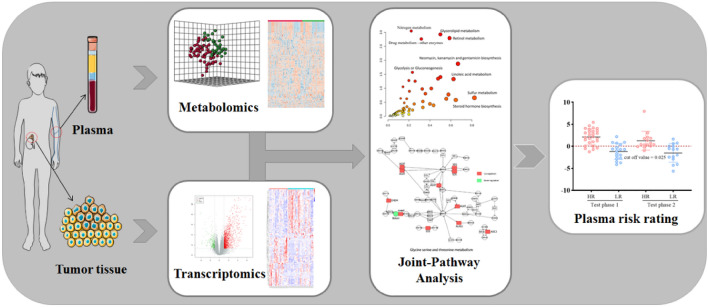
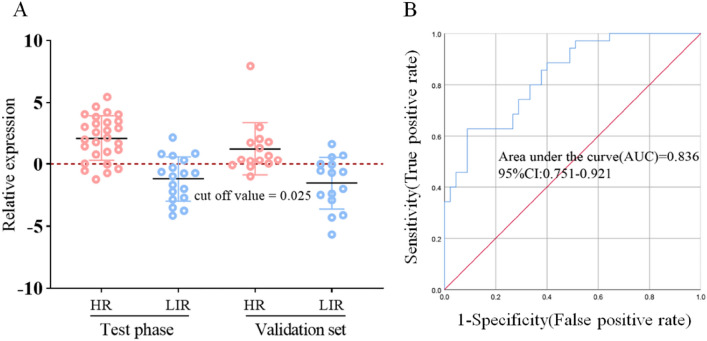
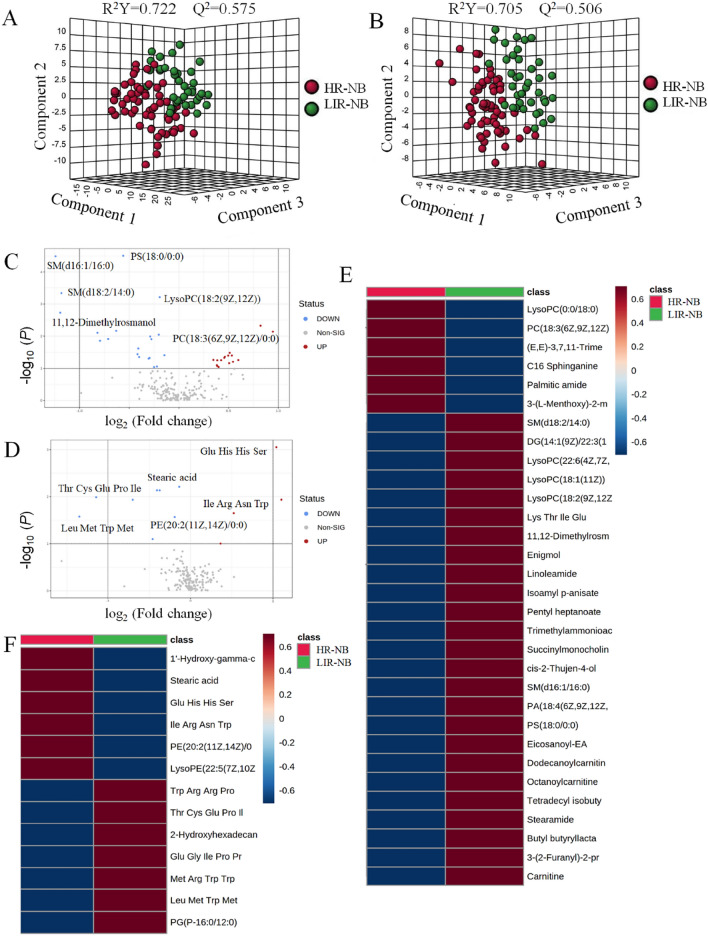
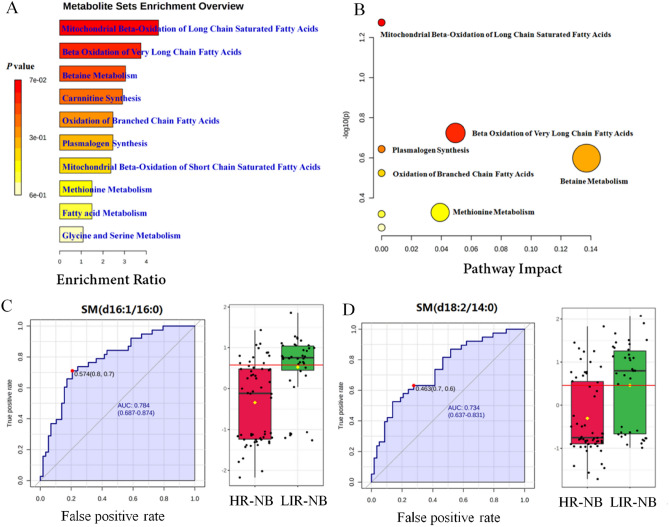
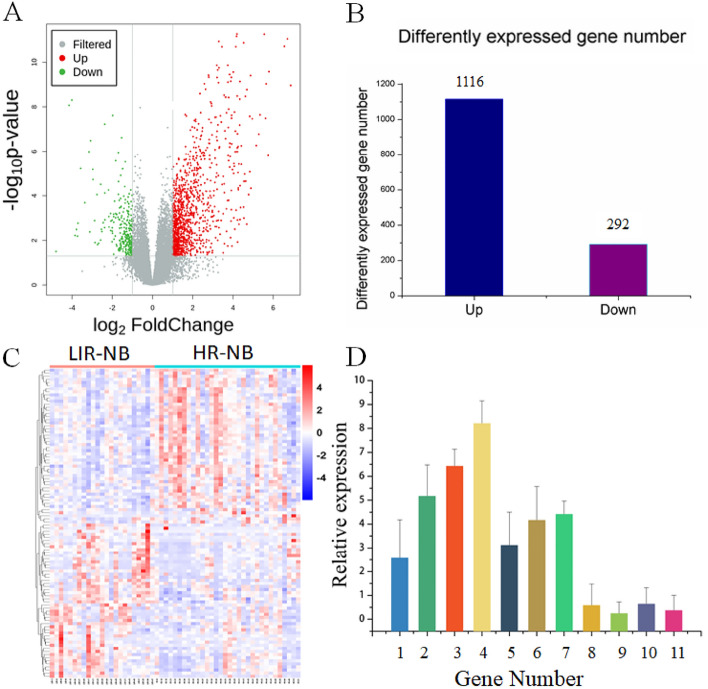
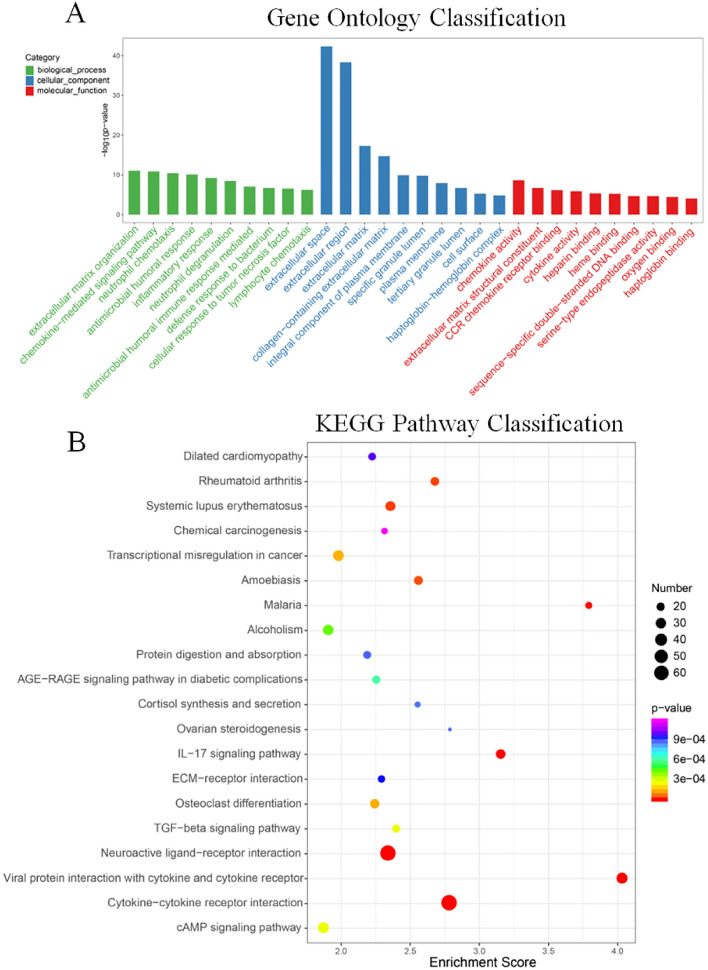
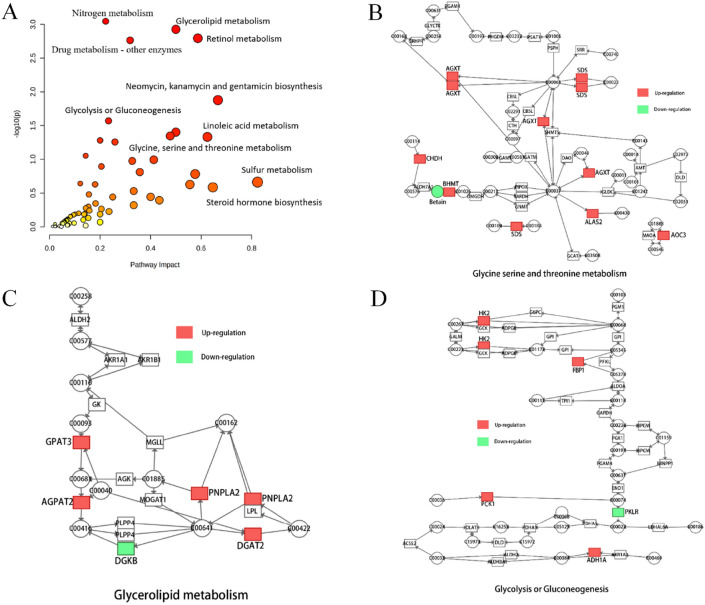
High-risk neuroblastoma (HR-NB) has a significantly lower survival rate compared to low- and intermediate-risk NB (LIR-NB) due to the lack of risk classification diagnostic models and effective therapeutic targets. The present study aims to characterize the differences between neuroblastomas with different risks through transcriptomic and metabolomic, and establish an early diagnostic model for risk classification of neuroblastoma.Plasma samples from 58 HR-NB and 38 LIR-NB patients were used for metabolomics analysis. Meanwhile, NB tissue samples from 32 HR-NB and 23 LIR-NB patients were used for transcriptomics analysis. In particular, integrative metabolomics and transcriptomic analysis was performed between HR-NB and LIR-NB. A total of 44 metabolites (P < 0.05 and fold change > 1.5) were altered, including 12 that increased and 32 that decreased in HR-NB. A total of 1,408 mRNAs (P < 0.05 and |log(fold change)|> 1) showed significantly altered in HR-NB, of which 1,116 were upregulated and 292 were downregulated. Joint analysis of both omic data identified 4 aberrant pathways (P < 0.05 and impact ≥ 0.5) consisting of glycerolipid metabolism, retinol metabolism, arginine biosynthesis and linoleic acid metabolism. Importantly, a HR-NB risk classification diagnostic model was developed using plasma circulating-free S100A9, CDK2, and UNC5D, with an area under receiver operating characteristic curve of 0.837 where the sensitivity and specificity in the validation set were both 80.0%. This study presents a novel pioneering study demonstrating the metabolomics and transcriptomics profiles of HR-NB. The glycerolipid metabolism, retinol metabolism, arginine biosynthesis and linoleic acid metabolism were altered in HR-NB. The risk classification diagnostic model based on S100A9, CDK2, and UNC5D can be clinically used for HR-NB risk classification.
高危神经母细胞瘤(HR-NB)的存活率明显低于低风险和中风险神经母细胞瘤(LIR-NB),因为缺乏风险分类诊断模型和有效的治疗靶点。本研究旨在通过转录组学和代谢组学来描述不同风险神经母细胞瘤之间的差异,并建立神经母细胞瘤风险分类的早期诊断模型。
使用来自 58 例 HR-NB 和 38 例 LIR-NB 患者的血浆样本进行代谢组学分析。同时,使用来自 32 例 HR-NB 和 23 例 LIR-NB 患者的 NB 组织样本进行转录组学分析。特别是,对 HR-NB 和 LIR-NB 进行了整合代谢组学和转录组学分析。共有 44 种代谢物(P<0.05,倍数变化>1.5)发生改变,其中 HR-NB 中 12 种增加,32 种减少。在 HR-NB 中共有 1408 个 mRNAs(P<0.05,|log(倍数变化)|>1)显示出明显改变,其中 1116 个上调,292 个下调。对这两种组学数据的联合分析确定了 4 条异常途径(P<0.05,影响≥0.5),包括甘油磷脂代谢、视黄醇代谢、精氨酸生物合成和亚油酸代谢。重要的是,使用血浆循环游离 S100A9、CDK2 和 UNC5D 开发了 HR-NB 风险分类诊断模型,验证集中的曲线下面积为 0.837,灵敏度和特异性均为 80.0%。
本研究提出了一项新的开创性研究,展示了 HR-NB 的代谢组学和转录组学特征。HR-NB 中甘油磷脂代谢、视黄醇代谢、精氨酸生物合成和亚油酸代谢发生改变。基于 S100A9、CDK2 和 UNC5D 的风险分类诊断模型可在临床上用于 HR-NB 风险分类。