Engel Manja M, Woertman E M, Dijkerman H C, Keizer A
Department of Experimental Psychology, Faculty of Social and Behavioural Sciences, Utrecht University, 3584 CS, Utrecht, The Netherlands.
Department of Clinical Psychology, Faculty of Social and Behavioural Sciences, Utrecht University, Utrecht, The Netherlands.
J Eat Disord. 2023 Oct 9;11(1):179. doi: 10.1186/s40337-023-00903-y.
Research on body image in eating disorders has predominantly focused on negative body image, only recently shifting to positive body image. Findings suggest that enhancing positive body image can, amongst other things, serve as a protective mechanism against (re)developing a negative body image. One suggested way of enhancing positive body image is to focus on enhancing body functionality appreciation. Although studies show promising effects, this research is mainly conducted in non-clinical samples.
The current study investigated the levels of positive and negative body image in an online community sample of patients with an eating disorder (PAT, n = 227), patients recovered from an eating disorder (REC, n = 102) and controls (HC, n = 175) (self-reported diagnosis, not confirmed). In addition, we tested whether body functionality appreciation was associated with appearance dissatisfaction (negative body image) and body appreciation (positive body image).
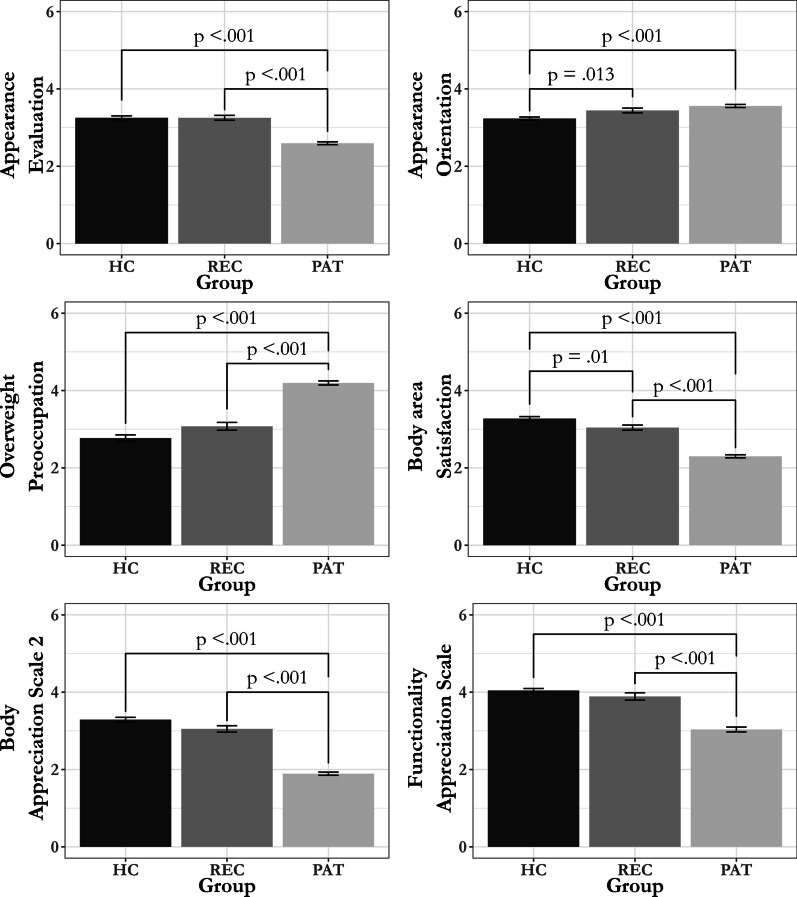
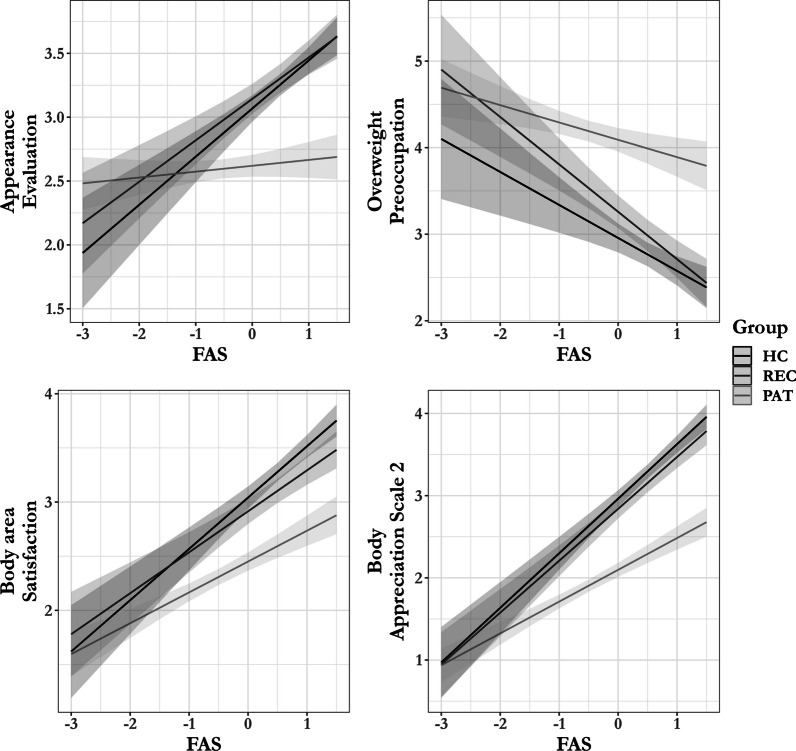
REC showed similar results to controls to most of the body image measures except for how much importance one places on their appearance (no different between REC and PAT), and how satisfied one is with certain body parts. For this measure, REC scored in-between PAT and HC. We further found functionality appreciation to be significantly associated with of both positive and negative body image, except for appearance evaluation in patients with an eating disorder.
This study showed a positive association between body functionality appreciation and positive body image and a negative association between body functionality appreciation and negative body image. Further research is required to investigate the effectiveness of interventions targeting body functionality appreciation in clinical settings.
饮食失调领域对身体意象的研究主要集中在消极身体意象上,直到最近才开始转向积极身体意象。研究结果表明,增强积极身体意象在诸多方面可作为一种保护机制,防止消极身体意象再次出现。一种增强积极身体意象的建议方法是专注于提升对身体功能的欣赏。尽管研究显示出了有前景的效果,但这项研究主要是在非临床样本中进行的。
本研究调查了一个在线社区样本中饮食失调患者(PAT,n = 227)、从饮食失调中康复的患者(REC,n = 102)和对照组(HC,n = 175)(自我报告诊断,未经证实)的积极和消极身体意象水平。此外,我们测试了对身体功能的欣赏是否与外表不满(消极身体意象)和身体欣赏(积极身体意象)相关。
除了一个人对外表的重视程度(REC和PAT之间没有差异)以及对某些身体部位的满意度外,REC在大多数身体意象测量方面的结果与对照组相似。对于这一测量,REC的得分介于PAT和HC之间。我们进一步发现,除了饮食失调患者的外表评价外,对功能的欣赏与积极和消极身体意象均显著相关。
本研究表明,对身体功能的欣赏与积极身体意象呈正相关,与消极身体意象呈负相关。需要进一步研究以调查在临床环境中针对身体功能欣赏的干预措施的有效性。