Kaur Baneet, Khanna Deepesh
Department of Medicine, Nova Southeastern University Dr. Kiran C. Patel College Of Osteopathic Medicine, Clearwater, USA.
Department of Foundational Sciences, Nova Southeastern University Dr. Kiran C. Patel College of Osteopathic Medicine, Clearwater, USA.
Cureus. 2023 Sep 7;15(9):e44866. doi: 10.7759/cureus.44866. eCollection 2023 Sep.
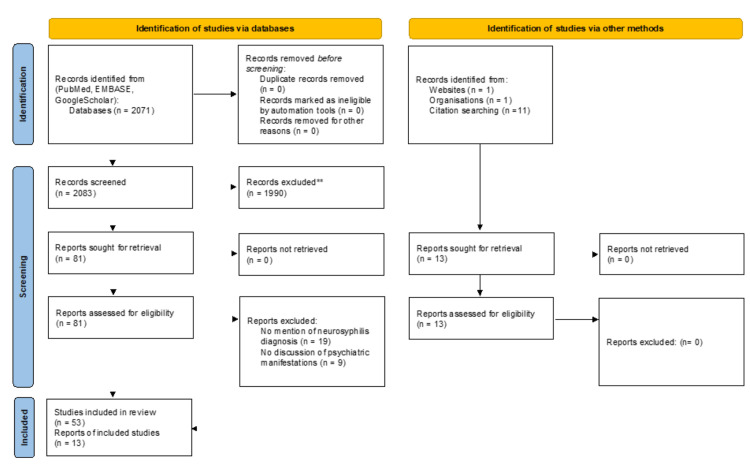
Neurosyphilis is an infection of the central nervous system caused by the spirochete, . New syphilis infections have been increasing around the world each year. This disease was much of a concern in the pre-penicillin era, where when left untreated many cases progressed to tertiary syphilis which can commonly manifest as neurosyphilis. Of particular interest, neurosyphilis has been linked to masquerading itself as various psychiatric conditions. This narrative review focuses on exploring psychiatric manifestations of neurosyphilis as well as the importance of screening in psychiatric settings and clinicians maintaining high clinical suspicion of the disease. A systematic search was conducted for published articles from 2003 to 2023 using PubMed, EMBASE, and Google Scholar. A total of 66 articles met the criteria and were used for detailed analysis, where psychiatric manifestations and clinical progression of patients were discussed in detail. Psychiatric manifestations that were explored include dementia, delirium, depression, mania, personality changes, and psychosis. One of the most common manifestations of neurosyphilis appears to be severe neurocognitive impairment. There are also rare psychiatric conditions neurosyphilis mimics that have been described in literature such as Capgras syndrome and Geschwind syndrome. A narrative review of the literature revealed a low level of clinical awareness of neurosyphilis as a possible etiology of various psychiatric disorders. This resulted in delayed or inaccurate diagnosis and consequently delayed initiation of adequate treatment. Considering that many psychiatric manifestations of neurosyphilis are reversible with proper treatment, it is imperative to implement routine screening for syphilis among psychiatric patients.
神经梅毒是由螺旋体引起的中枢神经系统感染。每年全球新的梅毒感染病例都在增加。在青霉素时代之前,这种疾病备受关注,因为如果不进行治疗,许多病例会发展为三期梅毒,而三期梅毒通常会表现为神经梅毒。特别值得注意的是,神经梅毒与伪装成各种精神疾病有关。这篇叙述性综述重点探讨神经梅毒的精神症状,以及在精神科环境中进行筛查的重要性,同时强调临床医生要对该疾病保持高度的临床怀疑。我们使用PubMed、EMBASE和谷歌学术对2003年至2023年发表的文章进行了系统检索。共有66篇文章符合标准并用于详细分析,其中详细讨论了患者的精神症状和临床进展。所探讨的精神症状包括痴呆、谵妄、抑郁、躁狂、人格改变和精神病。神经梅毒最常见的表现之一似乎是严重的神经认知障碍。文献中还描述了神经梅毒模仿的罕见精神疾病,如卡普格拉综合征和盖斯温德综合征。对文献的叙述性综述显示,临床医生对神经梅毒作为各种精神障碍可能病因的认识水平较低。这导致诊断延迟或不准确,从而延误了适当治疗的开始。鉴于神经梅毒的许多精神症状通过适当治疗是可逆的,因此对精神科患者进行梅毒常规筛查势在必行。