Qaqish Arwa, Abdo Nour, Abbas Manal Mohammad, Saadeh Nour, Alkhateeb Mohammad, Msameh Renad, Tarawneh Shahd, Al-Masri Mona
Department of Biology and Biotechnology, Faculty of Science, The Hashemite University, Zarqa, Jordan.
Department of Cellular Therapy and Applied Genomics, King Hussein Cancer Center (KHCC), Amman, Jordan.
PLoS One. 2023 Oct 11;18(10):e0291643. doi: 10.1371/journal.pone.0291643. eCollection 2023.
Although penetrative sex is the most common route of HPV infection, there is strong evidence of non-sexual modes of transmission. As the first of its kind, this study aimed to investigate the knowledge and awareness of Jordanian physicians on such routes.
A questionnaire was conducted among a national Jordanian sample of physicians from Jordanian health sectors. The survey included questions assessing participants' knowledge on HPV, non-sexual routes of infection and HPV vaccines. Physicians' attitudes towards HPV screening and vaccination were covered. Statistical analysis was carried out using SAS 9.4, ANOVA, post-hoc Tukey-Honest test and Kruskal-Wallis test. All significant differences were set at α = 0.05.
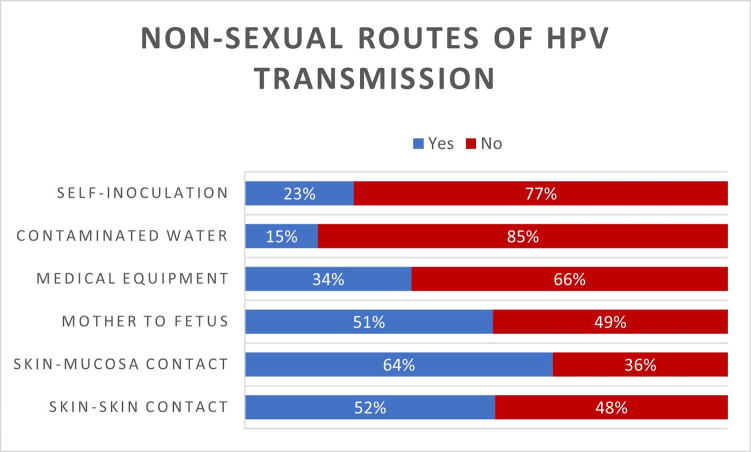
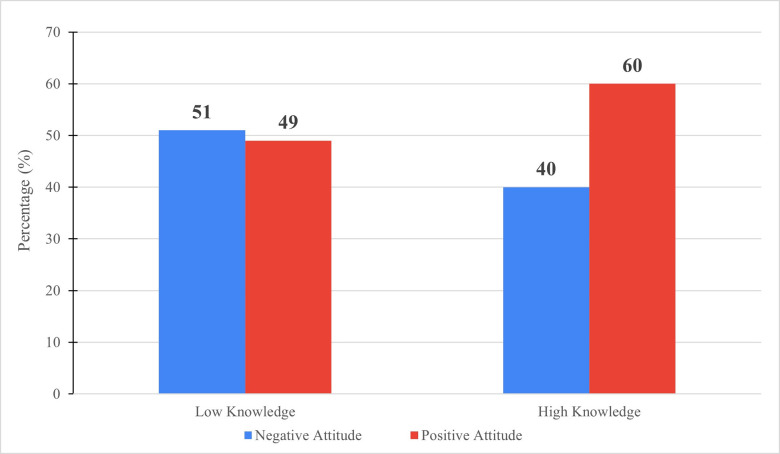
A total of 412 participants completed the survey. Physicians showed a huge deficit in knowledge on nonsexual routes of HPV transmission. They agreed that the most and least common routes of non-sexual transmission are skin to mucosa (64%) and contaminated water (15%), respectively. Females showed significantly better knowledge in all aspects of HPV transmission and vaccination (p<0.0001) and more positive attitudes towards HPV screening and vaccination compared to males (p = 0.03). Age group ≤ 25 and academic physicians demonstrated higher knowledge on HPV vaccines compared to their counterparts in non-academic places (p = 0.002). Specialty and experience seemed to have no impact on knowledge or attitudes of participants. Higher knowledge physicians had more positive attitude towards vaccination and screening compared to lower knowledge fellows (p<0.001).
The noteworthy findings of this study is the extremely low level of knowledge on non-sexual routes of HPV infection among Jordanian physicians. Increasing the level of awareness of physicians and healthcare workers on these routes and their association with cervical and other cancers through university curricula and other reliable sources is strongly recommended.
尽管性行为是HPV感染最常见的途径,但有确凿证据表明存在非性传播方式。作为同类研究中的首例,本研究旨在调查约旦医生对这些传播途径的了解和认识。
对约旦医疗部门的全国医生样本进行问卷调查。该调查包括评估参与者对HPV、非性感染途径和HPV疫苗的知识的问题。涵盖了医生对HPV筛查和疫苗接种的态度。使用SAS 9.4、方差分析、事后Tukey-Honest检验和Kruskal-Wallis检验进行统计分析。所有显著差异设定为α = 0.05。
共有412名参与者完成了调查。医生对HPV非性传播途径的知识存在巨大欠缺。他们认为非性传播最常见和最不常见的途径分别是皮肤到黏膜(64%)和受污染的水(15%)。与男性相比,女性在HPV传播和疫苗接种的各个方面表现出明显更好的知识(p<0.0001),并且对HPV筛查和疫苗接种的态度更积极(p = 0.03)。年龄≤25岁的人群和学术医生相比非学术机构的同行对HPV疫苗有更高的了解(p = 0.002)。专业和经验似乎对参与者的知识或态度没有影响。知识水平较高的医生与知识水平较低的医生相比,对疫苗接种和筛查的态度更积极(p<0.001)。
本研究的显著发现是约旦医生对HPV非性感染途径的知识水平极低。强烈建议通过大学课程和其他可靠来源提高医生和医护人员对这些途径及其与宫颈癌和其他癌症关联的认识水平。