The BioActives Lab, Center for Desert Agriculture, Biological and Environmental Science and Engineering Division, King Abdullah University of Science and Technology, Thuwal 23955-6900, Kingdom of Saudi Arabia.
The Plant Science Program, Biological and Environmental Science and Engineering Division, King Abdullah University of Science and Technology, Thuwal 23955-6900, Kingdom of Saudi Arabia.
Proc Natl Acad Sci U S A. 2023 Oct 17;120(42):e2306263120. doi: 10.1073/pnas.2306263120. Epub 2023 Oct 11.
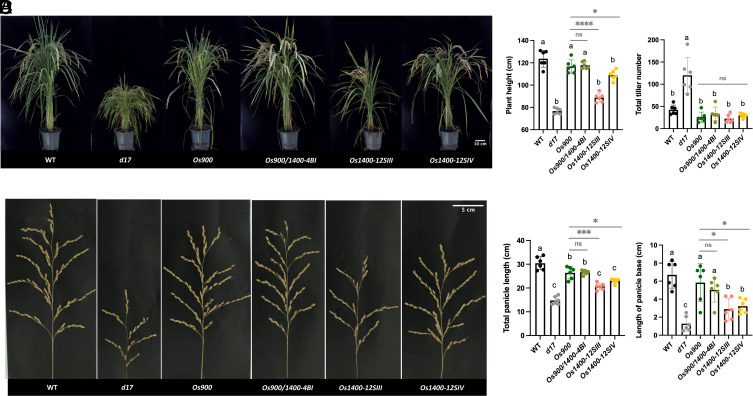
Strigolactones (SLs) regulate many developmental processes, including shoot-branching/tillering, and mediate rhizospheric interactions. SLs originate from carlactone (CL) and are structurally diverse, divided into a canonical and a noncanonical subfamily. Rice contains two canonical SLs, 4-deoxyorobanchol (4DO) and orobanchol (Oro), which are common in different plant species. The cytochrome P450 OsMAX1-900 forms 4DO from CL through repeated oxygenation and ring closure, while the homologous enzyme OsMAX1-1400 hydroxylates 4DO into Oro. To better understand the biological function of 4DO and Oro, we generated CRISPR/Cas9 mutants disrupted in or in both and . The loss of OsMAX1-1400 activity led to a complete lack of Oro and an accumulation of its precursor 4DO. Moreover, mutants showed shorter plant height, panicle and panicle base length, but no tillering phenotype. Hormone quantification and transcriptome analysis of mutants revealed elevated auxin levels and changes in the expression of auxin-related, as well as of SL biosynthetic genes. Interestingly, the double mutant lacking both Oro and 4DO did not show the observed architectural phenotypes, indicating their being a result of 4DO accumulation. Treatment of wild-type plants with 4DO confirmed this assumption. A comparison of the seed germinating activity and the mycorrhization of , and loss-of-function mutants demonstrated that the germination activity positively correlates with 4DO content while disrupting has a negative impact on mycorrhizal symbiosis. Taken together, our paper deciphers the biological function of canonical SLs in rice and reveals their particular contributions to establishing architecture and rhizospheric communications.
独脚金内酯(SLs)调控许多发育过程,包括分枝/分蘖和根际相互作用。SLs 来源于 carlactone(CL),结构多样,分为典型和非典型亚家族。水稻含有两种典型的 SLs,4-去甲独脚金醇(4DO)和独脚金醇(Oro),它们在不同的植物物种中很常见。细胞色素 P450 OsMAX1-900 通过重复的氧化和环化作用将 CL 转化为 4DO,而同源酶 OsMAX1-1400 将 4DO 羟基化为 Oro。为了更好地理解 4DO 和 Oro 的生物学功能,我们生成了 CRISPR/Cas9 突变体,分别或同时破坏 和 。OsMAX1-1400 活性的丧失导致 Oro 完全缺失和其前体 4DO 的积累。此外, 突变体表现出更短的株高、穗长和穗基长,但没有分蘖表型。 突变体的激素定量和转录组分析显示生长素水平升高,以及生长素相关基因以及 SL 生物合成基因的表达变化。有趣的是,同时缺乏 Oro 和 4DO 的 双突变体没有表现出观察到的结构表型,表明它们是 4DO 积累的结果。用 4DO 处理野生型植物证实了这一假设。对 、 和 功能丧失突变体的种子萌发活性和菌根共生的比较表明,萌发活性与 4DO 含量呈正相关,而破坏 对菌根共生有负面影响。总之,我们的论文阐明了水稻中典型 SLs 的生物学功能,并揭示了它们对建立结构和根际通讯的特殊贡献。