College of Animal Science and Technology, Hebei Agricultural University, Baoding 071000, China; College of Food Science and Technology, Hebei Agricultural University, Baoding 071000, China.
College of Animal Science and Technology, Hebei Agricultural University, Baoding 071000, China.
Poult Sci. 2023 Dec;102(12):103132. doi: 10.1016/j.psj.2023.103132. Epub 2023 Sep 20.
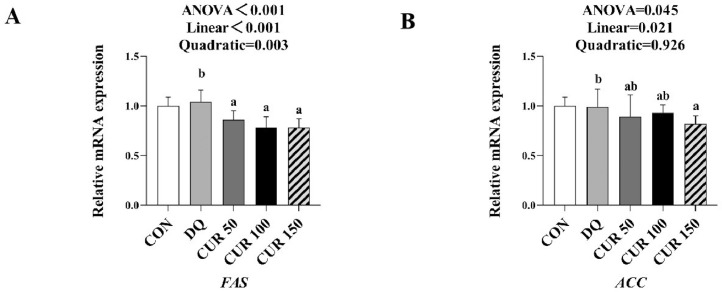
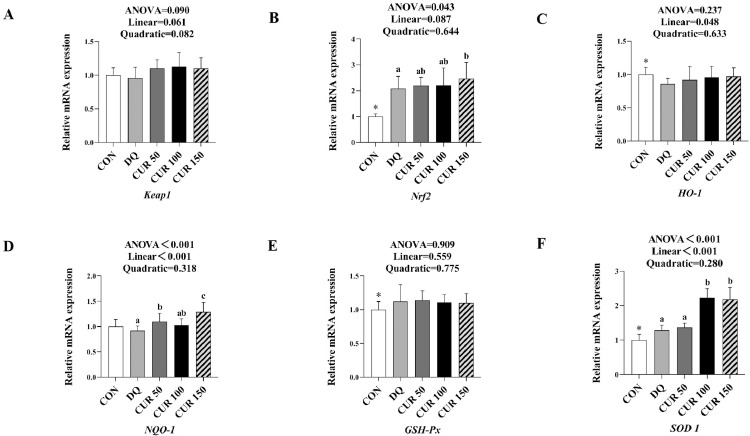
This study purposed to investigate the alleviating effect of dietary curcumin supplementation on oxidative stress in the liver of broilers induced by diquat. One-day-old Cobb broilers (400) were selected and randomly divided into 5 groups, with 8 replicates and 10 broilers per replicate. The control group and the diquat group were fed the basal diet, while the curcumin supplementation groups were fed the basal diet supplemented with different amounts of curcumin (50, 100, and 150 mg/kg). On d 21 of the test, 1 broiler was randomly selected from each replicate and intraperitoneally injected with 20 mg/mL of diquat solution at a dose of 1 mL/kg BW or equivalent physiological saline (for the control group). After 48 h of feeding, the selected broilers were slaughtered for analysis. The results show that diquat treatment reduced the antioxidant capacity of the liver, caused oxidative stress, and affected its lipid metabolism. However, diet supplementation using curcumin completely or partially reversed the effect of diquat on the liver of broilers. The blood alanine aminotransferase activity, total bilirubin and total protein levels, and liver Caspase-3 mRNA abundance in broilers were lower or significantly lower in the curcumin supplementation group than in the diquat group (P < 0.05). The curcumin supplementation groups had significantly higher total antioxidant capacity activity but significantly lower malondialdehyde in the liver of broilers than the diquat group (P < 0.05). The blood triglyceride level of broilers was lower or significantly lower in the curcumin supplementation groups than in the diquat group (P < 0.05). The activities of cetyl coenzyme A carboxylase in the liver were significantly lower in the 150 mg/kg curcumin supplementation groups than in the DQ group (P < 0.05). In conclusion, dietary curcumin supplementation could ameliorate the effects of diquat-induced oxidative stress on the antioxidant capacity, tissue morphology, and lipid metabolism of the liver of broilers, thus protecting the liver. The recommended dosage for broiler diets is 100 to 150 mg/kg curcumin.
本研究旨在探讨膳食姜黄素补充对百草枯诱导的肉鸡肝脏氧化应激的缓解作用。选择 1 日龄科宝肉鸡(400 只),随机分为 5 组,每组 8 个重复,每个重复 10 只鸡。对照组和百草枯组饲喂基础日粮,姜黄素补充组分别在基础日粮中添加 50、100 和 150 mg/kg 姜黄素。试验第 21 天,每组随机选择 1 只鸡,每只鸡腹腔注射 20 mg/mL 百草枯溶液 1 mL/kgBW 或等体积生理盐水(对照组)。给药后 48 h 屠宰,取肝脏进行分析。结果表明,百草枯处理降低了肝脏的抗氧化能力,引起氧化应激,影响其脂质代谢。然而,用姜黄素进行饮食补充完全或部分逆转了百草枯对肉鸡肝脏的影响。与百草枯组相比,姜黄素补充组肉鸡血液丙氨酸转氨酶活性、总胆红素和总蛋白水平以及肝脏 Caspase-3 mRNA 丰度较低或显著较低(P<0.05)。姜黄素补充组肉鸡肝脏总抗氧化能力活性显著升高,丙二醛含量显著降低(P<0.05)。与百草枯组相比,姜黄素补充组肉鸡血液甘油三酯水平较低或显著较低(P<0.05)。150 mg/kg 姜黄素补充组肉鸡肝脏中的乙酰辅酶 A 羧化酶活性显著低于 DQ 组(P<0.05)。综上所述,膳食姜黄素补充可改善百草枯诱导的氧化应激对肉鸡肝脏抗氧化能力、组织形态和脂质代谢的影响,从而保护肝脏。肉鸡日粮中姜黄素的推荐用量为 100-150 mg/kg。