Guo Ciliang, Kong Lingkai, Xiao Lingjun, Liu Kua, Cui Huawei, Xin Qilei, Gu Xiaosong, Jiang Chunping, Wu Junhua
State Key Laboratory of Pharmaceutical Biotechnology, Jiangsu Key Laboratory of Molecular Medicine, Medical School of Nanjing University, National Institute of Healthcare Data Science at Nanjing University, Nanjing University, 22 Hankou Road, Nanjing, 210093, Jiangsu, China.
Jinan Microecological Biomedicine Shandong Laboratory, Shounuo City Light West Block, Qingdao Road 3716#, Huaiyin District, Jinan, Shandong, China.
Cell Biosci. 2023 Oct 13;13(1):188. doi: 10.1186/s13578-023-01135-y.
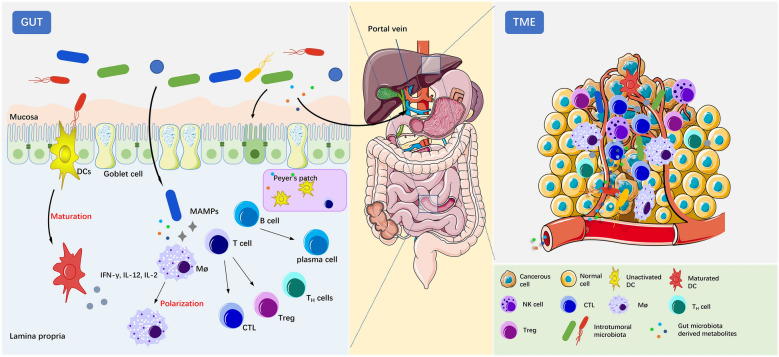
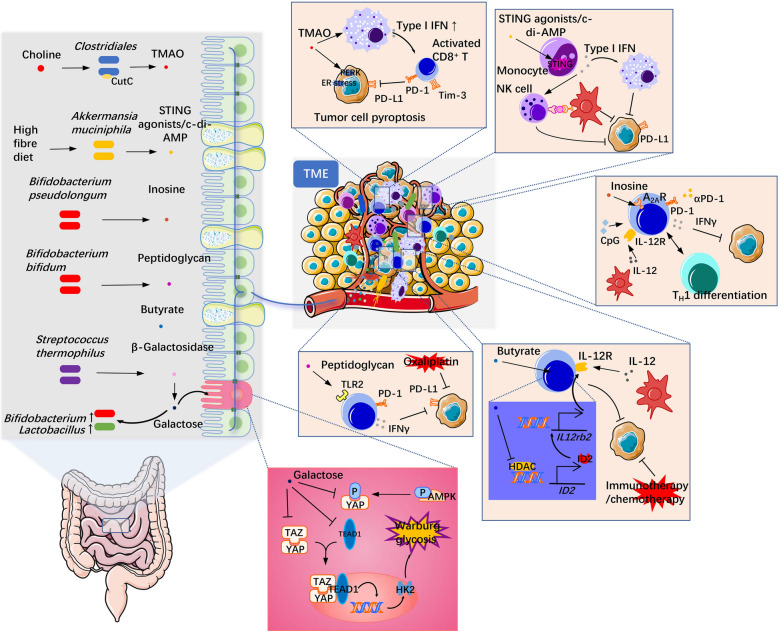
Immunotherapy is one of the fastest developing areas in the field of oncology. Many immunological treatment strategies for refractory tumors have been approved and marketed. Nevertheless, much clinical and preclinical experimental evidence has shown that the efficacy of immunotherapy in tumor treatment varies markedly among individuals. The commensal microbiome mainly colonizes the intestinal lumen in humans, is affected by a variety of factors and exhibits individual variation. Moreover, the gut is considered the largest immune organ of the body due to its influence on the immune system. In the last few decades, with the development of next-generation sequencing (NGS) techniques and in-depth research, the view that the gut microbiota intervenes in antitumor immunotherapy through the immune system has been gradually confirmed. Here, we review important studies published in recent years focusing on the influences of microbiota on immune system and the progression of malignancy. Furthermore, we discuss the mechanism by which microbiota affect tumor immunotherapy, including immune checkpoint blockade (ICB) and adoptive T-cell therapy (ACT), and strategies for modulating the microbial composition to facilitate the antitumor immune response. Finally, opportunity and some challenges are mentioned to enable a more systematic understanding of tumor treatment in the future and promote basic research and clinical application in related fields.
免疫疗法是肿瘤学领域发展最快的领域之一。许多针对难治性肿瘤的免疫治疗策略已获批准并上市。然而,大量临床和临床前实验证据表明,免疫疗法在肿瘤治疗中的疗效在个体间存在显著差异。共生微生物群主要定植于人体肠道腔内,受多种因素影响并表现出个体差异。此外,由于肠道对免疫系统的影响,它被认为是人体最大的免疫器官。在过去几十年中,随着下一代测序(NGS)技术的发展和深入研究,肠道微生物群通过免疫系统干预抗肿瘤免疫治疗的观点已逐渐得到证实。在此,我们综述近年来发表的重要研究,重点关注微生物群对免疫系统的影响以及恶性肿瘤的进展。此外,我们讨论微生物群影响肿瘤免疫治疗的机制,包括免疫检查点阻断(ICB)和过继性T细胞疗法(ACT),以及调节微生物组成以促进抗肿瘤免疫反应的策略。最后,提及了机遇和一些挑战,以便未来更系统地理解肿瘤治疗,并促进相关领域的基础研究和临床应用。