Dormegny-Jeanjean Ludovic Christophe, de Billy Clément, Mainberger Olivier, Weibel Sébastien, Schorr Benoit, Obrecht Alexandre, Landré Lionel, Berna Fabrice, Causin Jean-Baptiste, Blanc Frederic, Danila Vlad, Tomsa Mihaela, Pfleger Geraldine, Meyer Camille, Humbert Ilia, Javelot Hervé, Meyer Guillaume, Bertschy Gilles, Foucher Jack Rene
Treatment resistant depression expert center of Alsace (CEDRA), Strasbourg-Rouffach-Erstein-Brumath, Rouffach, France.
Non-Invasive neuroModulation Center of Strasbourg (CEMNIS), University Hospital of Strasbourg, Strasbourg, France.
Front Psychiatry. 2023 Sep 27;14:1194090. doi: 10.3389/fpsyt.2023.1194090. eCollection 2023.
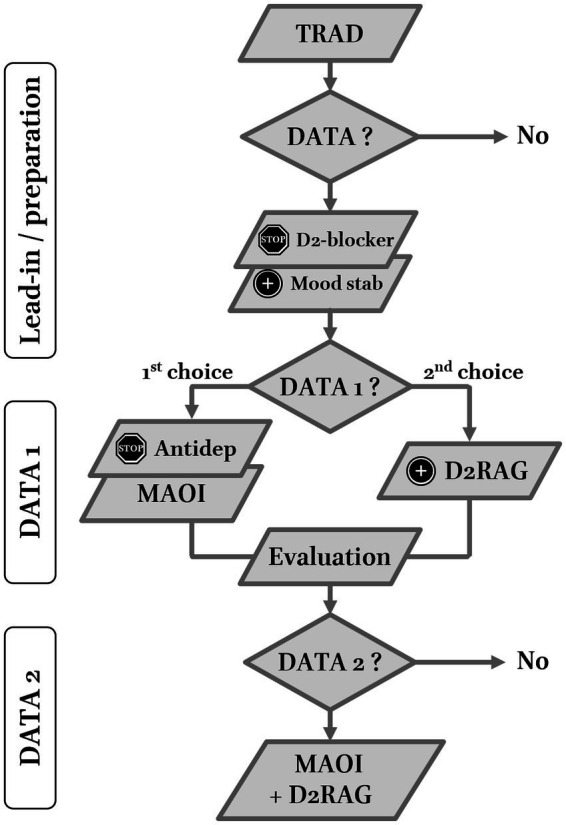
Among treatment-resistant depression (TRD), we identified anergic-anhedonic clinical presentations (TRAD) as putatively responsive to pro-dopaminergic strategies. Based on the literature, non-selective monoamine oxidase inhibitors (MAOI) and dopamine D2 receptor agonists (D2RAG) were sequentially introduced, frequently under the coverage of a mood stabilizer. This two-step therapeutic strategy will be referred to as the Dopaminergic Antidepressant Therapy Algorithm (DATA). We describe the short and long-term outcomes of TRAD managed according to DATA guidelines.
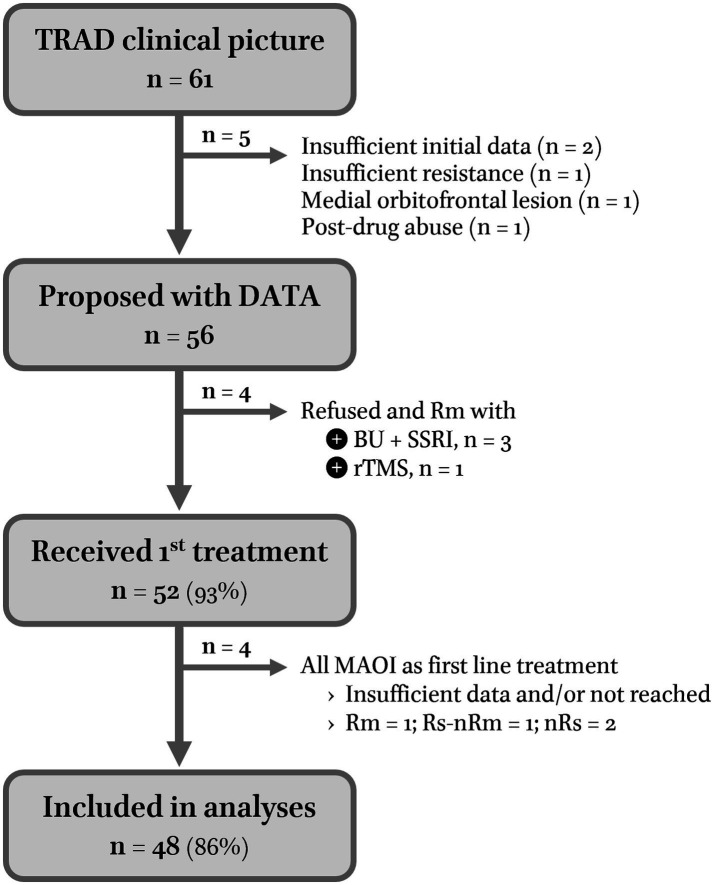
Out of 52 outpatients with TRAD treated with DATA in a single expert center, 48 were included in the analysis [severity - QIDS (Quick Inventory of Depressive Symptomatology) = 16 ± 3; episode duration = 4.1 ± 2.7 years; Thase and Rush resistance stage = 2.9 ± 0.6; functioning - GAF (Global Assessment of Functioning) = 41 ± 8]. These were followed-up for a median (1st - 3rd quartile) of 4 (1-9) months before being prescribed the first dopaminergic treatment and remitters were followed up 21 (11-33) months after remission.
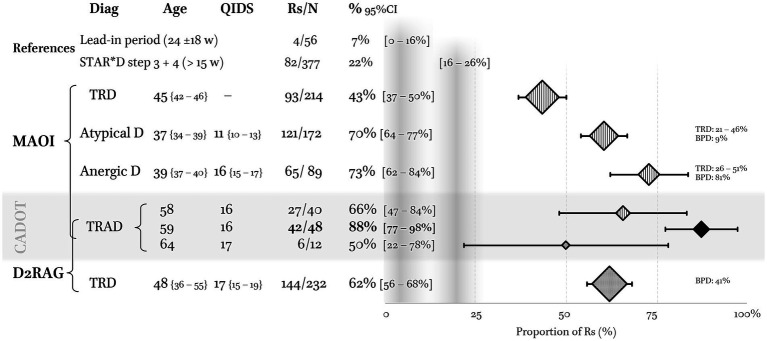
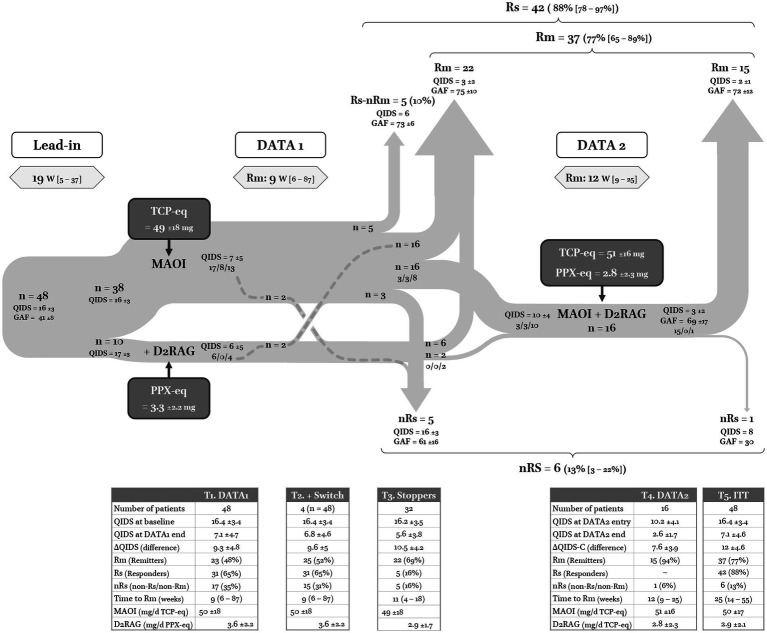
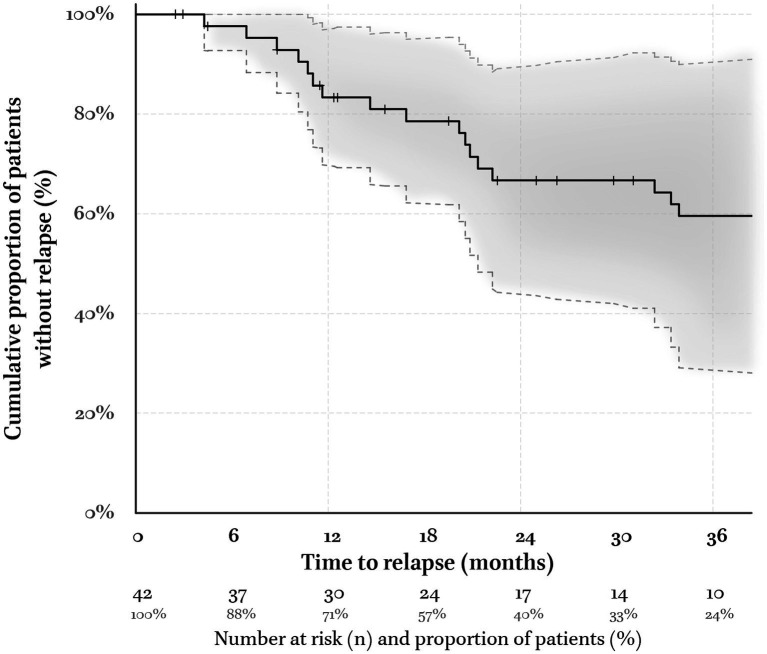
At the end of DATA step 1, 25 patients were in remission (QIDS <6; 52% [38-66%]). After DATA step 2, 37 patients were in remission (77% [65-89%]) to whom 5 patients with a QIDS score = 6 could be added (88% [78-97%]). Many of these patients felt subjectively remitted (GAF = 74 ± 10). There was a significant benefit to combining MAOI with D2RAG which was maintained for at least 18 months in 30 patients (79% [62-95%]).
These results support TRAD sensitivity to pro-dopaminergic interventions. However, some clinical heterogeneities remain in our sample and suggest some improvement in the description of dopamine-sensitive form(s).
在难治性抑郁症(TRD)中,我们确定了无活力-快感缺失临床表现型(TRAD)可能对促多巴胺能策略有反应。根据文献,非选择性单胺氧化酶抑制剂(MAOI)和多巴胺D2受体激动剂(D2RAG)被依次应用,通常在心境稳定剂的覆盖下。这种两步治疗策略将被称为多巴胺能抗抑郁治疗算法(DATA)。我们描述了根据DATA指南管理的TRAD的短期和长期结果。
在一个单一专家中心接受DATA治疗的52例TRAD门诊患者中,48例纳入分析[严重程度 - QIDS(抑郁症状快速检查表)= 16±3;发作持续时间 = 4.1±2.7年;Thase和Rush抵抗阶段 = 2.9±0.6;功能 - GAF(总体功能评估)= 41±8]。在开始首次多巴胺能治疗前,对这些患者进行了中位(第1 - 3四分位数)4(1 - 9)个月的随访,缓解者在缓解后随访21(11 - 33)个月。
在DATA步骤1结束时,25例患者缓解(QIDS <6;52% [38 - 66%])。在DATA步骤2之后,37例患者缓解(77% [65 - 89%]),另外5例QIDS评分为6的患者也可计入(88% [78 - 97%])。这些患者中的许多人主观感觉缓解(GAF = 74±10)。将MAOI与D2RAG联合使用有显著益处,30例患者(79% [62 - 95%])至少维持了18个月。
这些结果支持TRAD对促多巴胺能干预的敏感性。然而,我们的样本中仍存在一些临床异质性,提示多巴胺敏感型的描述需要进一步改进。