Division of Multi-Organ Transplantation, Department of Surgery, University of California San Francisco, 513 Parnassus Ave, Med Sciences Bldg, Room S1268, San Francisco, CA, 94143, USA.
Seattle Children Research Institute, Seattle, WA, USA.
Inflammation. 2024 Feb;47(1):346-362. doi: 10.1007/s10753-023-01913-3. Epub 2023 Oct 13.
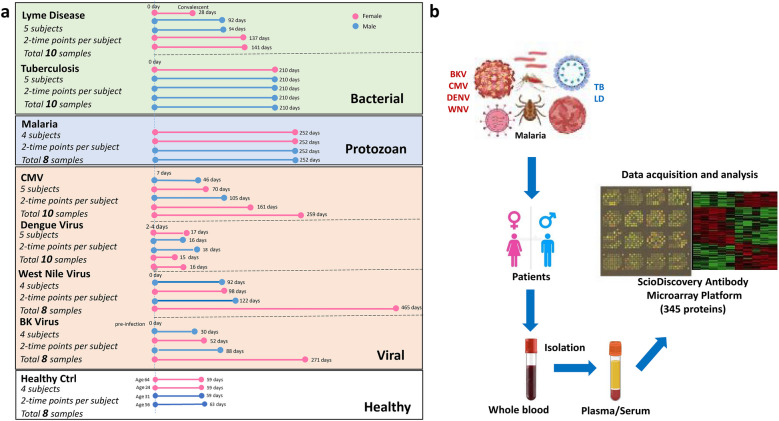
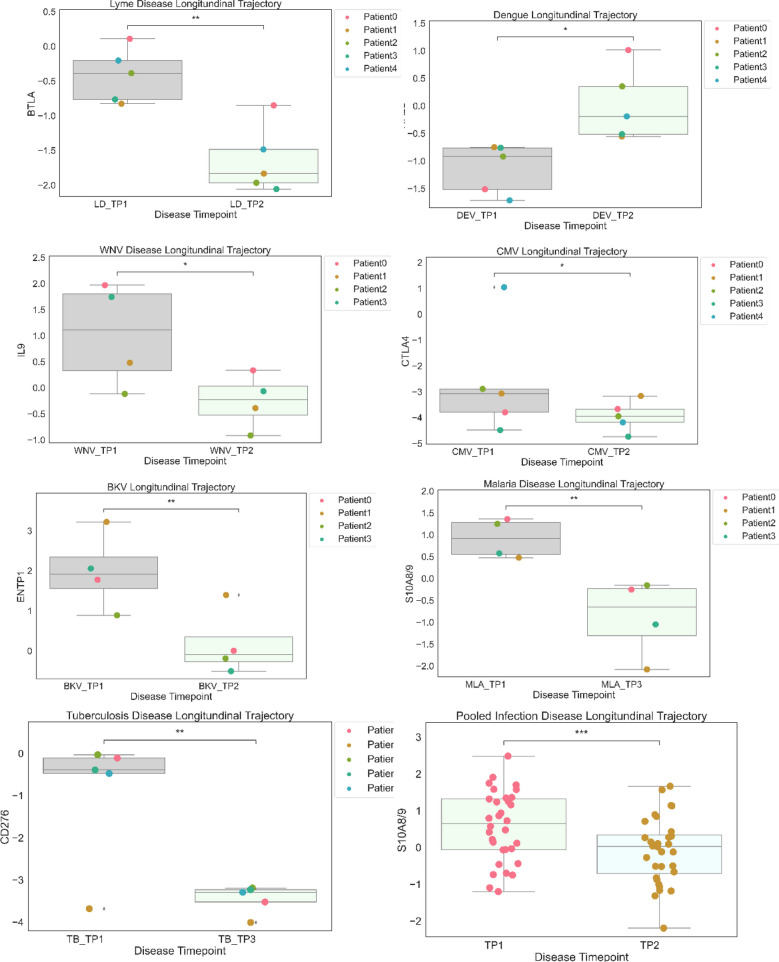
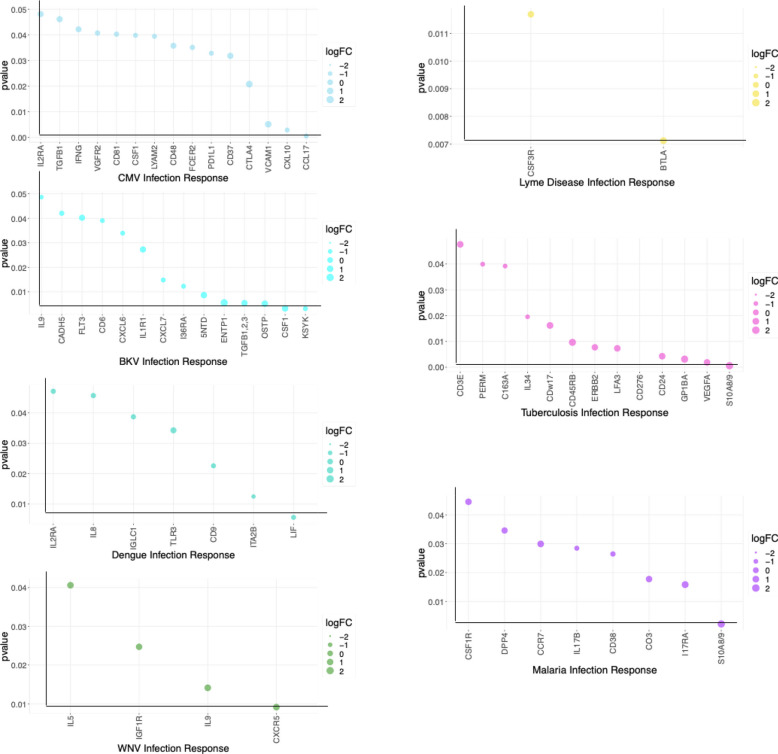
Infectious diseases are a significant burden in global healthcare. Pathogens engage with different host defense mechanisms. However, it is currently unknown if there are disease-specific immune signatures and/or if different pathogens elicit common immune-associated molecular entities to common therapeutic interventions. We studied patients enrolled through the Human Immunology Project Consortium (HIPC), which focuses on immune responses to various infections. Blood samples were collected and analyzed from patients during infection and follow-up time points at the convalescent stage. The study included samples from patients with Lyme disease (LD), tuberculosis (TB), malaria (MLA), dengue virus (DENV), and West Nile virus (WNV), as well as kidney transplant patients with cytomegalovirus (CMV) and polyomavirus (BKV) infections. Using an antibody-based assay, we quantified ~ 350 cell surface markers, cytokines, and chemokines involved in inflammation and immunity. Unique protein signatures were identified specific to the acute phase of infection irrespective of the pathogen type, with significant changes during convalescence. In addition, tumor necrosis factor receptor superfamily member 6 (TNR6), C-C Motif Chemokine Receptor 7 (CCR7), and C-C motif chemokine ligand-1 (CCL1) were increased in the acute and convalescent phases across all viral, bacterial, and protozoan compared to blood from healthy donors. Furthermore, despite the differences between pathogens, proteins were enriched in common biological pathways such as cell surface receptor signaling pathway and response to external stimulus. In conclusion, we demonstrated that irrespective of the pathogen type, there are common immunoregulatory and proinflammatory signals.
传染病是全球医疗保健的重大负担。病原体与不同的宿主防御机制相互作用。然而,目前尚不清楚是否存在特定于疾病的免疫特征,或者不同的病原体是否会引起共同的免疫相关分子实体来对抗共同的治疗干预。我们研究了通过人类免疫学项目联盟(HIPC)招募的患者,该联盟专注于对各种感染的免疫反应。在感染期间和恢复期的随访时间点从患者中采集和分析血液样本。该研究包括莱姆病(LD)、结核病(TB)、疟疾(MLA)、登革热病毒(DENV)和西尼罗河病毒(WNV)患者的样本,以及肾移植患者巨细胞病毒(CMV)和多瘤病毒(BKV)感染的样本。使用基于抗体的测定法,我们量化了涉及炎症和免疫的~350 种细胞表面标志物、细胞因子和趋化因子。鉴定出与感染的急性期特异性相关的独特蛋白质特征,而在恢复期则发生显著变化。此外,肿瘤坏死因子受体超家族成员 6(TNFR6)、C-C 基序趋化因子受体 7(CCR7)和 C-C 基序趋化因子配体 1(CCL1)在急性和恢复期均增加,与来自健康供体的血液相比,所有病毒、细菌和原生动物。此外,尽管病原体之间存在差异,但蛋白质在共同的生物学途径中富集,如细胞表面受体信号通路和对外界刺激的反应。总之,我们证明了无论病原体类型如何,都存在共同的免疫调节和促炎信号。