Institute of Botany, Jiangsu Province and Chinese Academy of Sciences (Nanjing Botanical Garden Memorial Sun Yat-Sen), Nanjing 210014, China.
Jiangsu Key Laboratory for the Research and Utilization of Plant Resources, Jiangsu Provincial Platform for Conservation and Utilization of Agricultural Germplasm, Nanjing 210014, China.
Int J Mol Sci. 2023 Sep 23;24(19):14464. doi: 10.3390/ijms241914464.
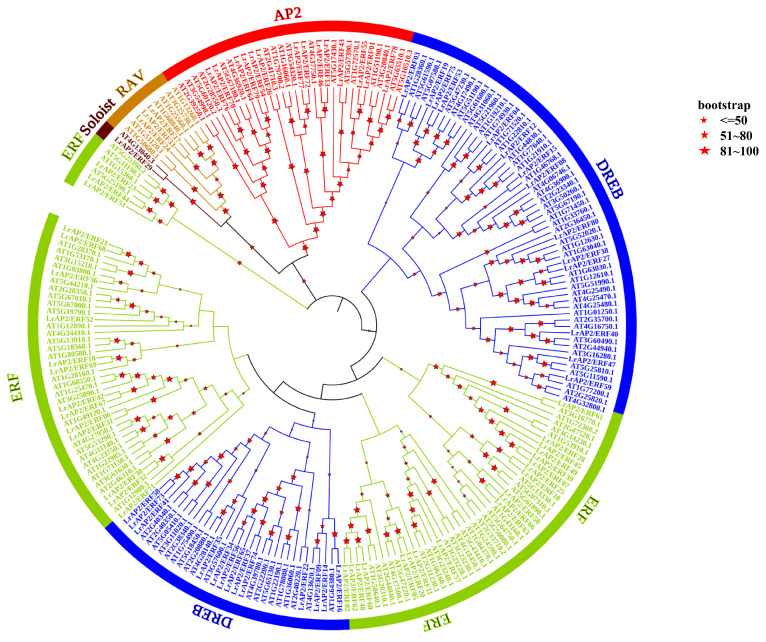
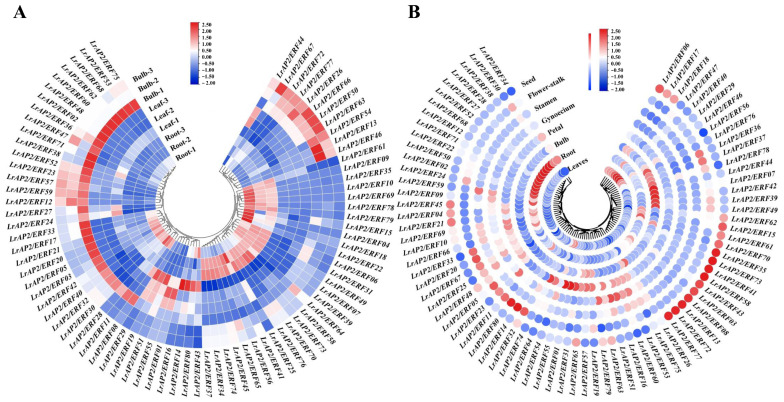
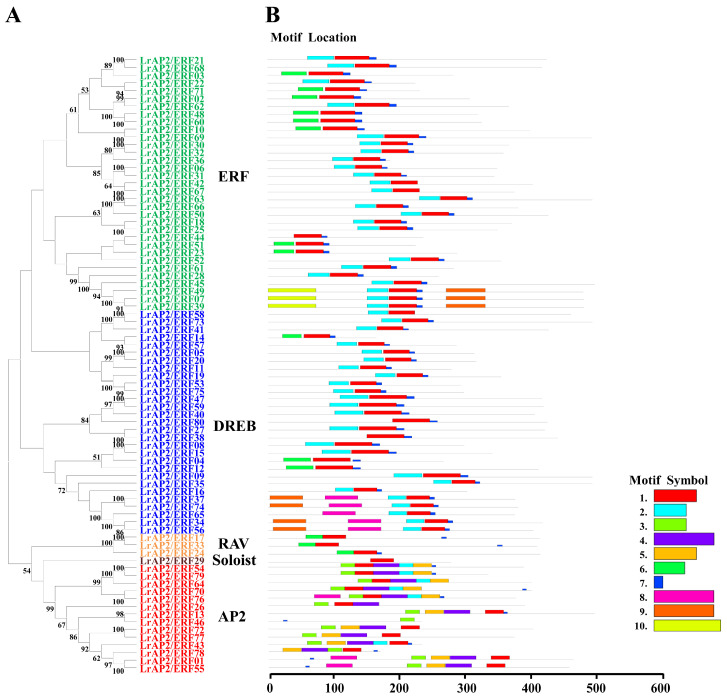
The APETALA2/ethylene-responsive transcription factor (AP2/ERF) family has been extensively investigated because of its significant involvement in plant development, growth, fruit ripening, metabolism, and plant stress responses. To date, there has been little investigation into how the genes influence flower formation and anthocyanin biosynthesis in . Herein, 80 putative transcription factors (TFs) with complete open reading frames (ORFs) were retrieved from the transcriptome sequence data, which could be divided into five subfamilies dependent on their complete protein sequences. Furthermore, our findings demonstrated that genes belonging to the same subfamily had structural similarities and conserved motifs. genes were analyzed for playing an important role in plant growth, water deprivation, and flower formation by means of gene ontology (GO) enrichment analysis. The expression pattern of the genes differed across tissues and might be important for growth and flower development. In response to methyl jasmonate (MeJA) exposure and drought stress, the expression of each gene varied across tissues and time. Moreover, a total of 20 anthocyanin components were characterized using ultra-performance liquid chromatography-electrospray ionization tandem mass spectrometry (UPLC-ESI-MS/MS) analysis, and pelargonidin-3-O-glucoside-5-O-arabinoside was identified as the major anthocyanin aglycone responsible for the coloration of the red petals in . In addition, we mapped the relationships between genes and metabolites and found that is strongly linked to pelargonidin accumulation in petals. These findings provide the basic conceptual groundwork for future research into the molecular underpinnings and regulation mechanisms of AP2/ERF TFs in anthocyanin accumulation and floral development.
AP2/ERF 转录因子家族在植物发育、生长、果实成熟、代谢和植物应激反应中起着重要作用,因此受到了广泛的研究。迄今为止,关于这些基因如何影响 和花形成和花色素生物合成的研究还很少。本文从 转录组序列数据中获取了 80 个具有完整开放阅读框 (ORF) 的假定 转录因子 (TF),它们可以根据完整蛋白序列分为五个亚家族。此外,我们的研究结果表明,属于同一亚家族的基因在结构上具有相似性和保守基序。通过基因本体 (GO) 富集分析,对 基因在植物生长、水分胁迫和花形成中发挥的重要作用进行了分析。 基因的表达模式在不同组织中存在差异,可能对 的生长和花发育很重要。对 基因的表达模式进行分析,结果表明,在受到茉莉酸甲酯 (MeJA) 处理和干旱胁迫时,每个 基因在不同组织和时间的表达情况都有所不同。此外,还使用超高效液相色谱-电喷雾串联质谱 (UPLC-ESI-MS/MS) 分析鉴定了总共 20 种花色素成分,鉴定出矢车菊素-3-O-葡萄糖苷-5-O-阿拉伯糖苷是导致 的红色花瓣着色的主要花色素苷糖苷元。此外,我们还对基因和代谢物之间的关系进行了作图,发现 与 花瓣中矢车菊素的积累密切相关。这些发现为研究 AP2/ERF 转录因子在花色素苷积累和花发育中的分子基础和调控机制提供了基本的概念基础。